
Segregation, malaria and 25,000 dead: The hidden history of the Panama Canal in a literary epic
Panamanian-American Cristina Henríquez portrays the construction of the crossing in a new novel and finds an echo with the current fears of immigrants in the United States
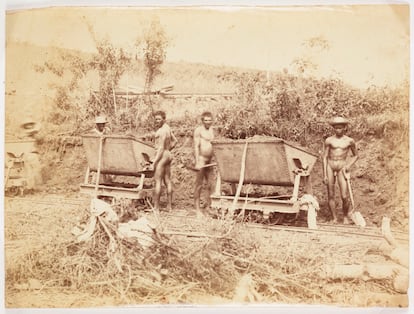

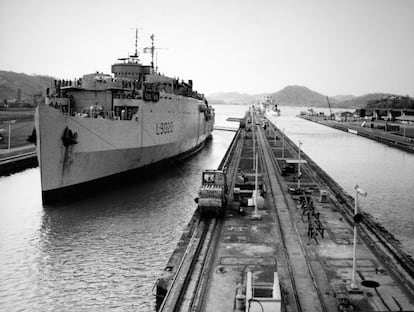
In 1907, in the heart of a sweltering jungle, one of the most ambitious engineering feats of the 20th century began: the construction of the Panama Canal. But what is usually recounted in history books — the diplomatic treaties, the astronomical figures, the names of engineers — leaves out those who put their bodies (an estimated 25,000 dead), their homes, and their health at risk. In The Great Divide, now also available in Spanish, Panamanian-American writer Cristina Henríquez, 48, decided to rescue their stories.
“I grew up visiting the canal,” the author says via video call. “But I didn’t know much about its history. I had a lot of assumed ideas, and one was that Panamanians had built the infrastructure. But when I started researching, I discovered that, of the 50,000 workers, only 357 were Panamanians. That was a shock. I thought: if they didn’t build it, who did?” The answer led her to search through archives, libraries, and gather testimonies: Antilleans from Barbados, Jamaicans, workers from 90 different countries who came to that small corner of the world. Asked if she feels anything different seeing the canal now, Henríquez smiles: “The truth is, I’d never crossed it before. I did it two years ago, when the book came out in English, and it was very revealing, because I already knew what was under the water and the asphalt: the bodies, the people. It was a very meaningful experience for me; it was something symbolic.”
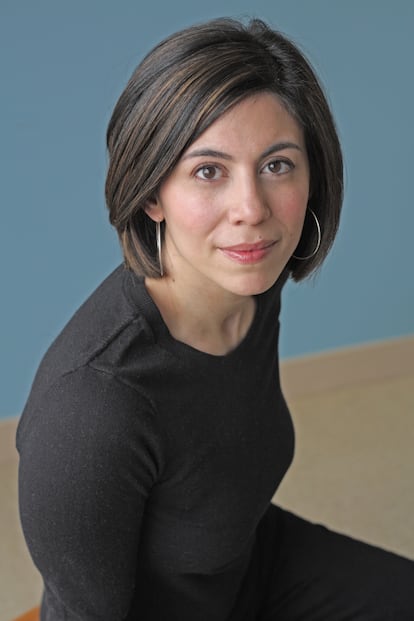
That feeling — of walking on ghosts, on forgotten memories — is what fuels the atmosphere of her novel. Set in Panama at the beginning of the 20th century, the book intertwines the lives of Ada, a teenager from Barbados who arrives alone, in hiding, seeking money for a cure to save her sister; Omar, a young Panamanian who wants to work on the canal despite his father’s objections; Francisco, his father, a fisherman and symbol of resistance to the infrastructure; and John Oswald, an American scientist on a mission: to combat malaria among the workers.
Through them, Henríquez stages a choral story, a symphony of voices marked by progress... and by its cost. “I researched for years, and it took me five more years to write the novel. Sometimes I would read an entire book about trains in America just to end up using one sentence, but I needed that context. Every door I opened led me to new revelations.” One of those discoveries was the system of segregation implemented by the Americans in the Canal Zone: a strict division between “gold” and “silver” workers, which marked who deserved privileges and who barely had access to the basics. “I was able to understand that system in a very profound way. It was extremely shocking to discover that racialized and deeply violent hierarchy,” says Henríquez.
If anything stands out in The Great Divide, it’s the sensorial texture of its prose. Reading the novel is like sweating alongside the characters, feeling the mud, the humidity, the latent threat of disease, and the collapse of buildings. “That comes from my experience in Panama. I’ve been there every year since I was eight months old, and I have that sensorial memory of being there, of the sweat on my skin, the smell of the earth and the plants. That’s imprinted on my prose. I wrote the book by hand, in a notebook, and I think there’s something about it that heightens tactility, a kind of synesthesia that changed the way I write.” This technical choice — writing by hand — was no coincidence: Henríquez was coming out of a block, following the success of her third book, The Book of Unknown Americans (2014). “I was stuck. I felt like there were people waiting for this new book, and that blocked me. Writing by hand reconnected me with intimacy, not just with myself, but with the characters.”
That intimacy is especially palpable in the character of Francisco, the fisherman who sees how the waters he inherited from his ancestors are now exploited by foreign hands. “Francisco is my favorite character. There’s something very candid about him,” says Henríquez. “But also Ada and Omar, who were the first to appear in my mind. They were with me from the beginning.” Not to mention John Oswald, the American scientist: was he included to humanize the foreigner, or to lay bare his moral limits? “The original idea for the book was born 20 years ago: I wanted to tell this story from the Panamanian perspective. But when I discovered that very few Panamanians had worked there, I knew I had to broaden the focus. And, of course, I also needed a character from the United States. Although his perspective has been told many times before, I thought, ‘I can give it a twist, see what happens when I mix all these voices.’”
Interweaving of voices
This interweaving of voices is one of the novel’s greatest achievements. Far from simplifying the story, Henríquez makes it more complex: there is resistance and collaboration, pain and hope, broken dreams and symbolic triumphs. At one point in the book, the inhabitants of a town that will be submerged rebel against the eviction. They lose, but their struggle remains a testament to dignity. “I didn’t think about the parallels with the present when I began writing,” the author admits. “But when I began to study them more, I saw them clearly. The canal brought people from all over the world and plunged them into a deeply racist system. And although I didn’t want to emphasize it too much — I wanted to focus on 1907 — I knew the attentive reader would pick up on it. Today we continue to deal with the same tensions: migration, inequality, exploitation.” And how does she view the present of the United States, being half Panamanian, half American? It takes her a few moments to answer: “My father, a U.S. citizen for decades, carries his passport with him every time he goes for a walk,” she explains with a hint of frustration. “There’s a real level of fear, a very deep fear among migrants. I think there’s a feeling of not knowing when this will end. I don’t know the answers to what’s going to happen, but I try to process what’s happening through my writing. It’s a very dangerous time. We’re living in very dangerous times.”
“What does progress mean, and for whom?” Henríquez asks aloud, spelling out the question implicit in her book. She doesn’t offer answers, but by telling the stories of those silenced by history, she opens a luminous crack in the official narrative. A crack through which a truth seeps in, also speaking out loud: “Every great human project leaves its mark, and writing about it is a way of not forgetting.”
Sign up for our weekly newsletter to get more English-language news coverage from EL PAÍS USA Edition









































