
Fear of ICE raids expected to increase absenteeism at start of school year
Arrests near education centers are worrying students, parents, and teachers, who are preparing for an academic year marked by Donald Trump’s deportation campaign
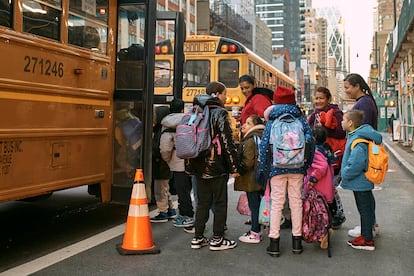

Reuniting with classmates, summer stories to tell, the sports field... going back to school is always an exciting time. For many families, however, this excitement now comes in the form of anxiety and fear: wondering if it’s worth the risk of facing immigration agents to take their children to school.
Elementary and high schools are establishing protocols to follow, and community organizations are preparing parents for what is more like a battle than a return to school: the war the Donald Trump administration has waged on immigration. And on this front, the biggest casualties are students dropping out to avoid detention and deportation.
“We anticipate that several students will be missing due to the raids, because parents are afraid of being separated from their children and children are afraid of leaving their parents. Our school has been hit hard by ICE raids. They’ve been on several streets, in nearby courthouses, in Home Depot stores…” says Karina Pérez, a teacher at the Miguel Contreras Center in Westlake, California.
The school where she works is located near a DIY store where the latest massive ICE raid took place, resulting in the arrest of 16 people. The agents arrived disguised in a moving truck, in an operation the government itself dubbed a Trojan Horse, which spread fear among the community in this county near Los Angeles, where the Latino population is majority.
Deported without graduating
This month, Pérez’s students will miss their 17-year-old Guatemalan classmate, who was deported this summer along with her mother. She had been in the country for a decade, was a brilliant student, and was set to graduate this year. ICE agents detained her as she left one of her routine immigration court appointments. “Her classmates are very sad, especially those who ran track with her. They’re outraged that she can’t be in her senior year of high school,” Pérez says.
Pérez teaches special education students and says that in her nine years as a teacher, there has always been concern for undocumented students, but nothing like the current situation. “The kids no longer have the security they used to have, when schools were considered sanctuaries,” she explains.
As soon as he returned to power, Trump buried the notion that schools, like hospitals and places of worship, were considered “sensitive locations,” off-limits to immigration enforcement activity. To date, ICE has not entered educational centers, but these have had to create protocols for dealing with agents if they attempt to arrest students on their premises, in addition to organizing training sessions for teachers and parents.
Border czar Tom Homan, in an interview with Univisión, rejected the idea that ICE would make arrests in schools. “We don’t conduct operations in schools, churches, or hospitals. That’s a lie used by some media outlets to generate public outrage against ICE.” And while there are no known cases of arrests inside schools, they have occurred outside, when parents are dropping off or picking up their children, causing dramatic scenes of family separation.
As a defense against experiencing this devastation firsthand, the solution is absenteeism, which has been noted in summer classes at the Miguel Contreras School. It has also been apparent in schools in the San Jose district, in Santa Clara County, California, where the majority of students have a migrant relative and where families have suffered the scourge of ICE operations.
But the fall in attendance was already felt as soon as the Trump administration took office. In January, Santa Clara County schools recorded a decrease of 5,000 students, and the number doubled to 10,000 in February, Jorge Pacheco, administrator of the Santa Clara County Office of Education, told San José Spotlight. “This fear has been causing significant trauma that has been preventing children from learning and reaching their socio-emotional and academic milestones,” he said.
Migrant organizations are trying to reassure the community so that students don’t drop out of school, despite the risk. Fanny Yanes is a community organizer for CASA in Fairfax County, Virginia. “Our work consists of providing talks to parents so they know their rights, so they feel safe and continue sending their children to school,” she explains. Yanes recently met with school supervisors in her county, who assured her they have taken measures for a possible ICE visit, although without specifying what those measures are.
CASA has created groups on the WhatsApp messaging app so participants can alert each other to where raids are taking place. If ICE agents are spotted outside a school, they would recommend that parents not pick up their children and contact the school. “We didn’t have that concern before, but the magnitude of the situation, as it stands now, is something else entirely,” she notes.
In recent months, counties have had to improvise protocols to send to schools to ensure they know how to react if ICE agents invade. Not allowing entry without a warrant and not providing student information were some of the guidelines sent to schools to ensure student well-being.
Federal law prevents schools from collecting immigration status information on admissions applications, and the Supreme Court’s 1982 ruling in Plyler v. Doe granted all children the right to public school education, regardless of immigration status. Some Republican-led states, such as Tennessee and Texas, however, have enacted laws to strip undocumented minors of this right.
According to 2021 data compiled by FWD.us, there are approximately 620,000 undocumented students in elementary and secondary schools (K-12), although that number is now estimated to be higher. Most states have at least 1,000 undocumented students in their schools, although this number is significantly higher in Texas (111,000), Florida (74,000), and California (72,000).
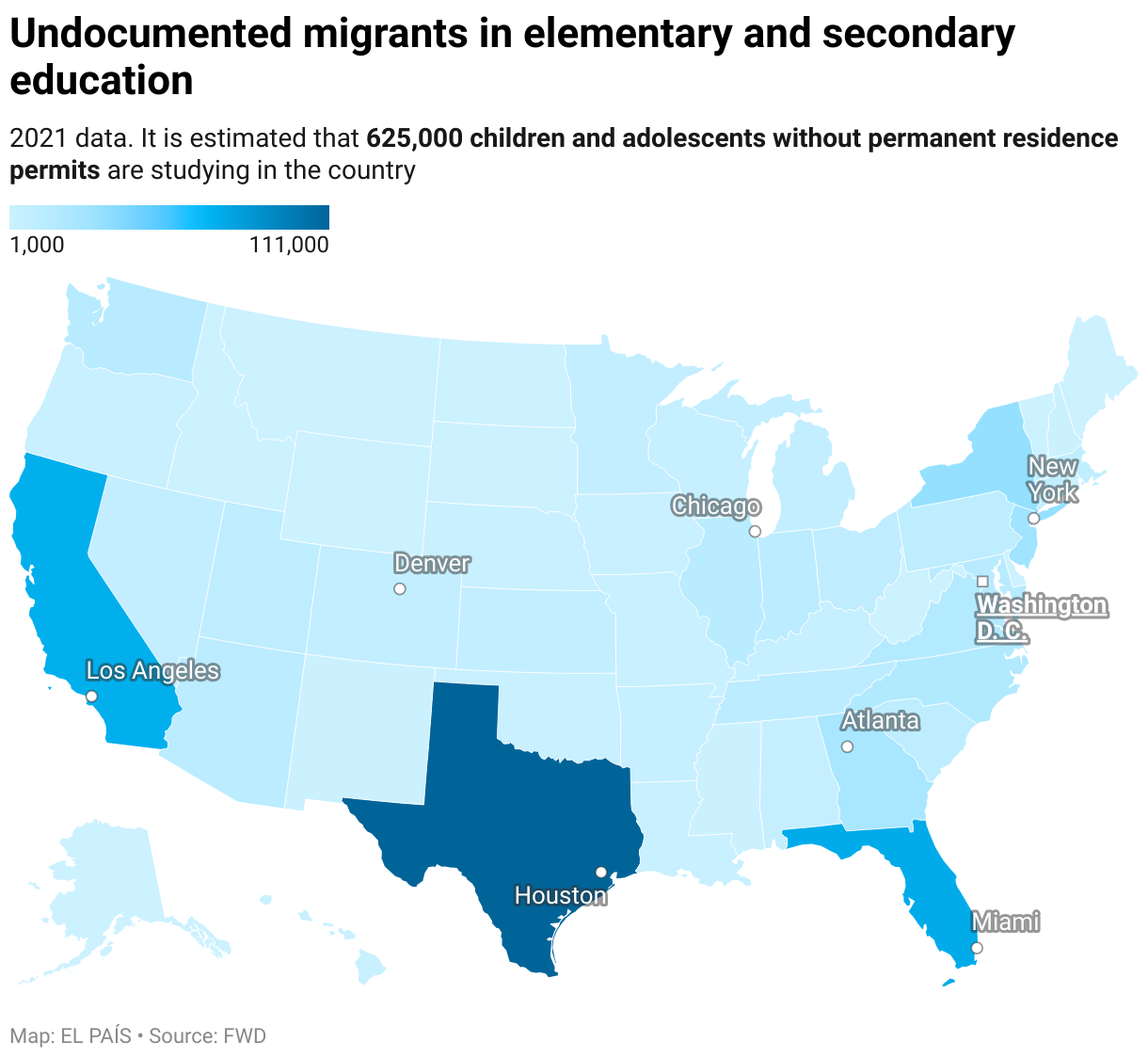
Added to this are the 3.9 million students who are U.S. citizens but are at risk of family separation because one of their parents is undocumented.
“For many families, the return to school symbolizes a return to another public space where there is no guarantee of protection from ICE. Over the summer, we already saw fewer families in parks and more cancellations of parties and celebrations where migrants gathered, due to a reasonable fear of ICE showing up. It’s understandable that families have concerns about their safety,” says Loredana Valtierra, partner at The Century Foundation, a think tank that promotes equality in education. This think tank has developed a guide for schools to protect the environment from fear of immigration authorities.
Sign up for our weekly newsletter to get more English-language news coverage from EL PAÍS USA Edition









































