Trump says he is not considering military strike against Venezuela
The US president denies reports suggesting an imminent operation
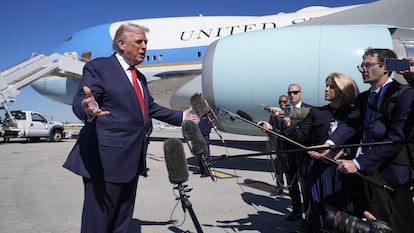

“No.” That was the emphatic response given by U.S. President Donald Trump aboard Air Force One when asked about a series of reports claiming that a U.S. strike on military targets in Venezuela was imminent. Has Trump decided to order such an attack? “No, it’s not true,” he replied, in a terser style than usual.
With this, Trump put the theory on hold that he is willing to cross another Rubicon by launching an offensive in Venezuelan territory against targets — civilian and military — allegedly linked to drug trafficking.
On Thursday, it emerged — thanks to reporting by The Wall Street Journal — that the Pentagon had identified targets in Venezuelan territory, including ports and airports under military control, which Washington accuses of being connected to drug cartels, particularly the Cartel of the Suns. Beyond combating drug trafficking, the move would be viewed as an escalation against Venezuela, much like previous attacks on alleged drug boats have been seen as efforts aimed at pressuring Venezuelan President Nicolás Maduro and destabilizing the Chavista regime.
This Friday, the Miami Herald reported that the next step could be “a matter of days or even hours.” White House spokesperson Anna Kelly later denied this, saying that such news cannot rely on “unnamed sources.” “Any announcements regarding Venezuela policy would come directly from the president,” she said.
"There are reports that you are considering strikes within Venezuela. Is that true?"@POTUS: "No, it's not true." pic.twitter.com/YwXua82X9H
— Rapid Response 47 (@RapidResponse47) October 31, 2025
An operation of this magnitude would represent a major escalation of U.S. foreign policy in Latin America and revive the specter of U.S. interference in the region. So far, the situation seems to be moving that way: for the past two months, the U.S. military has carried out 15 extrajudicial attacks against 16 vessels (including a submarine) allegedly involved in drug trafficking in the Caribbean and Pacific waters. At least 61 people have been killed in these operations.
The White House accuses Maduro’s government of leading a criminal organization engaged in drug trafficking. Last August, U.S. authorities doubled the reward to $50 million for any information leading to the capture of the Venezuelan president, who last year, according to much of the international community, stole the elections from the opposition led by recent Nobel Peace Prize laureate María Corina Machado. Rewards of $25 million are also offered for some of Maduro’s lieutenants, such as Interior Minister Diosdado Cabello and Defense Minister Vladimir Padrino López.
As U.S. attacks on the alleged drug boats continued, the United States ordered a military deployment of unprecedented scale. Trump considers the crews — whose identities are unconfirmed and for whom there is no evidence of wrongdoing — to be members of an army waging war on the U.S. by flooding it with fentanyl and cocaine. The operations began in August.
Around 10 warships, including a nuclear submarine, and 10,000 troops have moved into the area of influence of U.S. Southern Command. Last Friday, Trump ordered the deployment of the largest and most modern aircraft carrier in the fleet, the Gerald R. Ford, to the Caribbean. The warship, with a crew of more than 5,000 sailors, was in Europe at the time and had just passed through the Strait of Gibraltar. It is expected to reach the region early next week.
According to The Wall Street Journal, the planned attacks on Venezuela — that Trump now denies — would have been carried out from the air with very precise targets.
Trump’s categorical denial on Friday recalled memories in Washington of the U.S. strike on three uranium enrichment and storage sites in Iran last June.
At that time, it was the same New York-based newspaper that reported the attack was imminent. The U.S. president later refused to clarify whether the plans were true, and went to play golf. The next day, bombs fell on sites in Fordow, Natanz, and Isfahan.
Sign up for our weekly newsletter to get more English-language news coverage from EL PAÍS USA Edition