
Former Trump adviser John Bolton pleads not guilty to 18 counts of mishandling classified information
Former National Security Adviser appears in court after being accused of sharing confidential data with his family
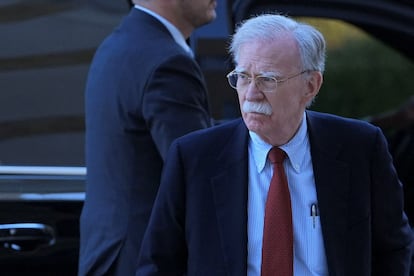

Former National Security Adviser John Bolton pleaded not guilty Friday in a Greenbelt, Maryland, court to 18 counts of possessing and transmitting information affecting the security of the United States in violation of the Espionage Act.
Bolton, who was indicted by a grand jury on Thursday on the charges following an FBI investigation lasting over three years, is the third political foe of Donald Trump to be indicted in the past three weeks, since the Republican sent a social media message to his attorney general, Pam Bondi, ordering her to force the prosecution of people he believes have harmed his political career.
The former high-ranking official had surrendered early Friday morning at the Greenbelt courthouse, as agreed with those handling his case. At the time, Bolton, who appeared with his lawyers, made no statement. If convicted, he faces a 10-year prison sentence on each charge.
Immediately after his indictment was made public, Bolton had stated that he was “looking forward to the fight” to defend his conduct, which he considers lawful, “and to expose Trump’s abuse of power.”
The indictment alleges that Bolton, 72, shared classified information with two members of his family — his wife and daughter, according to U.S. media — with a view to using it in a book he was writing. That material included notes taken during intelligence meetings and conversations with leaders and senior officials from other countries.
Trump’s revenge
Trump, who promised during the election campaign that he would take revenge on his enemies if he returned to power, has already taken steps to secure charges against some of those implicated in the legal cases brought against him while he was outside the White House.
Almost immediately after that message to Bondi, a grand jury in Alexandria, Virginia, indicted former FBI Director James Comey on charges of obstruction of justice and lying to Congress. Trump considers the former top official one of his greatest enemies for opening an investigation into connections between Russian representatives and his 2016 presidential campaign.
Last week, New York District Attorney Letitia James was indicted on charges of alleged mortgage fraud. James had taken the president and his family business to court in a civil fraud case in which a judge ordered the Trump Organization to pay $450 million in fines. Last August, another court overturned that ruling.
Bolton’s case appears distinct from those of James and Comey. The former National Security Adviser had long been under FBI scrutiny, and the charges are much more detailed. Last August, federal agents searched both his private residence in Bethesda, Maryland, and his office in downtown Washington.
Bolton, one of the most recognizable faces in Trump’s first-term administration, served as ambassador to the UN under George W. Bush (2001-2009) before becoming the current president’s third National Security Advisor during his first term. A neoconservative, considered a foreign policy hawk, he held the position in the Trump White House for 17 months. During that time, he frequently clashed with the president over how to proceed on a wide range of geopolitical issues, from North Korea, with whose leader, the autocrat Kim Jong-Un, Trump sought to meet — he did so three times — to Afghanistan and Iraq.
After his resignation in 2019, the then-advisor published a memoir, The Room Where It Happened, about his time in the West Wing of the White House. The presidential office unsuccessfully tried to prevent the volume from reaching print, claiming it contained classified material.
Sign up for our weekly newsletter to get more English-language news coverage from EL PAÍS USA Edition









































