
US on brink of government shutdown after unsuccessful meeting between Trump and Democratic leaders
Disagreement over funding for public health services threatens to turn off the tap of public money for the first time since 2018

Every few months, Washington stages its own version of Peter and the Wolf, a recurring drama starring Democrats and Republicans on Capitol Hill seeking an agreement to extend temporary funding for the administration. They usually flirt with the disaster that would result from a government shutdown, which is ultimately averted, more or less in extremis. But sometimes, that disaster does take place. And all indications are that this week could be one of those times.
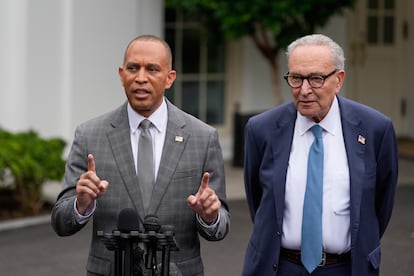
If both parties do not reach an agreement, the tap of public money will be shut off at 12:01 a.m. on Wednesday, October 1, the start of the new fiscal year. On Monday, with just over 30 hours remaining until the deadline, U.S. President Donald Trump met in the late afternoon with the four most powerful politicians on Capitol Hill to narrow their differences in an attempt to avoid the dreaded shutdown. Hakeem Jeffries and Chuck Schumer, leaders of the Democratic minorities in the House of Representatives and the Senate, joined the Republican majorities in both chambers, Mike Johnson (lower) and John Thune (upper), with the threat of a disagreement looming on the horizon that the White House has promised to use to turn the temporary suspension of pay for tens of thousands of civil servants that any shutdown brings into permanent layoffs.
To avoid a shutdown, Democrats are demanding an extension of subsidies under the Affordable Care Act (also known as Obamacare, the law that extended health care coverage to millions of Americans not covered by private insurance) and a reversal of the cuts to Medicaid and other health programs that Republicans are threatening.
After the meeting, Schumer and Jeffries appeared before White House reporters. Schumer spoke of “major differences on health care,” while Jeffries described them as “significant and relevant.”
Next, it was the Republicans’ turn, accompanied by Vice President J. D. Vance, who stated: “I think we’re headed into a shutdown because the Democrats won’t do the right thing. I hope they change their mind.” Both Johnson and Thune called on Democrats to approve an extension of funding until November 21 to allow time to negotiate a budget bill for 2026. Both emphasized that during Joe Biden’s years in the White House, their party reached agreements with its rivals on up to 13 occasions to avoid a shutdown.

The White House’s threat of tens of thousands of layoffs has left Democrats in a difficult position. If they don’t accept the Republican plan, Trump will try to blame them for these job losses, even though his administration has been engaged in a chainsaw purge of officials using the Department of Government Efficiency (DOGE) since January, and this seems like the perfect excuse to continue these cuts.
Schumer under pressure
Schumer is the politician under the greatest pressure. Republicans, who hold a slim majority in the House of Representatives, can push through the government funding plan without the support of any of their opponents. In the case of the Senate, where they hold 53 seats to the Democrats’ 43, they need the support of at least seven members of their rival caucus.
Schumer is also the most veteran of the bunch. In 2018, he refused to fund the Trump administration due to his opposition to its immigration policy. He held the line for more than 30 days before accepting a deal to reopen the administration. In March of this year, he received harsh criticism from the more progressive Democrat wing when he agreed to vote for the temporary funding extension without concessions. He did so arguing that a shutdown would only exacerbate the effects of Trump’s policies. Jeffries has less experience in these matters: Monday was the first time he had held a formal meeting with the president of the United States.
As for the Republicans, Vance and Schumer, after the White House meeting, repeated falsehoods Trump had floated last week about what Democrats are seeking in return for extending administration funding. According to the president, they want “over $1 Trillion Dollars” to “continue free healthcare for illegal aliens (a monumental cost!), force taxpayers to fund transgender surgery for minors, have dead people on the Medicaid roles, allow illegal alien criminals to steal billions of dollars in American taxpayer benefits, try to force our country to again open our borders to criminals and to the world, allow men to play in women’s sports, and essentially create transgender operations for everybody.”
There have been 14 government shutdowns since 1980. The most recent occurred in 2018 and lasted 34 days. Last December, Democrats and Republicans were on the verge of failing to reach an agreement, which would have left public officials without pay at Christmas.
Not all federal services would be interrupted this Wednesday if the shutdown becomes a reality. Essential aspects of government operations, such as mail delivery or the work of air traffic controllers, would continue. National parks and public museums, on the other hand, are preparing to close. For most Americans, the effects are limited. In Washington, where many of the civil servants who will stay home if the government shuts down are concentrated, things are different. As the clock continues to tick, the capital holds its breath in case this time the wolf really does knock on the door.
Sign up for our weekly newsletter to get more English-language news coverage from EL PAÍS USA Edition









































