
ICE hunt targets students and their families at the start of the new school year
Arrests made in recent days around educational centers are raising alarms in the migrant community and driving the absenteeism of thousands of students
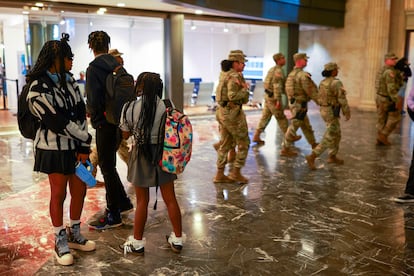

From Washington, D.C. to California, the return to school has been marred by the Trump administration’s immigration crackdown. Immigration and Customs Enforcement (ICE) agents have been carrying out violent arrests outside public schools, despite the agency’s acting director, Todd Lyons, stating that such operations would only be carried out under “special circumstances” or in “urgent situations.” Affected parents and guardians, as well as teachers and school administrators, have been quick to raise their voices in protest.
The superintendent of the Los Angeles Unified School District — one of the largest in the country with more than 500,000 students of whom 7,500 are without legal status — Alberto Carvalho anticipated the situation and urged authorities not to carry out immigration enforcement activities within a two-block radius of schools, from one hour before the start of the school day until one hour after classes end. “We don’t want anyone to stay home out of fear,” he said; but this is exactly what is happening in several areas of the country.
School absenteeism this new academic year is in the thousands. Miami-Dade and Broward, two of Florida’s most populous counties, saw significant enrollment declines. In Broward, the number of students fell from 326,279 last year to 313,220 this year, or 13,059 fewer students. In Broward, 236,548 students were enrolled this year, 11,379 fewer than in 2024. A study conducted by Stanford University and published in June already reflected that student absences due to ICE raids were wreaking havoc on schools. In California’s Central Valley, an agricultural region home to many immigrant workers, classroom absences increased by 22% last semester.
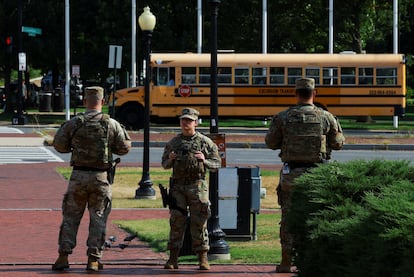
While the restriction on ordering raids in so-called “sensitive areas” (such as schools, churches, and hospitals) was lifted in late January, it has never been fully enforced because the Fourth Amendment protects all persons from unreasonable searches. During an informational session for public schools in Washington, district officials clarified to parents that ICE can only enter schools with court authorization. “Any law enforcement action on school grounds can only be carried out with a valid warrant or court order. If ICE agents arrive at a school, administrators are clear on what to do next,” said Lewis Ferebee, the district’s chancellor. Agents also cannot access student records and files, as required by the Family Educational Rights and Privacy Act (FERPA).
What immigration officers can do without a warrant is set up in public places, such as parking lots, driveways, and bus stops. School entrance lobbies are also considered public spaces, so they are not safe zones. In this regard, the educational community has decided to organize to confront ICE operations in their surroundings. In several cities across the country, teachers are positioning themselves around the school block to escort and provide reassurance to students and their families upon arrival.
Washington D.C.
For a month now, the nation’s capital has been grappling with an unprecedented immigration offensive, aggravated by the deployment of the National Guard on its streets. In the first half of August alone, federal agents arrested more than 300 people for reasons related to their immigration status, and the district’s schools have not been spared from the siege.
At schools like CommuniKids, where 90% of the staff are immigrants, the board has recommended that teachers carry their passports at all times. Schools with a majority of Latino students are creating protocols to respond to a potential ICE raid, instructing teachers to contact school administration and the police.
The climate of intimidation has escalated to the point where many Spanish-speaking parents and teachers are afraid to speak Spanish to avoid being targeted by agents. CNN reported that a public charter school (schools with no tuition and open enrollment) allocated funds from its annual budget to rent a private bus to take students to and from subway stations to avoid being ambushed by ICE agents on the way to school.
California
Since the resumption of classes, schools in Los Angeles and San Diego have documented at least 10 arrests in their surrounding areas. One of the most high-profile cases was the arrest of Baldemar Gutiérrez, a 15-year-old student at San Fernando High School who has a speech disability and could not be identified due to his condition. Superintendent Alberto Carvalho called the action “unjustifiable” while the Department of Homeland Security issued a statement clarifying that the agents made an error while “conducting an operation to arrest undocumented criminal Cristian Alexander Vásquez Alvarenga.”
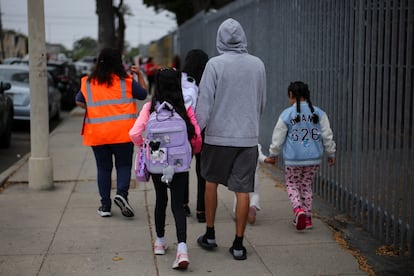
Los Angeles Unified School District officials have reported the presence of ICE around four major schools: Bakewell Primary Center, Harte Prep Middle School, Cortines School of Visual & Performing Arts, and Victory Boulevard Elementary. During these operations, Juan José Martínez Cortés, a Mexican citizen, was arrested outside Linda Vista Elementary School as he was picking up his son. The district issued a statement seeking to reassure families and reiterate that schools remain “safe spaces.” However, outside Montgomery High School in the Sweetwater Union High School District, ICE agents detained a student’s father before the start of the school day.
Florida
In one of the states with the largest Latino immigrant population, immigration authorities’ activities near schools appear to have ulterior motives, but they always end with foreigners detained. A traffic operation near Apopka High School — an institution with nearly 3,500 students in northwest Orange County — resulted in the arrest of five migrants. The school activated the “hold/secure” protocol, requiring teachers and students to remain in classrooms while campus security is monitored.
Sign up for our weekly newsletter to get more English-language news coverage from EL PAÍS USA Edition









































