
Barrio Obrero, the Dominican heart of Puerto Rico, is torn apart by ICE raids: ‘It’s a city under siege’
President Donald Trump’s policies are spreading terror in a neighborhood of the U.S. territory considered the epicenter of the island’s immigrant community
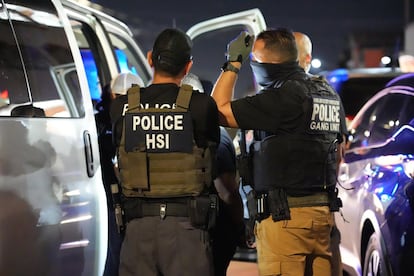

What for years had been the beating heart of the Dominican community in Puerto Rico is now a city under siege. At ten in the morning on a hot, idyllic May day, the streets of Barrio Obrero — located in San Juan, the capital of the U.S. territory — are nearly empty. “Before, by this time you could already hear the velloneras,” laments Pastor Nilka Marrero, who has spent over a decade serving the area’s immigrants. She’s referring to the record-playing machines in the businesses surrounding the neighborhood’s main square, once a lively gathering spot that today stands deserted. “They used to play salsa: ‘Del Barrio Obrero a la 15, un paso es…’” she sings, quoting Puerto Rican salsa artist Willie Rosario, as she taps out her own rhythm on the table. But not anymore. Months of immigration raids ordered by the Trump administration have silenced this neighborhood, where the fear of being detained or deported is overwhelming.
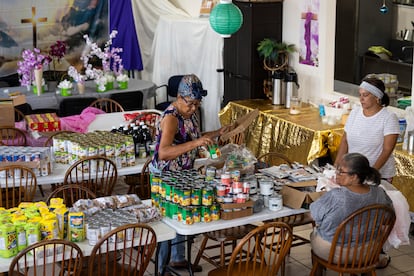
“This is a city under siege — you never know when they’re going to come and arrest you, sometimes without a warrant or any explanation. It’s terrifying,” adds the reverend of the San Pablo Methodist Church, located on the corner of the Antonio Barceló Plaza in Barrio Obrero. On Wednesday morning, she is coordinating a team of volunteers gathered in the congregation’s dining hall to bag food — canned vegetables, beans, various types of cookies, juices. In the afternoon, they’ll distribute the bags throughout the neighborhood, going directly to the homes of immigrants who, out of fear of being detained, have given up even going to the supermarket. Some of the volunteers say that the community is so terrified that sometimes people don’t even want to open the door of their homes to receive the food.
In Puerto Rico, the first immigration raid of Donald Trump’s second administration took place on January 26, six days after the president took office. The small Caribbean island of 3.2 million people is a U.S. territory, and although it has its own local government and constitution, it is controlled by the federal government. Therefore, the policies dictated by the Trump administration in Washington — including those pertaining to immigration — also apply here, where the population is made up of U.S. citizens who cannot vote for the president and have no meaningful representation in Congress.
That January Sunday marked a turning point in Barrio Obrero. Around noon, federal agents descended on the area in patrol cars and even an armored military vehicle. They detained people on their way to Pastor Marrero’s church, one man who was heading out to buy an avocado to go with his lunch, others were simply hanging out in front of a local business... “They started breaking down doors violently. Right across the street, they took two fishermen. The daughter, who has cancer, lost her father and brother — the ones who supported her,” the pastor recalls. In total, authorities arrested 47 individuals, two of whom were later released because their papers were in order.’
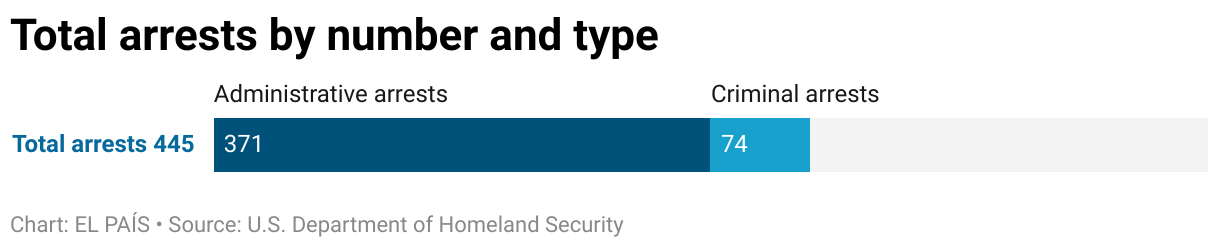
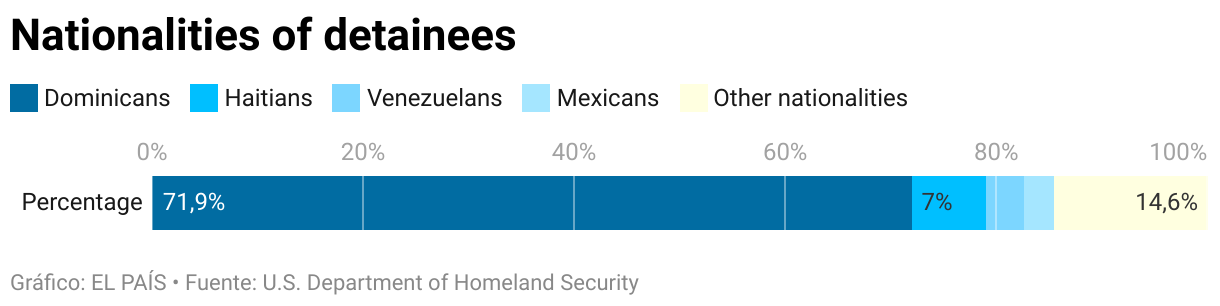
The message was clear: Puerto Rico is not exempt from Trump’s detention and deportation machine. Since that day, 445 people have been detained on the island, according to data provided to this newspaper by the Department of Homeland Security (DHS). The vast majority are men, and nearly 72% of those detained are Dominican citizens, followed by Haitians, Venezuelans and Mexicans. Of the total, “81 people have been removed to their country through voluntary departure or expedited removal,” according to Sandra Colón, spokesperson for the DHS office on the island. According to the latest data from the U.S. Census Bureau, around 90,000 immigrants were living in Puerto Rico in 2022. It is estimated that more than half are Dominicans. The number of undocumented individuals remains unknown.
Just like in the mainland United States, authorities on the island have claimed that the detentions are focused on immigrants with criminal records. But when asked how many of those detained actually had criminal backgrounds, Colón responded: “We are not recording that information.” Moreover, according to DHS figures, only 74 of the arrests (16.6% of the total) have been criminal, while the rest have been administrative — meaning they were due to violations of immigration laws or procedures.
The detentions have disrupted not only the immigrant community on the island, but the entire territory. In just a few months, the perception that Puerto Rico was a sanctuary for immigrants has been shattered — a place where foreign communities had coexisted for years with the local one, enriching Puerto Rican society. A small piece of land in the Caribbean that feels more a part of Latin America than the United States, where Spanish is spoken, where fellow Latin American brothers and sisters are welcomed, and where immigrants are allowed to open bank accounts, obtain a special driver’s license, and begin a new life. Raids have always existed, as have racism and prejudice, but never at the level seen now.
Detained and without access to legal representation
One of the most recent large-scale raids took place on May 8 at a luxury hotel in the tourist district of Condado, also in San Juan. Around 53 Dominican workers were arrested at the La Concha resort while doing construction work. The group was taken to a processing center near the capital, where they spent several days sleeping on cots on office floors.
The executive director of the American Civil Liberties Union (ACLU) in Puerto Rico, Annette Martínez Orabona, went to the facility to inquire about the status of the detainees. She asked whether the immigrants were being provided with legal assistance. The security at the center assured her that they were given a list of lawyers to contact, but when Martínez saw the list, it was for lawyers in Florida — none on the island.
“In Puerto Rico, detentions occur, but due to a general practice of the U.S. government, practically all detained migrants are transferred out of Puerto Rico. After detention, they may remain in Puerto Rico for 24 to 78 hours until they are moved,” explains Martínez Orabona from a conference room in the ACLU offices in San Juan.
From the island, detainees are sent to centers in states like Texas or Florida. Although transferring immigrants from center to center is a common practice, the ACLU stresses that the case of those moved out of Puerto Rico is especially concerning because it not only means separating them from their families and community but also from their legal representation.
“It’s something that creates a great difficulty because people who had ongoing immigration cases here have been detained — meaning their legal representation is in Puerto Rico,” the lawyer points out. “I know it’s terrible anywhere in the United States, but in Puerto Rico’s case, it’s worse because we are not contiguous to the mainland. It’s not a matter of just getting in a car and getting there,” she insists.
I know it’s terrible anywhere in the United States, but in Puerto Rico’s case, it’s worse because we are not contiguous to the mainland. It’s not a matter of just getting in a car and getting there"Annette Martínez Orabona, director of the ACLU in Puerto Rico
A united front against Trump’s immigration policies
Since the raids intensified in January, the ACLU has led several initiatives to protect the local immigrant community. Among them, three months ago they formed an alliance with the Puerto Rico College of Surgeons, through which they provide health services, such as telemedicine, and medical guidance to immigrants regardless of their status. In February, the two organizations set up a phone line to assist the community, which has received 20 calls to date.
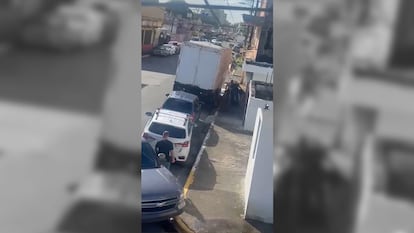
Most of the calls were from people seeking guidance and asking, for example, if undocumented individuals could go to the doctor. “However, eight of those calls were for medical attention — injuries, uncontrolled blood pressure, symptoms of dizziness. And the telemedicine doctors went to these people’s homes and treated them,” says Dr. Carlos Díaz-Vélez, president of the College of Surgeons, from his office in San Juan. “It’s humanitarian aid we’re providing, because you can’t play around with health,” he emphasizes.
The initiative was launched after workers at medical centers located in areas like Barrio Obrero raised the alarm because many of their patients were not attending their appointments. “There were patients who needed follow-up for certain conditions, such as people with cancer or pregnant women, but they were not showing up for their appointments, and medications were left waiting at pharmacies because they weren’t being picked up,” recalls Díaz-Vélez. “And when we called them to ask why they weren’t going to their appointments, they said they didn’t want to leave their homes for fear of being intercepted on the way, or that they would be in a pharmacy or a laboratory and end up getting arrested.”
In the weeks after the raids intensified, school attendance in predominantly immigrant areas also dropped significantly. In February, schools with a high number of Dominican students reported absentee rates of up to 70%, the island’s Department of Education warned at the time.
That percentage has been decreasing, according to Mercedes Martínez, president of the Puerto Rico Federation of Teachers: “Parents have found ways for their children, for the most part, to get to the classroom — either by sending them alone or asking someone else to accompany them to school.” But that doesn’t mean they aren’t still scared, she assures. “It’s a terrifying situation for students with migrant families. It’s something that affects their emotional health and academic performance.”
It’s a terrifying situation for students with migrant families. It’s something that affects their emotional health and academic performance"Mercedes Martínez, president of the Puerto Rico Federation of Teachers
In response to this situation, the local Department of Education established a closed-gate protocol at schools, denying access to any federal agents or immigration officials to public schools unless they have a court order.
But for Martínez, it’s not just about protecting the schools. “The problem is what happens on the way to school or on the way home,” she points out. “And also in the homes of migrant parents. Many of them are unemployed because they don’t dare to look for work. They can’t work, they can’t pay rent, they can’t pay for food. It creates an unprecedented social crisis because even if the student goes to school, if they’re not properly fed, don’t have a safe roof over their heads, and are living in fear, they may be physically at school but emotionally carrying significant damage,” she laments.
An “apathetic” local government
The local government has done little to challenge Trump’s immigration measures. On the contrary, the ACLU asserts that there is “an intentional effort to facilitate the implementation of those policies.”
The governor, Jenniffer González, a Republican who supports Trump, initially assured that the president’s immigration policies would not affect the immigrant community in Puerto Rico. Since then, however, she has said that the island “cannot afford” to ignore the administration’s guidelines on immigrant detentions because Puerto Rico would risk losing federal funding. Federal funds that Trump already withheld from the island during his first term, and which the local government is accused of mismanaging. EL PAÍS received no response when contacting the governor’s office for this report.
In the local legislature, there is a bill promoted by the ACLU that seeks to establish a series of “sensitive locations,” such as schools, hospitals, community centers or churches, where collecting information about a person’s immigration status would be prohibited “unless strictly required by law.” It would also require the creation of clear protocols for possible immigration interventions in these places. These protections are similar to the federal mandate that Trump ended in January, which prohibited raids in these areas.
For now, the future of the local legislation is uncertain. But Pastor Marrero remains hopeful, although she is aware that even if the bill passes the legislature, González could give in to Trump’s pressures and refuse to sign it: “Our governor, unfortunately, has taken on an apathetic role, showing little compassion.”
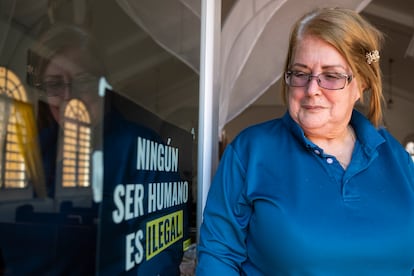
The reverend knows that immigration agents could burst into her church at any moment. “One day, they’re going to break down my door,” she whispers. As the volunteers — some of them immigrants — prepare the food bags, her eyes constantly scan the windows facing the street, suspicious of any vehicle that might signal the start of a raid. “As soon as they’re around, I go out into the street. As soon as they arrive in the neighborhood, people text me and we head outside,” she says.
In addition to distributing food to the community, the Methodist Church of San Pablo in Barrio Obrero offers workshops, prepares hot lunches, and donates clothing. Soon, a clinic providing legal and psychological assistance for affected immigrants will be opened, and tutoring for their children will be available. “A long-distance runner practices every day; we’ve been at this for 10 years,” says Marrero. “This church is made up of migrants.”
Across the street, in the Barceló Plaza, the few who dare to be seen in the early afternoon barely raise their eyes. A small group of men playing dominoes in the plaza remain silent when asked about the raids, about how they have been affected by them. An older man, with a Dominican accent, finally responds: “We are sad because they are taking our people away.”
— How often do you get together to play dominoes here?
— Every day of the year.
— And with the raids, are there fewer people coming to play?
— A lot are missing. Nobody wants to come anymore.
Sign up forour weekly newsletterto get more English-language news coverage from EL PAÍS USA Edition









































