
Cristina Jiménez, activist: ‘Being a good immigrant doesn’t protect us from being discriminated against, abused, and deported’
The organizer publishes her debut memoir, ‘Dreaming of Home,’ a coming-of-age story that reads like a love letter to the immigrant community in the U.S. and a roadmap to inspire new advocates
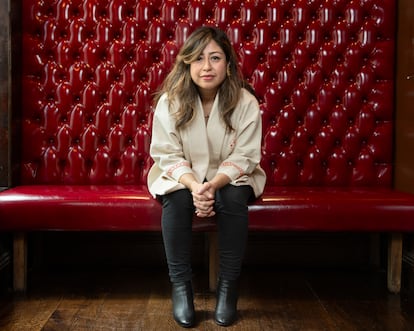

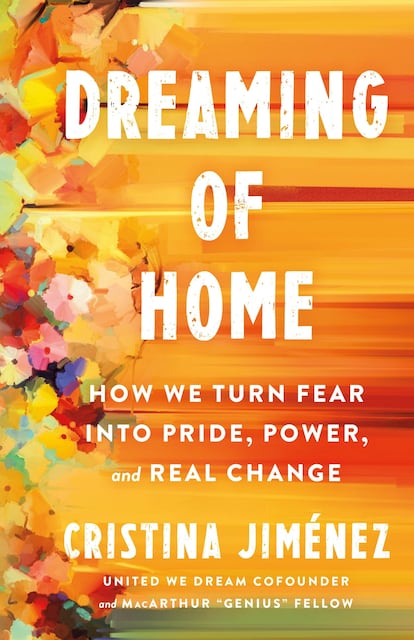
Cristina Jiménez (Quito, 40 years old) never planned for her debut memoir to be published during a second Donald Trump presidency. After the Republican’s first term in office, the co-founder of United We Dream, the largest immigrant youth-led network in the United States, which was instrumental in the advocacy surrounding the creation of the Deferred Action for Childhood Arrivals (DACA) program, decided to write a book about her journey from a young undocumented immigrant in Queens to one of the leading voices in the fight for immigration justice in the country. Now, in the midst of Trump’s heightened anti-immigration crusade, Jiménez hopes that Dreaming of Home will serve as a roadmap for a new resistance front against the president’s agenda and rhetoric.
“I knew in 2016 that I did not want to feel like that ever again, and I never dreamed for my book to be out in a moment where we are under another Trump administration. But what I want people to know with this story is that what is going to get us through this moment is going to be community, solidarity, and organizing,” Jiménez says in an interview with EL PAÍS in Manhattan in mid-May ahead of the book’s release date on the 27th. “I want to remind us that we have the power to build a different country and not be in this situation again.”
Indeed, in the current political context, Dreaming of Home: How We Turn Fear into Pride, Power, and Real Change (St. Martin’s Press) reads like a guide on how to inspire new generations of activists. It’s a coming-of-age tale about a 13-year-old Ecuadorian immigrant without papers who, like many before and after her, struggles to cope in a country that continuously rejects her. But it’s also the story of how a group of undocumented youth came together in the early 2000s to fight for their rights to stay in the country that they had grown to know as home. A love letter to the immigrant community in the U.S., it’s about failure and heartache, but also about empowerment and hope.
Question. When did you decide to write this book?
Answer. It was the night of the 2016 election, I was the executive director of United We Dream, and we were gathered to see the results. We had done so much work through our advocacy arm to inspire voters to engage in the election. When the results were confirmed, I was with my mom and a bunch of people that had mixed status, and everyone just started crying and hugging each other because we knew what this would mean. I remember feeling very overwhelmed and paralyzed by the fear of what was about to come. My mom came up to me, she was crying, and she asked me: “Mija, ¿qué vamos a hacer?” I had gone through a process of transforming from a place of being so fearful about being undocumented and having so much shame to, as a community organizer, feeling so powerful. But for the first time, I looked at her and felt powerless. I couldn’t tell her that we were going to be okay. But what I could tell her was, “we’re going to fight back.”
Q. The book is your story, but it’s also a historical lesson of this country’s immigration system. Why did you decide to write it like that?
A. Part of it is a vulnerable story of me growing up undocumented, very intimate, but it’s also about pulling off the curtain of why we have the immigration system that we have. A lot of people right now are saying, “We can’t believe this is happening. How is it that ICE can violate people’s rights and disregard the courts and violently enter into homes and pull people out of cars and leave children stranded without their parents?” And I tell them that this is what this deportation force was designed for. The system, the laws that we see operating right now, are there by design. And they are more dangerous now with someone in power who completely believes in the ideology of white nationalism and in leading the country as a dictator.
Q. Having lived through and organized during the first Trump administration, do you feel that the country has been slow to react this time?
A. The conditions are severely different this time. It goes without saying that whether you’re an immigrant or not, what’s happening right now has everybody scared. But I would also say that even though we may not be seeing the big protests from back then, like the Women’s March that happened right after [the 2016 election], where you had millions of women take to the streets, the reality is that when you look at the amount of people that have protested now, it’s a lot more than in the first year of the first Trump administration. So, I’m actually very encouraged.
Q. There’s a line in the book where you say, “I wish I had been in the room when those decisions were being made” when talking about immigration policy. As an activist, you have been in the room for the past 10 to 15 years, but we’re still seeing all this rolling back of rights. What else is needed?
A. We cannot have solutions if the people that will be directly impacted are not in the table of conversation, so that’s just my principle. What I’m trying to drive with the book is that we need more of us to be in the room, to have the power to shape institutions, policy, culture, and the narrative. Yes, there are hundreds more than perhaps when I started, but we need a lot more. The point here is that we’ve made progress and the very fact that we are seeing a lot of the rollback that you mentioned is because we have been successful, so they’re pushing back because we have been winning.
Q. Early in the book, you note that, back in the 1920s, people didn’t need passports, visas, or green cards to come to the U.S. It’s hard to imagine that, especially now. Could it ever be the same?
A. It’s a policy choice to close the door to mostly brown and Black working class poor people from around the world and open it to groups like white South Africans. And because humans have made those decisions, I believe it’s possible for them to make different ones. I tell the story of how young undocumented people who seemingly had zero power were able to organize to create the transformation and the change that we’ve seen in the last 20 years. But imagine if the rest of the country, those who are U.S. citizens, realized their own power.
Q. You grew up in the U.S. in the aftermath of 9/11, and in the book you admit that the first time you felt American was precisely after the attacks. You have since become a citizen yourself, how has that feeling of belonging evolved?
A. It’s very interesting, because who is an American? Who gets to define who’s an American? Dreaming of Home is a way of saying that we get to define that, not Trump. For me, this is something that goes beyond a country identity. The question that I’m really pushing here is what is home? Imagine this: you’re a 13-year-old Ecuadorian girl that was uprooted from everything that meant home to her. And when the attacks happened in 9/11, I felt the pain, the suffering, the fear with everybody. It was the first time that I realized that this is home.
Q. But you felt at home in a country that spurned you and your family for being undocumented.
A. It was and is a conflicting truth for me. You can see in this book how I explore my own contradicting feelings about home and this country. Because at the same time that this young and undocumented person found home here, it is also a place that rejects me and doesn’t want me. And sometimes, to be real, I contend with that. There are many days that I get very upset at myself for wanting this country to embrace me. That is true, but the other truth is that this country has given me people that love me. It has given me my family. My family is here because Americans from all walks of life stopped the deportation of my husband. That is the truth about America, too.
Q. Throughout the book, you revisit the concept of the good versus bad immigrant. What’s the danger of that myth?
A. When we come here, everything tells us that just by being here we’ve done something wrong. I believed that, even though my parents and I came here seeking a better life, fleeing poverty and political instability, somehow we had done something wrong. People in power want us to believe that. But I have come to see that it doesn’t matter how good of an immigrant you are, we are still going to experience systematized racism. Being a good immigrant doesn’t protect us from being discriminated against, abused and exploited by the system, and from being detained and deported. My book is an invitation for people in our communities to shed that lie.
Q. Throughout your life and work, the word “dream” has always been there: United We Dream as the name of your first organization, Dreaming of Home as the title of your memoir… What’s your biggest dream?
A. There are two things I would say. A lot of what we’re living right now could shut us down from dreaming, and I hope this story will remind us to keep doing it, because those dreams have been the ones that have led us to have a better country. We cannot give up on dreaming, even when the odds are so extreme. And personally, I have a three-year-old now and my biggest dream is that he can grow up in a country and a world where his life is equally valuable to everybody. Where he can be free to dream, to live and to be a gift and contribution to society. I wrote this book in the middle of giving birth to my kid and going through postpartum anxiety and depression, which was really tough. I know that so many moms and so many parents go through that, so I just want him to be proud.









































