Meghan O’Gieblyn, essayist: ‘I don’t think Trump really believes in God’
After abandoning her faith and turning to technology in search of existential answers, the American writer believes that ‘the solution to human nature is a spiritual one’
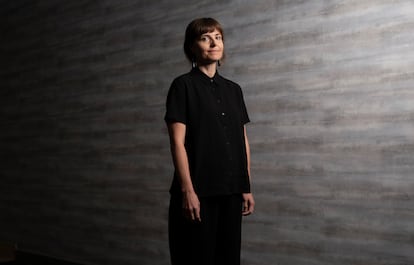

Meghan O’Gieblyn is comfortable admitting that she has more questions than answers. That is not to say she hasn’t been desperately looking for the latter, though. Having grown up in a deeply Christian evangelical family in the Midwest of the United States, O’Gieblyn (Boston, 1982) found certainty in faith for a long time. Until she began to question some of the religious convictions she had long held, and it all began to unravel. Left orphaned, trying to cope with existential quizzings that too often felt overbearing, she then turned to transhumanism, the philosophical and social movement that advocates for the use of technology to enhance human capabilities. She became engulfed by its theories… Until, once again, she felt they came up short.
Her latest book, God, Human, Animal, Machine: Technology, Metaphor, and the Search for Meaning (Knopf Doubleday, 2021) is a reflection of that fruitless quest for answers. In hindsight, she admits that writing about it all leaves her feeling more “confused,” but she has found peace in not knowing. “I’ve come to value humility in all forms, but especially epistemic humility, about what we can know and what we cannot know. Personally, I’m trying to just live more in a sense of uncertainty,” she says.
We meet at her hotel in Manhattan on the morning of July 4. Like many other tourists, she’s in New York City for the holiday weekend, in her case for a wedding. But unlike most of the other visitors, who are dressed head to toe in America-themed apparel to celebrate the nation’s 249th Day of Independence, O’Gieblyn is wearing all black. A somber choice for a somber time in the country’s history. Naturally, our conversation organically shifts to Donald Trump’s presidency, which she argues is sliding into “techno-fascism.”
Question. What made you lose your faith?
Answer. It was partly the problem of evil; this question of if there’s a benevolent, all-powerful God, why is there evil? I felt like the foundations of everything I thought I believed were in ruins. And it wasn’t just about there not being a God. It was also about history and time. In the Christian tradition, there’s this idea that history is a narrative arc that’s bending toward redemption. And in the wake of losing my faith, I had a sense that we’re just sort of going in circles, or that time isn’t going anywhere. I was adrift for a long time. I fell into an addiction for many years.
Q. Were you aware then that your shift towards transhumanism was you trading one coping mechanism for another?
A. I didn’t realize it at the time. I began reading thinkers like Ray Kurzweil and Nick Bostrom, who were writing about the idea that technology was going to help humanity transcend all of our flaws and evolve into this new post-human form of existence. I can see now that it had so many similarities to the Christian Redemption narrative. Since, I’ve become skeptical of looking to science and technology to fulfill spiritual desires.
Q. Why?
A. I think those two things are separate epistemologies. The way in which we approach science and technology is totally different from the longings that we have that are spiritual. But we confuse the two because a lot of people just don’t have a spiritual outlet in their lives today.
Q. Twenty-first-century technology was supposed to solve many of our problems, but it has created new ones that we can’t seem to overcome. Where does that leave humanity?
A. It sounds lofty to say, but I really do believe the solution to human nature is a spiritual one. You can interpret that broadly. Max Weber has an essay where he says that if you want transcendence and eternal life, don’t look for it in a lab. Just go to church. That’s my thinking now, and I say that as somebody who understands the seduction and pitfalls of those theories. Our desire for transcendence has been misunderstood as something that is going to happen on a material level through technology.
Q. Yet, we are at a point where it seems technology is taking over our lives.
A. It feels like it’s out of our hands. We are giving our agency and thought over to systems that are essentially unconscious. AI systems are intelligent, but they don’t have sentience, and that scares me a lot. There are a lot of basic things that can go wrong with AI because it’s something that didn’t evolve alongside us. It doesn’t have the same moral intuitions that we have, or the same socialization, despite all of its training.
Q. Are we losing our ability to discern between human and machine?
A. We are at a point where the lines are getting really blurry, but I also feel that they’re more important than ever. Those lines will allow us to be able to talk about something that is human, that is not just computational, but that we don’t fully understand yet, and that’s consciousness. These machines are very good at a lot of things, but they are lacking what we feel like is the most essential thing about us as humans.
Q. Can humans and new technologies coexist?
A. We don’t have to. The more people can fight back and refuse technologies that they feel are harmful, the better we’ll be. The technology’s not going anywhere, but we still have some ability to steer what our lives are going to look like.
Q. Will that resistance be enough, even as the United States, for example, has a president who is so close with Big Tech?
A. It does feel like we’re up against an impossible amount of money and power, like these systems are being employed against us. They’re in the justice system, the financial sector, education, immigration. And for creative people, these technologies are built on the work that we produce, and we’re not being compensated. However, I take heart in the fact that we’ve managed to resist other very destructive technologies in the past, like nuclear bombs.
Q. Is technology, as it’s employed now in countries like the United States, a system of oppression?
A. Absolutely. The fact that it is perpetuating systemic injustice, especially in the justice system and immigration, and the fact that the Trump administration is using it as propaganda. It’s becoming a tool of fascism in many ways.
Q. Is the Trump administration a technocracy?
A. A friend of mine says that we’re sliding into techno-fascism, which feels like a more accurate term. I was young enough during the Snowden leaks, when people were outraged that the government and technology companies were collecting all sorts of data on U.S. citizens. Now, we’re just giving our data away for free. We’ve overcome that panic, but it’s time to start caring again, and a lot.
Q. Returning to religion, this month marks a year since the first Trump assassination attempt. Many viewed it then as a divine act, and he portrayed it as such, too. Do you think Trump actually sees himself as a god?
A. I don’t think Trump really believes in God; he just figured out how to appeal to Christian voters. In American evangelicalism, a lot of stories from the Old Testament are used to justify his rise. Like the story of the evil king Nebuchadnezzar: many Christians believe that God will use Trump to carry out His will. They may not agree with his morals, but they believe he is divinely appointed.
Sign up for our weekly newsletter to get more English-language news coverage from EL PAÍS USA Edition