
A mountaineer, accused of manslaughter for the death of his partner during a climb: He silenced his phone and refused a helicopter rescue
Innsbruck prosecutors are seeking a three-year prison term for Thomas Plamberger, who attempted a difficult winter ascent of Austria’s highest peak, the Grossglockner, with his less experienced girlfriend
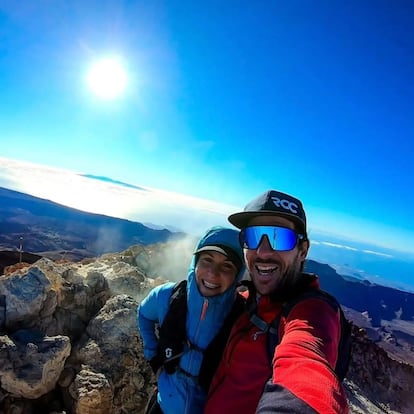

In the mountains, problems are often linked to bad decisions. The negligent decisions made by the Austrian mountaineer Thomas Plamberger, 36, on January 18 of this year could land him in jail. But whether or not he is found guilty by the courts on February 19, nothing will bring back his partner, 33-year-old Kerstin Gurtner. Almost a year ago now, the couple began the ascent of Austria’s highest mountain, the Grossglockner (3,798 m or 12,461 ft), via its southwest ridge — a long, complex route with sections that are especially treacherous in winter.
They began their ascent at 6:45 a.m., and shortly after 1:00 p.m. they were less than 250 meters from the summit. At that point, coinciding with the most difficult section of the route, their progress stalled, and nightfall soon overtook them. Their headlamps, clearly visible from the valley below, alerted the rescue services, and a helicopter was dispatched to extract them after 10:00 p.m., amidst increasingly strong gusts of wind. To their great surprise, Thomas Plamberger refused the rescue, and both continued climbing. But Kerstin Gurtner never reached the summit, which would have allowed them to descend through easier terrain to a sheltered hut. Rescue teams located her remains the following morning, just a few meters below the summit: she had endured a blizzard with wind gusts of up to 70 km/h (44mph) and a temperature of -20°C (-4ºF). She died of hypothermia.
In his statement to the police, the climber claims he refused the helicopter because they were both fine and planned to finish their ascent, but that “shortly afterward” his partner “showed increasing signs of exhaustion.” At this point, the climbing team decided to continue, perhaps judging that reaching the summit would make it easier to escape the mountain. The police are now wondering why Plamberger didn’t respond to messages and calls from the rescue services; he claims he didn’t hear the calls because his phone was on silent mode.
Emergency calls, key to the investigation
Finally, Plamberger called the rescue services at 12:30 a.m., but accounts differ: according to the rescuers, the conversation with the climber was unclear, while he maintains that he made it clear they needed to be rescued. In any case, it was already late for that, as conditions were no longer suitable for another helicopter flight. The rescue teams began their search on foot. The climber stayed with his partner until 2:00 a.m. He then set out to find someone who might be sheltering at a refuge on the opposite slope. He didn’t call for help again until 3:40 a.m. that morning.
The Innsbruck Attorney General’s Office has charged Plamberger with manslaughter due to gross negligence, citing several points that support its case. First, one of the defendant’s biggest mistakes was involving someone with little mountaineering experience in a demanding winter climb with a poor weather forecast. In the mountains, the most knowledgeable and experienced person is always responsible for their companions, and it is the abilities of those with fewer experience that should determine the difficulty of the ascent. Furthermore, the prosecution points out that in winter, the days are shorter, and an activity like the Grossglockner climb should have started at least two hours earlier than Plamberger and his partner had planned.
Without an emergency coat and without suitable boots
Rescue teams found the victim without any emergency coat; she was also not positioned to protect herself from the wind, another act of negligence according to the prosecution. Furthermore, the woman was still carrying her heavy backpack. One of the most striking aspects of the investigation is the deceased’s equipment: she wasn’t wearing mountaineering boots, but soft snowboard boots; she was also carrying a snowboard on her back. Anyone with even a modicum of experience knows that a ridge cannot to be tackled with boots of that type, and that carrying a snowboard is like carrying an anchor. Where was Plamberger’s experience to prevent such a blunder? Moreover, as the most experienced member of the team, he should have made the call to turn back when the wind picked up, before attempting the most challenging section of the route.
The prosecution also accuses him of failing to send distress signals until it was too late and of ignoring calls from rescue services. The prosecution intends to establish that the defendant committed a series of errors while he was responsible for the safety of the climbing team, while the defense maintains that it was all due to a series of small coincidences and nuances. No one, except the defendant, can explain the reasoning behind the team’s progression: Were the decisions made by consensus? Were they decisions imposed by the defendant? Why didn’t Kerstin Gurtner use her own phone to call for help? Did they have the same experience in the world of mountaineering, as Plamberger claims, or did his partner lack experience even if she was fit, as several sources indicate? What was the dynamic of communication between the couple? The court’s decision could usher in a new era of relationships within climbing teams.
Sign up for our weekly newsletter to get more English-language news coverage from EL PAÍS USA Edition









































