
Honey Thaljieh, co-founder of the Palestinian women’s national team: ‘Soccer gave me community, a sense of belonging, dignity’
The former player, currently a FIFA public relations officer, asserts her identity, Palestinian resilience and struggle, and the power of soccer as a tool for change in a conversation with EL PAÍS
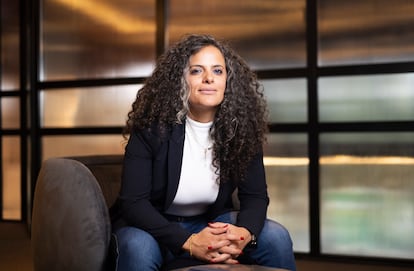

She was seven years old when, after watching a group of boys playing in the narrow streets of Bethlehem’s old town, she fell in love with soccer. “I grew up in a war zone, full of insecurity and injustice. I was at risk of being attacked, singled out, or arrested. Fear came from everywhere: from my parents, from society, from the world,” she recalls now. “What did we do to deserve this?” she constantly asked herself. Honey Thaljieh (Bethlehem, 41) pretended to be a “normal girl in a context that wasn’t,” and she found refuge in the ball. “It was a tool to escape social pressure and trauma, to free myself. Soccer gave me community, a sense of belonging, dignity on the field, a voice, and the power to fight for justice,” she reflects.
That girl who ran through alleys and between walls would end up tearing down her own. She co-founded the Palestinian women’s national soccer team, of which she was the first captain, and today works at FIFA in public relations, promoting social projects aimed at transforming lives through sport. She speaks of resilience, but is aware that not everyone is able to face adversity in the same way. “Everything revolved around hope,” she says of her early life from Barcelona, a day after participating in the first The Change conference. “That was my story of survival: soccer.”
Thaljieh — who defines herself as Palestinian, Arab, and Christian — was a teenager during the Second Intifada. One day, on her way to an exam, the streets were blocked by military checkpoints. She stopped an ambulance and hid inside. She wasn’t alone: there were other students in the same situation. When they arrived for the exam, after such a stressful experience, many of them burst into tears. Their teacher recited a quote from Yasser Arafat: “We Palestinians are like mountains; we cannot be moved by the wind.” Honey refused to let herself be swept away.
But she eventually lost hope. In 2002, she started university in Bethlehem, in the midst of the Intifada. Then there was a siege at the Church of the Nativity, next to her house. “Our life came to a complete standstill for 40 days. We thought there would be no tomorrow,” she recalls. Her cousin was murdered. The days passed, leaving “trauma” and “struggle,” she explains. “We lost our hopes, our dreams.” Then, walking through the university halls, she saw a poster that changed her life: “Girls interested in playing soccer, come to the athletics department.” She ran to the office. But the principal, Samar Araj, told her the notice was old, and that there were no more girls. “Let’s start now,” Honey said. Araj went to find the coach of the university’s men’s team, who gave Honey a ball. She dribbled, shot, and showed him her talent. “Now we can form the women’s soccer team,” the coach told her.
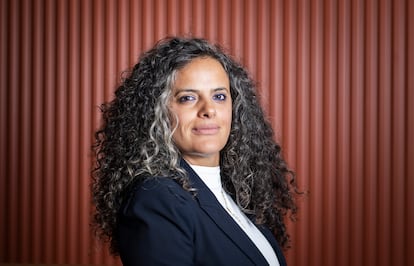
That moment marked the foundation of the Palestinian women’s national soccer team. They started out with five players, but they grew to achieve recognition from the Palestinian Football Federation and FIFA. “Now we have 30 clubs and hundreds of girls playing. Today, the situation is difficult, and there’s a lull due to the genocide [the interview was conducted before the ceasefire in Gaza came into effect on October 10]. But I hope women’s soccer grows. We have to fight for it,” says Honey, who played until injuries forced her to quit.
At least on the pitch. She wanted to go further and change things from within: she began to think about the FIFA Master’s program. “Everyone laughed. I’m from Bethlehem, from Palestine. There’s nothing there, no opportunities. You don’t even dare to dream. I dared.” And she was accepted. She studied in England, Italy, and Switzerland, and in 2012 became the first woman from the Middle East to earn the degree. She also won one of three internships at the sport’s world governing body, and for 13 years now, she’s been working there to promote social projects and programs that use soccer to change lives. “Soccer changed my life. It gave me dignity, it freed me from the circumstances and adversities I’ve been through. It empowered me. It’s a tool to change the lives of many people,” she says. And identity has a lot to do with it. “Identity makes you free. It may seem like it limits you, but once you accept it, it sets you free,” she asserts.
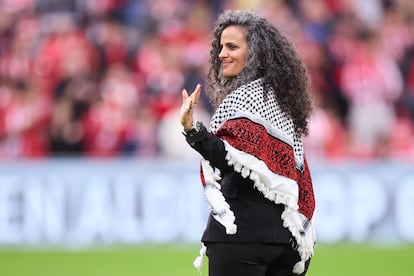
Today she lives far from Bethlehem, but her heart remains there. “What’s happening is against humanity on every level. It’s horrible. Palestinians have the right to peace and equal opportunities. I can’t imagine what my people go through every day when they wake up to destruction, murder, hunger, genocide, and ethnic cleansing,” she explains, her soul wounded but firm and proud to be Palestinian.
“What would you say to a Palestinian girl who dreams of playing soccer?” she is asked. “You will be there, and you will achieve it. We never give up. No matter what is happening, we will rise from the rubble. Those children will fight for a better future and will one day see peace in Palestine. That’s who we Palestinians are,” she says forcefully. “I’ve never seen the resilience of the Palestinian people anywhere else, and we never will. History will never forget, and neither will we.”
✊ #StopGenocidio 🇵🇸
— Athletic Club (@AthleticClub) October 4, 2025
San Mamés muestra su apoyo a Palestina, representada hoy sobre el césped por @HoneyThaljieh, un grupo de palestinos refugiados en Euskal Herria y representantes de @UNRWA Euskadi.
Animo! Zuekin gaude! لكم كل الدعم، نحن معكم!#AthleticMallorca #AthleticClub… pic.twitter.com/MDxKEEFVfh









































