
Soccer and Palestinian pride in Santiago, Chile
‘Baisanos,’ directed by siblings Francisca and Andrés Khamis, is a short documentary about the fans of Club Deportivo Palestino, a declaration of intent in solidarity with Gaza
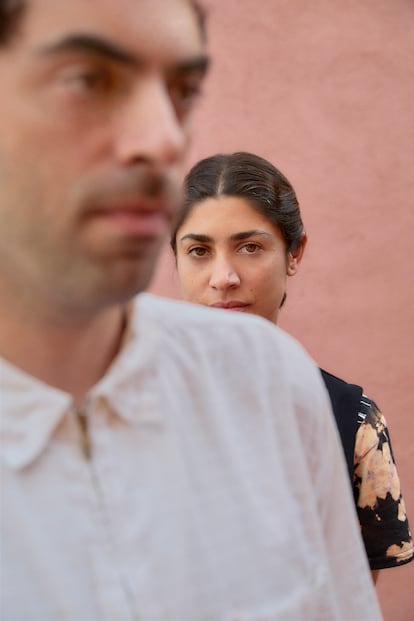

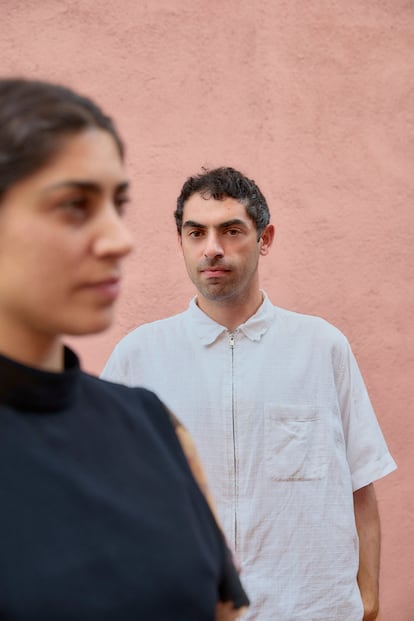
They were born in a different Palestine: that of the diaspora in Santiago, Chile. A portable country that their maternal and paternal grandparents carried on their backs on a journey of over 8,000 miles from the then-Christian towns of Bethlehem and Beit Jala to the Santiago neighborhood of Recoleta. The Khamis siblings, Francisca (36) and Andrés (32), grew up in the Chilean capital. They are Chileans of Palestinian origin who don’t speak Arabic and have eaten more pastel de choclo than maqluba or musakhan. “Our parents and grandparents had suffered racial discrimination and didn’t want to pass on the stigma of being immigrants to us,” Francisca explains, “so they worked hard to ensure that we grew up as Chileans.” But over time, they have come to realize that beneath that thick layer of assimilation, a solid Palestinian identity also survives.
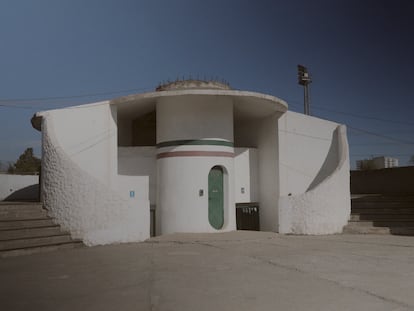
Part of that second skin has to do with a century-old soccer team, Club Deportivo Palestino, which plays “on lease” at the municipal stadium in La Cisterna, south of Santiago. Although a modest club, Palestino has been national champion twice and this year competed in the Copa Sudamericana. Its duels with the other pair of representatives from expatriate “colonies,” Audax Italiano and Unión Española, are local derbies that paralyze the city.
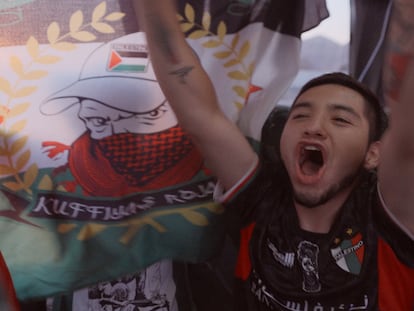
The Khamis siblings, according to Andrés, remember running around La Cisterna in shorts at a very young age: “Our mother, for some reason, supported Universidad Católica, but the rest of the family, starting with our father, were always Palestino fans.” Andrés and Francisca have just dedicated a short documentary to the club they’ve always loved. Specifically, to its most enthusiastic hardcore of fans, the baisanos, who accompany the club when it travels around the country and turn the stands of La Cisterna into a pressure cooker.
They conceived the project from a distance. Francisca was pursuing a postgraduate degree in audiovisual art in Amsterdam, and Andrés was pursuing a Master’s degree in film in Barcelona. They had collaborated on Paracaídas, a performance project by Francisca presented in 2022 that already grappled with diasporas, hybrid identities, and the fertilizing and benign aftermath left by migrations and cultural fusions. Baisanos is another step in the same direction, that of reconnecting with roots that have borne fruit on three continents.
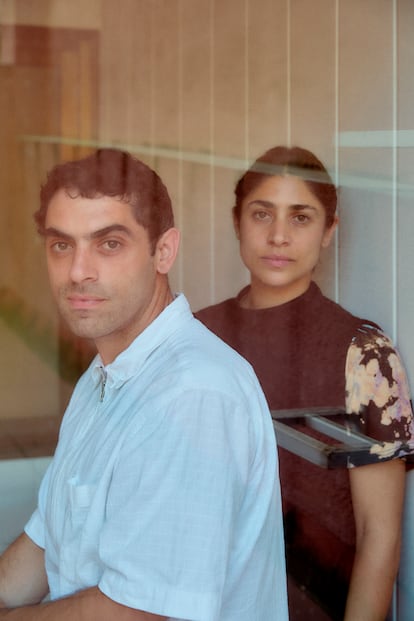
EL PAÍS met with them at the headquarters of La Casa de Cine, the audiovisual school that co-produced the short and where Andrés was a student. They had just been informed that Baisanos, still in the final stretch of post-production, has entered the official section of the Locarno Film Festival in Switzerland, a top-tier competition. “It’s a great boost,” says Andrés, “the confirmation that such a modest and precarious project, made with much more enthusiasm than money, can have value.” They both laugh heartily when we tell them that Colin, by British director Marc Price, is considered to be the cheapest genre film in history, with a budget of 63 pounds ($85.70) that, according to its director, could have come in at less than 60 if a supporting actress hadn’t demanded to be bought a packet of biscuits: “I would say that Baisanos was made not with 63 pounds, but with 63 friends, abusing the affection and goodwill of all of them, asking favors from each other, generating complicity,” Francisca says.
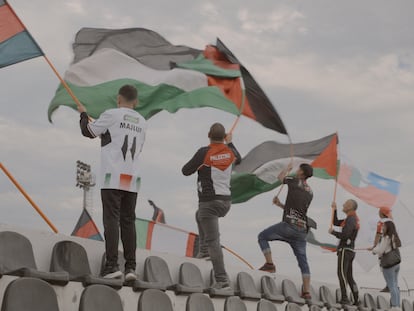
Chance intervened in the genesis of the project: “I had to film a short for La Casa de Cine, as part of my filmmaking course, and I suggested to Francisca that we take advantage of our vacation in Santiago to do something about the Palestinian community.” “Chile’s community of exiles is the largest outside the Arab world, and a large part of them are descended from the first group that left Christian Palestine, Bethlehem and its surroundings, in the final years of the 19th century,” adds Francisca. Once there, they came into contact with the fans of their childhood soccer team, those baisanos who are mostly of non-Arab Chilean descent but support the club and the Palestinian cause: “The Santiago diaspora has institutions like the Palestinian Community in Chile or the General Union of Palestinian Students,” Andrés explains, “but it seemed to us that the club and its fans are a much more transversal and open example of pro-Palestinian resistance, of solidarity and empathy towards a cause that at first seems foreign to you but that you can end up embracing as your own.”
The siblings acknowledge that, beyond Palestino and the national teams of their two countries, they aren’t big soccer fans themselves. “Sports are almost the least of our concerns here,” Francisca chimes in. “We have around 15 hours of footage that we’ve condensed into a 14-minute short film, and the pitch is almost never shown. The story is in the stands, on the team bus, and in the places where the people of Palestine gather.” The documentary follows them as they parade through the streets waving flags, chanting songs like “Gaza resists, Palestine exists,” celebrating a goal, or indulging in a certain degree of festive political incorrectness, dressing up as picture-postcard Arabs, complete with turbans and djellabas. “The man who appears dressed as an Arab is the club’s unofficial mascot,” Francisca explains, “he’s quite a character who deserves a film [of his own], but in ours, the main focus is on the ensemble.”
Once the images were collected, Andrés and Francisca conducted an initial screening in Amsterdam and began editing the resulting material: “The big challenge,” Andrés says, “was to give all that material meaning and a narrative coherence, and that’s when we started asking ourselves a lot of questions.” Questions like, as Francisca explains, “why are we looking at them, why are we telling their story and not any other story from Palestinian Chile, what are we doing talking about soccer, filming a crowd celebrating a goal, when what we intended was to show the solidarity with Gaza of the diaspora to which we belong?” They quickly accepted the reality: “It’s a documentary made from a position of privilege. Right now, in Gaza, which is suffering systematic genocide, it’s almost impossible to film anything or make any demands; it’s practically impossible to generate discourse.” They had intended to go to Bethlehem this summer for an artist residency, but right now Palestine is “a non-place that has been cut off from the rest of the world.” And not just Gaza, but also the West Bank of their grandparents. “In a situation like this,” the Khamis’ conclude, “you ask yourself what you can do and to what extent what you do might be sufficient.”
They created Baisanos to demonstrate this grassroots transnational solidarity between communities separated by over 8,000 miles. But they assume that, in a situation as “atrocious” as the one the Strip is experiencing, any effort seems insufficient, futile: “We view the future of our land with despair,” Francisca says. “I don’t know what will remain there when the destruction stops and Israeli troops withdraw. I would emphasize what Fela Kuti’s son [Femi] said a few days ago: that it’s all very well to go out into the streets shouting ‘Free Palestine!’ or ‘Free Congo!’, but what Europeans should start demanding is a ‘Free Europe,’ because the rise of the far right and supremacist rhetoric on that continent is contributing to the destruction of Gaza. Right now, there’s very little that can be done in Palestine, beyond resisting as best we can. But a healthy, sensible, and supportive European policy could, perhaps, stop the genocide.”
Sign up for our weekly newsletter to get more English-language news coverage from EL PAÍS USA Edition









































