
Living next door to the narcos: Southern Spain’s invisible war
Officers say they are on permanent alert, acutely aware that they live side by side with the very criminals they are tasked with fighting: ‘I left a wedding to avoid being photographed next to a known trafficker’
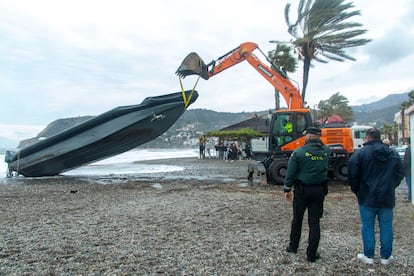

Among police officers and Civil Guard personnel stationed along southern Spain’s coast, what they call the “Northern Syndrome” is spreading. In police jargon, the term describes the state of constant vigilance in which officers live and work. It’s a reference to the way security forces operated in the Basque Country during the fight against the now-defunct ETA terrorist group.
Campo de Gibraltar, Huelva, Málaga, Seville, Granada, Almería, Murcia. “Drugs are already coming in everywhere,” say officers, as an armed and largely invisible war unfolds behind a reality masked by beach umbrellas, seaside bars, packed terraces, local fairs and the pilgrimage to El Rocío in Andalusia.
The syndrome is spreading as officers chase drug-smuggling speedboats, intercept shipments, come under machine-gun fire, and discover that their photographs are being circulated in traffickers’ WhatsApp groups. Just recently, for example, a patrol boat belonging to the Civil Guard’s Maritime Service in Huelva was fired upon during an operation that ended with 10 arrests and the seizure of six tons of hashish.
Yet despite the risks they face in their daily work, officers fighting drug trafficking in southern Spain still do not receive the hazardous-duty bonus, worth about €700 ($813) a month. The allowance, however, continues to be paid to officers in northern Spain for what the Interior Ministry describes as “political and historical” reasons.

Police unions and professional associations are lobbying Spain’s Interior Ministry, headed by Fernando Grande-Marlaska, to have these areas of southern Spain officially designated as Special Singularity Zones (ZES), a status that would bring improved working and living conditions for officers. The ministry argues that the region has benefited from special security plans since the start of the legislature, with resources and personnel reinforced as needed to adapt to the evolving fight against drug trafficking.
“But the situation is completely out of control. There are more and more of them [the traffickers] and fewer and fewer of us,” counters a veteran officer with the Civil Guard’s Anti-Drug Organized Crime Unit (EDOA) in Huelva. “Nobody wants to come here anymore. Most of those who arrive do so because they have to, and as soon as they can, they leave.”
In the areas most heavily affected by drug trafficking, including Algeciras, Isla Cristina, Punta Umbría, Islantilla, Ayamonte, Lepe, Cartaya and Matalascañas, police officers and Civil Guard personnel rely on anonymity for their safety. They are acutely aware that they live side by side with the very traffickers and criminal networks they are tasked with combating.
Anonymity
“Nobody knows what I do,” “I never take the same route when I leave home,” “we barely socialize with anyone,” “my children know there are things we don’t talk about outside the house,” “my wife has normalized the danger: I tell her I’m going to intercept a shipment and she asks if I’ll be home for dinner,” “we only form bonds with our own,” “this is not ordinary crime, this is a war between the state and drug trafficking and we’re fighting it with limited resources and largely on our own.”
These are some of the remarks shared by nearly a dozen Civil Guard officers and police officers interviewed for this report in Algeciras, in Cádiz, and across the province of Huelva, where traffickers have grown increasingly emboldened.
“Drug trafficking has become one of the main security challenges facing our province,” the Huelva branch of the Unified Association of Civil Guards (AUGC) said in a statement issued on June 23. The organization is among Spain’s most outspoken law enforcement associations, regularly exposing the conditions under which officers work and, at times, lose their lives.
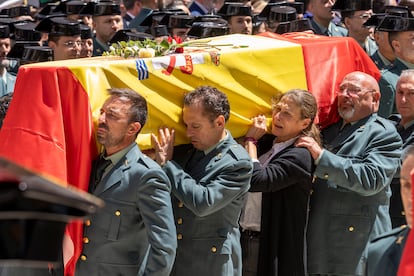
Some statistics help illustrate the scale of the problem. In 2025, authorities seized 65,301 kilograms of hashish in Huelva, up from 20,000 the previous year, while drug seizures across Andalusia increased by 38.5%, according to Interior Ministry figures. Cocaine seizures in Huelva reached 3,307 kilograms in 2025, a 24% increase from the previous year, according to Spain’s Anti-Drug Prosecutor’s Office. Across Andalusia, however, cocaine seizures fell by more than 50%. Officers say the explanation is straightforward: “Enforcement efforts focused on shipping containers in ports, which used to be the main entry point. Now they’re bringing it in on drug boats from the African coast and Portugal.”
Another figure stands out. In March and April alone, authorities seized 11 tons of cocaine in Huelva province, according to the AUGC, pending the release of the Interior Ministry’s official statistics for the current year. The growth is exponential, and those on the front lines of the fight against trafficking voice a concern that they believe is obscured by the official figures: “Far more cocaine is coming in, and we’re seizing less of it.” It is impossible to cover the nearly 700 miles between Huelva and Murcia, with several navigable rivers: Guadalquivir, Guadiamar, Guadiana, Odiel…
On the other side of this hidden reality, police officers and traffickers regularly cross paths in everyday life. They recognize each other in supermarket lines, at their children’s schools, in bars, some owned by traffickers, and even at the bank. They live in the same towns and cities, and it is no longer always clear who is watching whom.
Many officers have discovered their own photographs circulating in traffickers’ chat groups after seized phones were examined. They have seen images of themselves walking down the street in plain clothes accompanied by messages identifying them: “This one works for the UDYCO,” referring to the National Police’s Organized Crime Unit. Others have found photos of themselves dining with their families labeled simply: “This is so-and-so.” Officers have also uncovered pictures of their official and private vehicle license plates, as well as images of the entrances to their homes and garages. The surveillance is constant and goes both ways.
“I had to move my son to a different class so I wouldn’t have to run into a trafficker I’d just arrested at other children’s birthday parties,” says a National Police officer in Algeciras.
“I left a wedding to avoid being photographed next to a known trafficker,” adds another.
“One day you go to pay your bill at a restaurant, and they tell you someone else has already paid it, someone you know is involved in ‘the business,’” says one member of Huelva’s Civil Guard maritime unit. “Another day, an acquaintance from the neighborhood approaches you with an offer to work for a trafficker in exchange for a substantial amount of money.” The traffickers constantly try to use their financial clout to buy influence and loyalty in the communities where they live and work.
Doñana’s poachers
Much of the intelligence gathered by traffickers comes from what officers describe as “an army of youngsters.” Known as puntos, many of them minors, these lookouts monitor the territory from street corners and strategic vantage points, relaying movements in real time via messaging apps. They can earn as much as €1,000 ($1,160) for spending the day outside a building, reporting license plate numbers, or noting who passes through a particular intersection.
More recently, traffickers have recruited poachers from Doñana National Park. Born and raised in the area, they know the protected landscape, with its maze of meanders, estuaries, channels and marshlands, like the back of their hand. In exchange for hefty sums, they help move and conceal drugs through areas that are almost impossible for law enforcement to access.
“It’s a major entry point for drugs. Controlling it is practically impossible,” officers admit, frustrated by the traffickers’ ability to penetrate even the most difficult terrain.
Balaclavas, ballistic plates, reinforced body armor, automatic weapons and shields. In police operations across southern Spain, the distinction between a plainclothes narcotics officer and a GEO operative, a member of the National Police’s elite tactical unit, has become increasingly blurred. The same can be said for the difference between a detective in the Civil Guard’s judicial police and a member of the Rapid Action Group. Everyone is now heavily equipped, often with protective gear bought out of their own pockets, “in the absence of better equipment,” as officers put it, or even, they admit, with “material seized from traffickers.”
Everything is used to bring drugs ashore: semi-rigid speedboats, leisure craft and fishing vessels alike. Vast quantities of narcotics travel along the so-called “African route” from Latin America before reaching Spain. Cocaine is now arriving in tons through both the traditional and newly emerging hashish-smuggling corridors. A surge in coca production in Colombia has driven prices down sharply. While a kilogram fetched around €30,000 ($35,000) on the market five years ago, it now sells for roughly half that amount.
The growing flow of cocaine has gone hand in hand with rising violence among the criminal groups operating in southern Spain, an increase in the number of weapons in circulation, many of them absent from official seizure statistics, and a flood of money into the region. The immense financial power of the trafficking networks has tilted the balance in their favor, fueling the confidence and brazenness with which they now operate.
Everyone knows that behind the rundown façades of some buildings in Algeciras’s Saladillo neighborhood lie lavish homes equipped with every luxury. They know, too, that lookouts’ positions are coordinated at the Goya Café, across from the vast container terminals of the port, and that major deals between powerful trafficking bosses are struck at the Embajador restaurant. In reality, everyone knows what is going on, yet everyone carries on as though they do not.
Drug trafficking, officers say, has seeped into every corner of life. And now it is increasingly backed by assault weapons. Trust comes at a premium. Many officers live in a state bordering on paranoia. Some have had bullets strike or narrowly miss them. Others have found themselves mentally saying goodbye to their children while waiting for a final shot that, fortunately, never came.
After experiences like these, some seek psychological help to be able to sleep again, to resist reaching for their service weapon every time the doorbell rings, and to return each day to a frontline that they feel much of society neither sees nor understands. In their view, they are fighting a war largely out of sight, while those around them remain numb to its reality.
⚠️ Riesgo máximo
— AUGC Guardia Civil 🇪🇸 (@AUGC_Comunica) August 22, 2026
🔥 Tensión
🔫 Disparos
🌊 Rescates
Así es el día a día del Servicio Marítimo de la Guardia Civil 🚤
La agresividad del narco no nos va a parar, pero necesitamos medios y personal.
También recordamos que este esfuerzo tiene que ser reconocido: somos quienes más… pic.twitter.com/nytKAjZK5r
Parallel reality
“North of Despeñaperros, people in Spain have no idea what’s happening down here: shootouts where we’re firing service pistols and they’re shooting back with machine guns; killings and executions linked to score-settling, like the one in Isla Cristina the other day; chases by land, sea and air; live drug rip-offs... It all sounds like a movie, but it’s our everyday reality. It’s as if we live in a parallel world,” says an officer with the National Police’s GRECO unit, the Special Response Groups for Organized Crime, which has five teams of between nine and 12 officers in Andalusia.
“It’s only a matter of time before they kill one of us,” adds an officer from the Civil Guard’s anti-drug organized crime unit in Huelva.
The shift has been swift and dramatic. Officers with anti-drug units in Cádiz and Huelva trace it back to “the last two years.” They link it to Colombia’s surge in cocaine production, mounting pressure from the United States under U.S. President Donald Trump that has boosted the Atlantic African trafficking route, and the proliferation of weapons amid a war raging in the heart of Europe.
Criminal organizations now hire heavily armed hitmen to protect their shipments. “Albanian and Serbian mercenaries, career criminals, members of Latino gangs... We don’t know them, and they don’t know us,” say officers from the National Police’s GRECO organized-crime unit. “They come, do the job, escort the drugs at all costs, and then leave. They’re ruthless professionals.”
The sound of gunfire still rings in Marcos’s head. Marcos, not his real name, asked to remain anonymous. He can still see bullets kicking up sand at his feet as he ran alongside two fellow officers before diving into a ditch and taking cover in the undergrowth in Isla Mayor, near Seville, on November 8. He was one of three police officers wounded in the attack.
“It is a hostile landscape, with dirt roads, canals and warehouses. We arrived just before dawn,” he recalls. They had been sent to inspect the area after traffickers managed to evade a police operation and bring a shipment ashore. It must have been a valuable load. The smugglers had reportedly spent three days waiting off the Portuguese coast with the drugs aboard a speedboat.
“We reached a farmhouse, heard engines and saw lights approaching,” Marcos says. “Suddenly, it felt like I was watching a scene from Medellín: an SUV with the passenger leaning out of the window, face covered and holding an assault rifle. A trailer piled high with bales of drugs, guarded by two more masked men carrying AK-47s. Behind them, another SUV with two men brandishing long guns through the sunroof. All I could think about was not being seen, but they spotted our vehicle. They unloaded the drugs and came back for us.”
On January 27, Marcos took part in the arrest of the men who had riddled his team with bullets that morning. They were two well-known criminals, known as “Pajarito” (Abdelasid M. M., a 29-year-old from Algeciras) and “Moreno” (Muhammad Yunes M. S., a 22-year-old from Ceuta), both of whom had been handling weapons since they were 14.
Just a few days later, Marcos was back on duty, earning €2,300 ($2,670) net a month for a job with no fixed schedule and no fixed days off. But since the shooting, he has barely slept. His mind remains stuck in what he describes as a state of “permanent alert,” and he now sees a private psychologist at his own expense. “I walk the dog with my pistol; I anticipate all kinds of dangers,” he says.
Until “two or three years ago,” GRECO units operated within their own jurisdictions. Now they routinely have to back one another up because a single drug shipment can mobilize nearly 50 people, many of them armed, including transporters, lookouts, informants, paqueteros responsible for collecting the drugs, security personnel and operators of so-called guarderías, temporary stash houses where narcotics are stored.
“I’ve been doing this for more than 20 years, and I seized more weapons in 2025 than in the rest of my career combined, many of them long guns and military-style firearms,” says a GRECO officer in Cádiz.
The same is true in the Civil Guard. Since the Interior Ministry dismantled OCON-Sur, the Andalusian anti-narcotics coordination unit, in 2022 following allegations of corruption, many officers have found themselves pulled away from their regular public-security duties to reinforce the fight against drug trafficking because the Organized Crime and Anti-Drug Units do not have enough personnel. A Civil Guard officer assigned to public safety in Cartaya, Huelva, sums up the situation: “We’re stopping taking reports and assisting members of the public because every other day we’re being called in to support a drug-seizure operation.”
Sign up for our weekly newsletter to get more English-language news coverage from EL PAÍS USA Edition









































