
A billion galaxies, two cosmic mysteries: Inside NASA’s Nancy Grace Roman telescope
NASA has launched its most ambitious space telescope yet, a mission designed to help answer two of astrophysics’ biggest questions: what are dark matter and dark energy
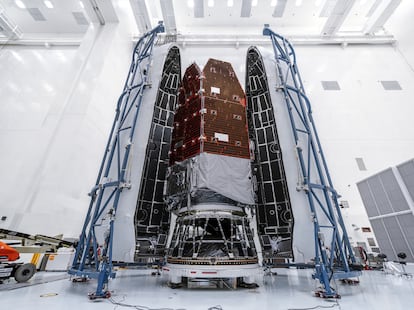

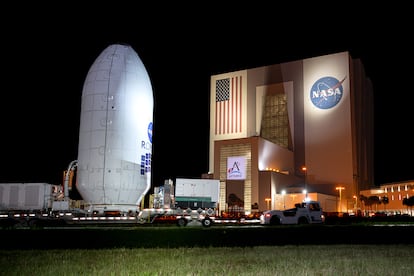
The most powerful cosmic surveyor ever sent into space is now on its way. NASA’s Nancy Grace Roman Space Telescope launched successfully on Sunday and has begun its journey to a gravitational outpost 1.5 million kilometers from Earth. From there, it will scan the heavens on an unprecedented scale, mapping more than a billion galaxies and potentially discovering up to 100,000 new worlds beyond our Solar System
“It will allow us to answer two of the most important questions facing our species,” Nicky Fox, associate administrator of NASA’s Science Mission Directorate, said ahead of the launch. “What is the universe made of? And are we alone in it?
That is because Roman is not designed to see farther than its predecessors, but to see more. Much more.
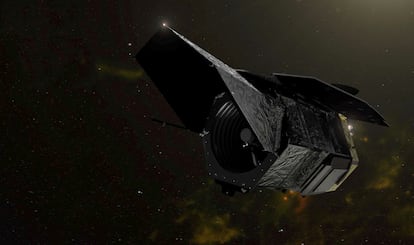
The distinction is not a trivial one. Roman has a 2.4-meter primary mirror, identical in size to that of the legendary Hubble Space Telescope, and with comparable resolution. But that is where the family resemblance ends. Its field of view is at least one hundred times larger, meaning that a single image will contain as much detail as one hundred Hubble photographs combined.
Mission scientists have summed it up with a striking comparison: there is no screen in the world large enough to display one of its full images. Another, more down-to-earth analogy puts it at the equivalent of 500,000 4K televisions lined up side by side.
Once operational, Roman will generate around 500 terabytes of data a year, more than Hubble created during its 35 years of tireless service to humanity. The mission is expected to last five years, with the possibility of a five-year extension.
“We’re going to look at the universe in a different way,” said Julie McEnery, the project’s senior scientist, on Saturday. “That alone makes Roman a revolution,” she added.
Begoña Vila, a Spanish systems engineer at NASA’s Goddard Space Flight Center and co-lead of operations for Roman’s Fine Guidance Sensor, put it another way in an interview with this newspaper: “This field of view is 100 or 200 times wider than what we have so far with Hubble and Webb. Clearly, it will be looking at parts of the universe we have not seen until now.”
The trick is not to look deeper, but wider. Compared with Hubble, and also with NASA’s other flagship space observatory, the James Webb Space Telescope, Roman can observe a vast area of sky.
Roman and Webb, in fact, will be neighbors. Both will operate from the L2 Lagrange point, 1.5 million kilometers from Earth, where the combined gravity of the sun and Earth makes it possible to maintain a stable orbit while blocking much of their light.
Vila, who has been involved with the Webb telescope since 2006 and with Roman since 2022, explains the difference between the two missions. “Webb can look in great detail, in the infrared, at small parts of the universe and show us the first objects that formed and how they changed over time,” she says. “Roman looks at the same wavelength, but with a field a hundred times larger: it is a survey telescope, taking wide images and moving from one area to the next. It will give us that overview of the universe’s structure, and it will return to observe it regularly, so we will see things that change. The interesting things we find, then Webb and Hubble can observe in much greater detail.”
Roman also follows Webb’s tradition of being named after a distinguished figure in NASA’s history. In this case, it honors Nancy Grace Roman (1925-2018), the agency’s first chief of astronomy and the first woman to hold an executive position at NASA, just six months after the agency was founded in 1959.
The University of Chicago had previously denied her a tenured position because she was a woman. At NASA, she became the driving force behind congressional approval for the construction of the Hubble Space Telescope. She even personally instructed astronaut Buzz Aldrin on celestial objects before the mission that would see him walk on the moon.
Two mysteries, one telescope
Roman’s primary mission is to harness its vast surveying power to answer two questions that have puzzled astrophysicists for decades: What is dark matter? And what is dark energy?
Dark matter makes up about 85% of all matter in the universe, but no one has ever seen it directly: it is detected only through its gravitational influence on visible matter. Dark energy, meanwhile, is the name scientists give to the force causing the universe’s accelerated expansion. Even less is known about it. “The word dark means we don’t know what it is,” explains Vila. “To me, it’s incredible that both make up 95% of what’s out there: the matter we are made of and the energies we know are only 5%.”
To solve these mysteries, Roman will conduct a massive sky survey covering more than 5,000 square degrees, nearly 12% of the entire sky, and will capture images of more than one billion galaxies in just a year and a half.
The telescope will rely on a technique known as weak gravitational lensing. As light from a distant galaxy travels across the universe toward Earth, its path is subtly bent when it passes through structures made of dark matter. By comparing these distortions across millions of galaxies, scientists can reconstruct the invisible cosmic web that surrounds and connects the galaxies we can see.
Roman will also hunt for tens of thousands of supernovae, which will allow researchers to measure the rate of the universe’s expansion at different points in cosmic history with unprecedented precision. Together, these two techniques are expected to measure the evolution of dark energy with a precision up to ten times greater than current estimates.
The urgency is not merely theoretical. In recent years, three troubling cracks have appeared in the standard model of cosmology. The universe appears to be expanding faster than predicted by existing models; matter seems to be distributed more evenly than expected; and the DESI instrument in Arizona has found indications that dark energy itself may be weakening over time.
“It’s somewhat intriguing, because there are signs that something is very wrong,” Julie McEnery admitted. For her, what is at stake is not an isolated measurement but something far more fundamental: “We do not understand, at a fundamental level, how the space we live in actually works.”
The instrument that never moves
Much of that precision depends on an instrument that rarely gets much attention: the Fine Guidance Sensor (FGS), for which Vila is a co-lead, both on Roman and on Webb.
“It’s the instrument that lets you point very precisely at a patch of sky and then keep the telescope extremely stable so it doesn’t move,” she explains. “We look for specific stars from which we want information, and we provide their position many times per second; for Roman, four times each second. If that position shifts, we correct the telescope’s orientation to bring it back. The movements are tiny, but thanks to them the observatory stays still while data are collected.”
The system, however, works differently on the two telescopes. “With Webb we choose a single star and guide on it. In Roman, because we have such a wide field, we use 18 different cameras, with a reference star in each. And we are going to do something for the first time: guide not only with stars but with spectra. The light of a star is dispersed into a line, and we guide by that line. It’s the first time we’re trying it,” Vila says.
Hunting for other worlds
Roman’s second major goal is the search for exoplanets, and here the numbers NASA is talking about are staggering. The mission is expected to discover around 100,000 new planets, compared with the little more than 6,000 confirmed exoplanets found in the entire history of astronomy.
Most of these worlds will be detected using the transit method, the workhorse technique of modern planet hunting, which looks for the slight dip in a star’s brightness when a planet passes in front of it.
But Roman will also bring something new to the table: gravitational microlensing. This technique exploits a prediction of Einstein’s theory of relativity. When two stars align from our point of view, the gravity of the foreground star magnifies the light of the more distant one. If the foreground star hosts a planet, the planet’s gravity leaves a second, subtler signature in that magnification.
Thanks to this approach, Roman will be able to detect worlds smaller than Mercury and even so-called rogue planets, which wander through space without a parent star. Some may have been ejected from their original planetary systems, while others may have formed in isolation. Studying this population could help astronomers answer one of the most enduring questions in planetary science: how common, or how unusual, a planetary architecture like our own Solar System really is.
A surprise before liftoff
Although Roman was designed primarily to investigate dark matter, dark energy and exoplanets, a study published this year by researchers at Lawrence Livermore National Laboratory points to an unexpected use for the telescope. Its extraordinary precision could make it possible to detect and measure the masses of isolated neutron stars, objects that have until now been almost impossible to weigh using conventional techniques.
It is perhaps the clearest example of something mission scientists repeat almost as a mantra: the most important discoveries made by a new observatory are rarely the ones it was built to find. More often, they are the ones nobody anticipated.
“We have absolutely no idea what we’re going to find,” Vanessa Bailey, a scientist at NASA’s Jet Propulsion Laboratory (JPL), admitted ahead of the launch.
Because Roman will observe regions of the universe in ways that have never been possible before, researchers are hoping not only for answers but for surprises.
“As we’ve never seen the parts of the universe that Roman is going to observe, we all want to find things we don’t expect, or don’t understand,” says Vila. She is even willing to make a prediction of her own: “Maybe there will be a Nobel Prize thanks to Roman’s data, for demonstrating something that explains dark matter and dark energy differently than we think now.”
The telescope will begin work long before it reaches its final destination. The journey to the L2 Lagrange point is expected to take about three months, during which engineers will gradually deploy and test its systems. Vila estimates that the first official scientific images could arrive as “a nice New Year’s gift.”
As with other major NASA observatories, Roman’s data will be made publicly available to the global scientific community, as well as to students and early-career researchers, with no proprietary period restricting access.
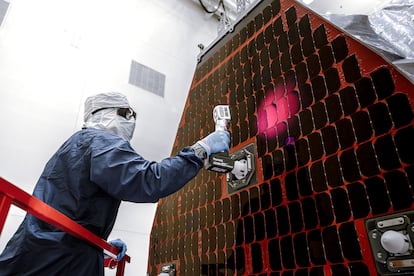
Built at NASA’s Goddard Space Flight Center in Maryland with the participation of more than a thousand engineers and technicians, Roman reached a major milestone on November 25, 2025, when its spacecraft and telescope sections were joined together in the center’s largest clean room. In another rarity for a flagship space mission, the project arrived at the launch pad nine months ahead of schedule and below its allocated budget.
Sign up for our weekly newsletter to get more English-language news coverage from EL PAÍS USA Edition









































