
The ‘green ray,’ the fascinating optical phenomenon that may follow the solar eclipse in the Balearic Islands
The emerald glow that captivated the heroine of a Jules Verne novel may appear for a few fleeting moments after the August 12 total eclipse off the coast of Mallorca

Helena Campbell did not want to get married. At least not until she had seen the green ray. The heroine of what is considered Jules Verne’s most romantic novel set out on a journey along the Scottish coast in search of the optical phenomenon, but when it finally appeared before her, she did not look at the horizon. She was looking at the love of her life.
Published in 1882, The Green Ray turned these flashes of light, visible when the Sun sets over the sea, into a genuine legend. Only the most observant and attentive people might be able to witness a green flash and, with luck, “never again be mistaken in matters of the heart,” according to one of the novel’s most famous lines.
Far from being merely a fanciful device or a myth, the green flash is an atmospheric optical phenomenon that lasts only a few seconds and occurs at the very end of sunset. According to astronomers in Spain’s Balearic Islands, it may be admired as “the icing on the cake” of the solar eclipse of August 12 along the coast of Mallorca. That said, patience is required. One must be highly observant and keep watching the Sun until it disappears completely.
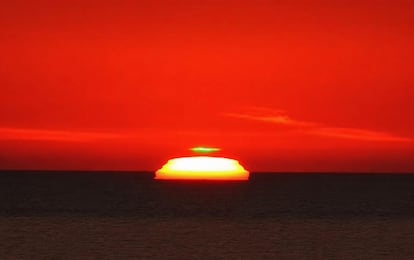
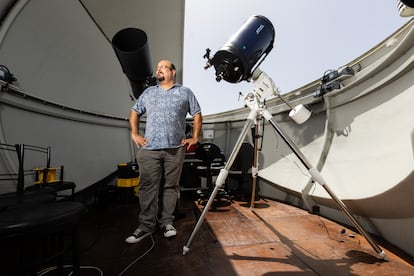
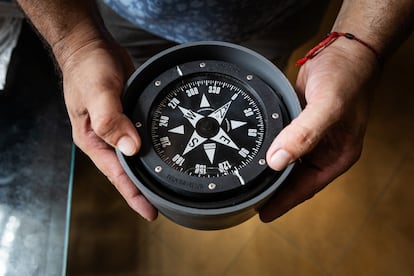
Amando Carbonell Santos, president of the Mallorca Astronomical Observatory, who has even managed to photograph the green flash (as shown in the image accompanying this article), describes it as “something magical.” Carbonell has spent his life admiring the sky and the stars and, from the observatory dome in the municipality of Costitx, hunting asteroids. But over the last year he has devoted himself to something else: locating the best spots on the island to watch the Moon fully cover the Sun for 96 seconds. With a marine compass in hand — an heirloom from his grandfather — and his car, he toured all of Mallorca to identify 35 locations where the total eclipse could be seen. He decided the ideal vantage would be a high place with an unobstructed view of the sea on the horizon.
The astronomer explains that because the Sun will be positioned so low in the sky at the moment of maximum eclipse, just two and a half degrees above the sea horizon, spectators will be able to enjoy a double astronomical spectacle only minutes apart. “It will be almost as if we had an eclipsed sunset. As the Moon begins to move away from the Sun, the star will be sinking into the horizon, and at that very moment we may be able to observe the last fragments of its light in the atmosphere, in other words, the green flash,” he says.
On the island of Mallorca, the eclipse’s totality will begin at 8:30 p.m. and last 1 minute and 36 seconds. Sunset that Wednesday will end at 8:49 p.m. It is an almost unique window. Thousands of people will have their eyes on the horizon and cameras ready, precisely when conditions for a green flash are most favorable. Protective glasses will no longer be necessary at that moment. Carbonell Santos acknowledges that the phenomenon is largely unknown and has received virtually no promotion, partly because of the public’s limited awareness of its existence and partly because of the legends and folklore that surround it.
What is a green flash?
A green flash is an atmospheric optical phenomenon caused by the refraction and dispersion of sunlight in Earth’s atmosphere. It occurs just as the Sun sets, although it can also be seen at sunrise.
As the Sun approaches the horizon, the atmosphere acts like a giant prism. At that moment, refraction separates the different colors of sunlight. Along the upper edge of the solar disk, violet, blue, and green light become visible. The violet and blue wavelengths are largely scattered by the atmosphere before they reach the observer’s eye. Green light, however, can remain visible for a brief instant, appearing as a vivid green rim or flash at the top edge of the Sun. To observe the phenomenon, the atmosphere must be exceptionally clear and nearly cloud-free. Such conditions are most commonly found over the sea or in the desert.
For decades, the existence of the green flash was doubted because it was so rarely observed, whether due to atmospheric conditions or its fleeting nature, as it is visible for only two or three seconds. However, scientific outreach and cultural works such as Jules Verne’s novel and Éric Rohmer’s 1986 film adaptation brought it worldwide fame.
The green flash has its devotees in Spain as well. In 2013, the meteorology enthusiasts of the Meteo Isla Bonita group attempted to organize a festival dedicated to observing the phenomenon at the port of Tazacorte, on the Canary Island of La Palma. The event never took place, but that did not deter the association. Last year, its members succeeded in photographing four green flashes in just two days, once again from La Palma.
Carbonell Santos has seen a couple of green flashes in recent years. As part of the Mallorca Astronomical Observatory’s public outreach workshops, he has traveled to different parts of the island to capture the phenomenon and teach others where to look for it. Last May, he went to the Banyalbufar viewpoint on Mallorca’s northern coast, where he managed to photograph the emerald light merging with the sea against the backdrop of an orange sunset.
The astronomer is excited that the Balearic Islands will be one of the world’s prime locations for observing the August 12 eclipse. He is aware of the pressure the event will place on the archipelago in the middle of the peak tourist season, but he says he prefers this kind of scientific tourism to “binge-drinking tourism.”
No one, he believes, will let pass unnoticed that brief night of 96 seconds descending in the middle of an August sunset. Nor will they overlook the fleeting ray of a color that, according to Verne, no painter could ever reproduce on a palette: “If there be green in paradise, it cannot but be of this shade, which most surely is the true green of hope!”
Sign up for our weekly newsletter to get more English-language news coverage from EL PAÍS USA Edition









































