
The custom 3D implant that helped Mario take off his shirt without feeling self‑conscious
Gregorio Marañón Hospital used the technology to model a surgical piece for a 20‑year‑old man with Poland syndrome, a visible chest malformation
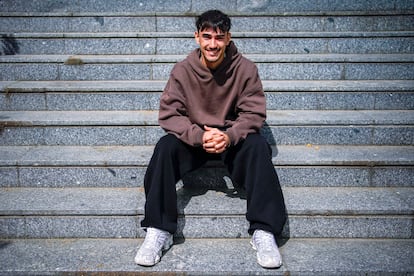

Unconsciously, Mario Rielo adopted certain postures to conceal his pectoral malformation. At the beach, at the pool, when he took off his shirt, he would raise one arm and touch the back of his neck. The gesture stretched his chest, evened out his silhouette, and disguised the indentation he had on one side of his ribcage since childhood.
“I realized I was doing it over time. I wasn’t doing it thinking, ‘I don’t want this to be noticeable.’ I was just doing it,” he says now, four months after the reconstructive surgery he underwent at the Gregorio Marañón Hospital in Madrid, with a custom-made prosthesis created in its 3D-printing laboratory.
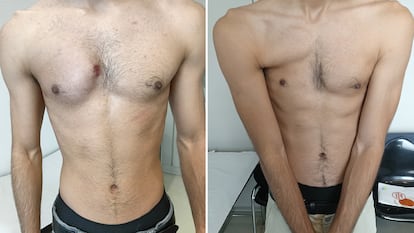
Mario is 20 years old, studies telecommunications, and was born with Poland syndrome, a rare condition that affects the development of tissues in the pectoral area: the muscle, areola, nipple, or mammary gland, depending on the case. In his case, the main alteration was the partial absence of the pectoralis major muscle. Functionally, he was fine. He could lead a normal life, but he always had a depression in his chest.
“With clothes on, it was hard to see from the outside. In some photos, you could see the raised area, like when a sweatshirt made a small indentation. People didn’t notice it; you had to look closely. But I could see it,” he says.
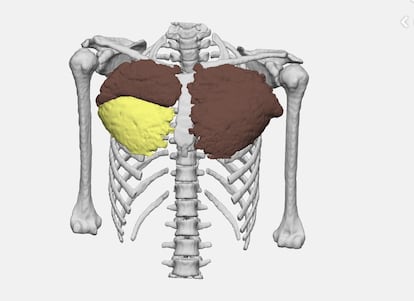
The plastic surgery team at the Gregorio Marañón hospital has used the center’s 3D printing unit to accurately reconstruct the anatomical defect for the first time: taking the healthy pectoral muscle as a reference, generating its mirror image, and comparing it with the affected side to determine the missing volume and the shape of the correction.
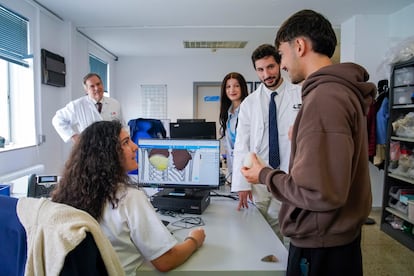
“The 3D unit has allowed us to create a perfect and exact mold of the muscle defect. And with this, we have adapted a commercial prosthesis so that it fits perfectly,” says Juan Cámara, lead surgeon in the operation.
Poland syndrome affects one in every 30,000 children. It is common enough that the Gregorio Marañón Hospital sees at least one case almost every year. “It’s sometimes not noticeable in childhood. It becomes more apparent with development, when the muscles take their final shape,” explains José María Lasso, head of the plastic surgery department at the hospital.
Mario remembers knowing from a young age that he was different. It wasn’t a traumatic realization, nor was there a specific experience that marked him, but from adolescence onward, he began to wonder if it could be corrected. “Around 15 or 16, when you start to worry more about your physical appearance, I thought about whether I could fix it somehow,” he says. At first, he was told to wait, that it was best not to intervene until he had developed more. Then came the consultations, the options, and the decision.
There were three possible solutions. One was to fill the depression with his own fat. This wasn’t a good option for Mario: he’s thin, and there wasn’t enough tissue available. Another option was to transfer dorsal tissue to cover the defect. From a reconstructive standpoint, this could have offered a good result, but Mario wasn’t convinced: “My problem was purely aesthetic. Removing tissue from another part of my body could make that area less functional. It wasn’t a problem that mattered enough to me to want to shift another problem elsewhere,” he explains.
The third option was an implant. And that was when a familiar problem in surgery arose: each patient’s body is unique, but the prostheses available on the market are usually standardized. 3D modeling made it possible to narrow that gap.
The medical team says that this is the key. The prosthesis offered a less invasive solution, provided it could be properly fitted. The 3D model was used to select and adapt the piece with greater precision.
The hospital is licensed to use the molds they use for testing in operating rooms, but not for implanting them in patients. That’s why they still rely on commercially available prostheses. Their next step is to obtain CE marking (a certification mark indicating a product meets high safety, health, and environmental protection requirements for sale within the European Economic Area) so they can manufacture their own prostheses, which would save a significant amount of money and allow for more customized devices.
“The industry is going to resist this, especially in breast cancer,” explains Lasso, who specifies that this technology can have many applications beyond breast cancer.
He mentions mandibular reconstructions, orbital defects, cranial reconstructions in patients who have suffered accidents or tumors, and malformations such as pectus excavatum, in which the sternum appears sunken. In some of these procedures, 3D printing makes it possible to create custom models, guides, or components that reduce surgical uncertainty. Where surgeons once had to improvise, they can now plan with almost millimetric precision.
The next step, further down the line, would be to create biological prostheses using stem cells — something Lasso believes could become a reality within a decade.
Mario’s case represents an intermediate step: it’s not yet the ideal of bioprinting, with manufactured structures perhaps one day populated with the patient’s own cells, but neither is it traditional reconstructive surgery. It marks a transitional phase between two worlds: the standard prosthesis and truly personalized reconstruction.
His surgery was in December. The recovery went better than he expected. After some initial discomfort, typical of having a foreign object inside, he says the progress was very good.
“It wasn’t painful at all,” says Mario. Mobility gradually returned with stretching exercises. The aesthetic result, which was the main goal, seems “fantastic” to him. “Going from nothing at all to having something there is already a huge step forward,” he says.
He knows that when he raises both arms, it is still noticeable that one side does not behave the same as the other. A muscle contracts, stretches, and moves; a prosthesis does not. But the difference now seems minimal compared to before. Previously, it was noticeable “in any position.”
So far, he has already noticed small changes: it is easier for him to take his top off, and he wears sleeveless shirts more often, even though a small scar is still visible — a detail that hardly bothers him at all.
Sign up for our weekly newsletter to get more English-language news coverage from EL PAÍS USA Edition









































