
Gibraltar’s monkeys eat dirt to purge the junk food tourists give them
Macaques ingest clumps of clay to help their digestive system process the sugars, fats, and dairy products from human snacks


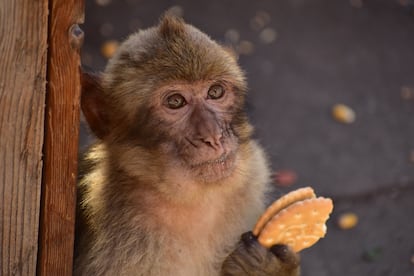
In nature, the Barbary macaque has a nearly vegetarian diet based on fruits, tender leaves, roots and an insect here and there. But on the Rock of Gibraltar, they also eat chocolate cookies, ice cream cones, M&M’s and potato chips. The result? A study published in Nature shows that the monkeys are eating dirt to purge the sugars, fats, and dairy products from this junk food tourists give them.
The 200 monkeys of Gibraltar are fed a diet similar to that of other communities in northern Africa by workers from the Gibraltar government. But, though giving them food is prohibited, many visitors to the rock still do so, and frequently. According to this new study, during up to 20% of the time the primates dedicate to eating, they are consuming the food that is either given to them by tourists, or that they steal off unsuspecting humans.
With more than 800,000 visitors (according to official figures) arriving in Gibraltar every year, the monkeys are among the area’s primary attractions. A group of researchers wanted to investigate how they were being affected by their human-altered diet. They had ample cause for concern: the majority of the new foods being given to the monkeys contain large quantities of sugar and processed fats that their systems don’t know how to process, and are low in fiber, to which their bodies are accustomed. Plus, ice cream, milkshakes and similar products contain milk and lactose, a sugar that humans (particularly those in the Western world) learned to metabolize thousands of years ago, but that other primates leave behind after weaning.
Between the summer of 2022 and the spring of 2024, during various stints in the field, the scientists observed 46 instances in which a monkey ate a clump of dirt. It’s a practice known as geophagia. Beyond human babies’ fondness for munching the substance, many species eat dirt, and for good reason. In some cases (and under the supplementation hypothesis), it is to obtain essential nutrients — especially minerals — that are missing from their regular diet. In the case of sodium, large African herbivores go where the salt is. But there is another explanation: some species use the substrate as a purgative, both for toxins and potential pathogens. Such would be the case of the monkeys of Gibraltar.
“We provide evidence of the detoxifying role of soil ingestion,” says Sylvain Lemoine, an anthropologist at the University of Cambridge and lead author of the study. “The [theory of] supplementation does not hold up, as there is nothing to indicate a need during certain reproductive stages (pregnancy, lactation) that females would need to supplement with minerals,” he adds. “Soil is readily available in the environment and may have effects that alleviate stomach pains caused by the consumption of human food,” he concludes.
The macaques have particularly been eating red dirt, an abundant clay on the rock. But they have also been filmed eating other types of earth. On some occasions, different monkeys from one community have even been seen stuffing fragments of asphalt torn from the road into their mouths. In around 20 cases, researchers were able to directly link this behavior to human food: the majority of the incidents took place between a few minutes to several hours after a monkey ate a processed snack.
A connection to tourists immediately emerged: the majority of the documented incidents involved monkeys from groups that live on the highest parts of the rock, where red clay abounds — and also tourists. Although they recorded dirt-eating cases in seven of the eight communities who live on the rock, the behavior was not observed in a final group that lives within the reserve, but in an area where visitors are not allowed.
Comparison with other Barbary macaques also reinforces the role of tourists. Reviewing the presence of geophagia in dozens of groups (some in captivity in Europe, as well as in the wild in Morocco and Algeria), cases were only found in one-third, with a low rate among the captive groups and a rare presence among the wild monkeys. “We consulted researchers and conservationists who study communities in the wild, semi-wild and in captivity to see if they had observed this behavior,” says Lemoine. “The results show that other populations rarely or occasionally are seen consuming dirt or charcoal, while those from Gibraltar stand out, due to their high rates and nearly generalized consumption,” says the anthropologist.
There are 23 species in the Macaca genus. Cases of geophagia have been observed in several of them. But there are only two cases in which they eat as much dirt as the Gibraltar monkeys: the Formosan macaques (Macaca cyclopis) and the Hong Kong macaques (Macaca mulatta and hybrids). All three have something in common: they are an attraction for both locals and tourists and have become accustomed to human food. Another piece of information may complete this panorama: they seem to have recently adopted the soil-eating practice. Today’s Gibraltar macaques are descended from individuals brought from North Africa to the rock, and on the African continent, this type of self-medication is very rare.
“Geophagia is a behavior that, despite the fact that it may seem strange, is very widespread in the animal kingdom, and is common among mammals, bird, reptiles and invertebrates,” María Carmen Hernández, assistant professor of zoology at the Autonomous University of Madrid, told SMC España. One of the cases Hernández has found most significant has been that of certain macaws and parrots, which gather in ravines to consume clay that is rich in minerals. “In this case, the intake of clay serves to provide essential minerals such as sodium,” says the professor, who is not involved in the current study. But in other animals, such as the macaques, Hernández concludes that clay “also performs functions related to digestive regulation and the neutralization of toxic compounds.”
Sign up for our weekly newsletter to get more English-language news coverage from EL PAÍS USA Edition









































