
Rafael Bachiller, astronomer: ‘This is how I imagine extraterrestrials: as tiny microbes’
The director of the Madrid Royal Observatory dreams of finding signs of life in space but laments the fact that countries are competing for control of the Moon instead of cooperating


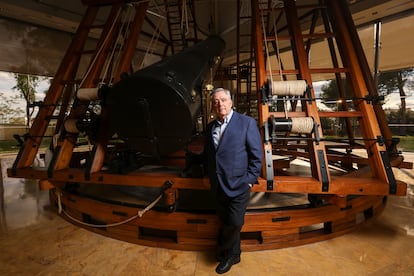
Rafael Bachiller seems far more interested in revealing all the treasures housed in the Royal Observatory of Madrid, which he directs, than in starting the interview. He enthusiastically shows off the replica of Herschel’s gigantic telescope destroyed by Napoleon’s troops, the library, and the precision clocks, acting as the best guide to this gem located in the Spanish capital’s Retiro Park. An astronomer born in Madrid in 1957, and recently awarded the Spanish Geographical Society Prize, he also heads the Eclipse Commission, which will study the eclipse that will be visible in Spain on August 12.
Question. Why did you become an astronomer?
Answer. I grew up in Arganda del Rey, a town 30 kilometers from Madrid where the skies were magnificent, incredibly dark, and breathtaking. That sparked my interest in astronomy. Now that wouldn’t be possible because light pollution has ruined those skies.
Q. Is that why you chose to study physics?
A. Yes, physics was an intermediate science between mathematics, which I was pretty good at, and chemistry, which allows us to understand what the universe and matter are made of. And that naturally led me to astronomy, which had always fascinated me. From a young age, I saved up to buy popular science and astronomy books.
Q. Did those skies disappear?
A. In Spain we still have some of the best-preserved dark skies in all of Europe and I work with the Starlight Foundation to have them certified and preserved for future generations; they have incalculable value.
Q. Which are the best places to view the August 12 eclipse?
A. It will be visible across a very wide area, from Galicia to the Balearic Islands. You need to position yourself well so that a hill or a grove of trees doesn’t block the sunset, because even if you’re on the eastern coast or in Mallorca, if you’re behind a mountain range you won’t see the eclipse. León, Burgos, Tierra de Campos... that whole area is expected to have favorable weather and good visibility.
Q. Will you convince everyone to wear safe solar viewing glasses?
A. There have always been people who lose their sight temporarily or totally during eclipses. Hospital emergency rooms are overwhelmed, and during the last eclipse in the U.S., in April 2024, the most searched term on Google afterward was “eye pain.”
Q. Eclipses do leave victims, then.
A. Yes, they do. We have to take this very seriously, and we’re going to launch an intensive campaign. You should never look directly at the sun, not even with an X-ray or any device other than certified glasses.
Q. Let’s talk about Artemis 2. What remains for us to discover about the Moon?
A. We still don’t know exactly its origin, its composition, or how the water is distributed across the surface. We know it’s concentrated at the poles, but we need to refine that knowledge.
Q. Will we ever find out?
A. We will undoubtedly make progress. It’s not essential for humans to do it on-site if robots can do it, as they can on Mars, where they are drilling into the surface to see if there is or has been bacterial activity. But the Moon’s real interest lies in establishing bases that can serve for other long-range missions and the mining of its very valuable natural resources. For us astronomers, the most valuable aspect is the far side, where we could install a magnificent observatory with no light or radio pollution. The far side is the ideal location for this.
Q. What would be your dream for scientific advancement in your lifetime?
A. I would love to see signs of complex amino acids on any of the discovered exoplanets, never mind any sign of life. We are getting closer and closer to finding a type of life that I imagine will be primarily microbial, because the history of life on Earth is a history of microbes. The appearance of complex beings is very recent, but for 4 billion years life has been microbial. That’s how many astronomers imagine extraterrestrials: as tiny microbes. I hope that one day we will see them, absolutely.
Q. What would finding amino acids mean?
A. It’s the basis of life, the precursor molecules, and we’re taking it step by step. Sugars and some simple amino acids have already been discovered in meteorites, but discovering complex molecules, those capable of reproducing, like DNA, that marvelous double helix that unwinds in two, which is the basis of life, would be a wonderful achievement.
Q. Do you think you’ll see it?
A. It is possible to see some signs, yes. The most promising places to find life in the solar system are not on Mars but on the icy moons of the giant planets, where there is an icy crust and underneath there are liquid seas where life can thrive.
Q. How do you see the struggle between powers over the Moon?
A. I feel very sorry because planetary exploration should be a mission for all of humanity. It’s unacceptable that the Moon should belong to the richest country. I wish that instead of exporting our terrestrial rivalries to space, we could build a space agency for everyone to accelerate our conquest. It’s regrettable that when the Orion spacecraft was behind the Moon, we lost 40 minutes of communication when China has spacecraft that could have facilitated it. It wasn’t done. And it was entirely feasible.
Q. And while we watch that progress, on Earth we are destroying ourselves.
A. It’s an incomprehensible paradox, just as I don’t understand at all the U.S. president’s rhetoric when he speaks of humanity’s achievement on the Moon while simultaneously maintaining an ultranationalist rhetoric about a Greater America on Earth. It’s contradictory and regrettable. Space exploration should be a unifying element among nations, inspired by scientists who are capable of collaborating more efficiently than politicians. We only have to look at Antarctica, where this collaboration works.
Q. Trump takes credit while cutting NASA budgets.
A. Some very significant cuts that, fortunately, Congress has been holding back. But now they are threatening the 2027 budget again, by around 30%.
Q. Do you like space movies?
A. A lot. The one I like the most is 2001: A Space Odyssey. They have nothing to do with real science, but for example Interstellar was very respectful of science because they got very good advice by a great expert on black holes.
Q. Would you like to go into space?
A. I’ve never considered it because my physical condition wouldn’t allow it, but it’s possible to go out into space through an observatory, on those magical nights of observation where one scrutinizes the farthest reaches of the universe. There, you’re already venturing into space in a different way, intellectually.
Q. Your wife and two daughters are also physicists. Do you talk about stars and microbes on Christmas Eve?
A. One of my daughters is a nuclear physicist and the other one is a particle physicist. One works at CERN in Geneva and the other has been at the particle accelerator in the Louvre, which works like a giant microscope and can detect art forgeries. We argue a lot, especially at Christmas; the conversations are usually exhausting (laughs) because we’re all very rational and try to push reasoning to the limit.
Sign up for our weekly newsletter to get more English-language news coverage from EL PAÍS USA Edition









































