
What is ‘tai chi walking’ and what can it do for your body?
This discipline blends this unhurried martial art with mindful movement and offers major benefits for aging bodies
Since late 2025, and continuing to this day, if you’re over 40 and spend any time on Instagram, you’ve probably come across him: a shirtless man with implausibly defined abs, standing in a picture-perfect Japanese garden, performing slow, graceful movements while a voice-over promises that you, too, could achieve that body by practising tai chi for 15 minutes a day in your living room.
The muscular man is an AI-generated image. The company behind the campaign was MadMuscles, a fitness app owned by a Ukrainian company based in Nicosia, Cyprus, that has been widely criticized for deceptive practices. Yet amid the marketing noise and impossible abs, there is something real: tai chi walking exists, it has centuries of history behind it, and science supports it with solid evidence. Just not in quite the way it was being sold.
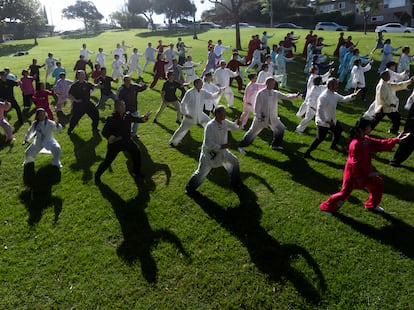
Tai chi walking is not an influencer invention. It was developed centuries ago as part of the martial and internal training traditions of classical tai chi. What social media has popularized is its most distilled form: a slow, deliberate and mindful walk that demands complete attention to every element of movement — how the foot touches the ground, how weight transfers from one leg to the other, how the spine remains upright, and how breathing is coordinated with each step.
The difference from ordinary walking is fundamental. When you walk normally, you generally rely on momentum; in essence, you fall forward and catch yourself with the next step. Tai chi walking removes that momentum almost entirely. Every step becomes a self-contained act of balance.
Marie Claire dubbed it the successor to the “hot girl walk,” the previous trend that revolved around striding out with confidence and attitude. The comparison is both accurate and amusing: where that trend was about energy and pace, this one is about radical slowness. At first it feels strange, even uncomfortable, as though the body is protesting against the absence of haste.
The benefits are backed by decades of research, but they are not the ones promised by the advertisements featuring the muscular man. A randomised controlled trial published in JAMA Network Open in 2024 assigned 342 people with prehypertension to two groups: one practised tai chi four times a week, while the other engaged in conventional aerobic exercise.
After one year, the tai chi group had reduced their systolic blood pressure by an average of seven points, compared with 4.6 points in the aerobic exercise group. The practice — which resembles a slow-motion dance — proved more effective than jogging at lowering blood pressure. And that conclusion comes from JAMA, one of the world’s most prestigious medical journals.
Research published in the Annals of Internal Medicine adds that practising tai chi twice a week for six months improves cognitive test scores by 1.5 points. Multiple reviews, including one by Harvard University, have also confirmed improvements in balance and fall prevention among older adults — arguably the most important and least glamorous benefit of all.
What tai chi walking does not do is make us look like the man in those advertisements. The promise that it could replace CrossFit is every bit as fanciful as the AI-generated images used to sell it.
What it does do, according to the scientific evidence, is improve movement quality, reduce stress and lower blood pressure. For someone over 40 whose joints already have a bit of mileage on them, that is no small thing.
The practice is 2,000 years old. The marketing, thankfully, is much younger.
Sign up for our weekly newsletter to get more English-language news coverage from EL PAÍS USA Edition









































