
Adults who collect children’s toys: The Labubu phenomenon exposed
These collectibles, sold in blind boxes and the successors of the famous Sonny Angels, have sparked a craze among consumers aged 15 to 40. Some observers claim their success is due to the fact that they are a way of escaping the chaos and confusion of the modern world
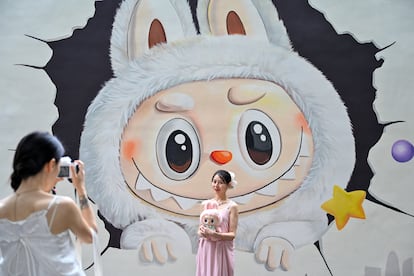

The pace is dizzying. We hadn’t even fully gotten our heads around the Sonny Angels when we were swept away by the Labubu, hairy elves with nine teeth — having more or less is the definitive sign that it’s a fake, like the ones circulating on Amazon, reveals Cynthia Pavón, a 24-year-old collector living in Miami. She buys hers in a physical store because falling for a fake Labubu — lafufus, she calls them — is “a humiliation.” To ensure authenticity, many people order theirs directly from the Pop Mart website, the Chinese company that created them in 2015 and sells them starting at $14 (although some can resell for several hundred). But then they’ll have to wait for shipping, and live with the fear that by the time the package arrives, Labubus will have gone out of style and there will be another cute collectible to chase by land, sea, and air.
“It could happen,” Pavón acknowledges in an Instagram post. “There are too many Labubu, they’ll soon stop being a status symbol.” There’s even speculation that they could be displaced by Crybaby — also from Pop Mart — dolls with big, tear-filled eyes that have embarked on a very similar path to success: Lisa, from the K-pop band Blackpink and star of The White Lotus, was seen with a Crybaby Cherry hanging from her Louis Vuitton bag. The Chinese company’s insistence on partnering with the French luxury house is the inspiration for a very popular Reddit forum: “My original Labubu in my fake Vuitton.”
No one knows exactly where these fads come from, how long they last, or why their fans are the most ungrateful and unfaithful collectors in history. In 2003, the economist Margo Bergman of the University of Houston studied the phenomenon of objects that inspired these global consumer crazes: they are products that many people become familiar with even if they’ve never bought them, which makes it easier for them to become popular very quickly, but only for a very short time. More than 20 years have passed, and Bergman assumes that social media and their algorithms have accelerated the entire trend cycle. “In 2003, a fad took months to start and lasted for several years. Now it can start in a matter of days and die before the first year,” she explains via email. She offers the example of spinners from 2017. “In terms of peak sales, the craze only lasted six months.” Technology “causes new developments to accelerate their pace to maintain their level of usefulness,” which “leads to a much shorter lifespan for trends.”
The Labubu dolls are the latest in a long line of iconic Asian collectible characters, which include Hello Kitty, now a 50-year-old veteran, Sonny Angels, and Gudetama, the apathetic egg yolk. Bergman points to other changes that have taken place over the past two decades. “In the 1980s and 1990s, these trends grew during gift-buying seasons for others,” such as Christmas. “Now, young people and adults consume them for themselves and at any time of year. I think it’s due to greater access to money or, perhaps, a greater willingness to go into debt for frivolous items.” A quick internet search for a product also leads to thousands of options for splitting payments. Not only is there more willingness to go into debt, but it’s also very easy to do so in just a few minutes.
It’s very likely that Labubu dolls will soon exhaust their upward trend of success and begin their free fall, but what won’t change with the next cute gadget that comes along is the distribution strategy of surprise boxes, which are bought without knowing what doll is inside. Forget about buying like an adult and checking the product before shelling out the cash. These toys are bought with faith and with the box sealed, in a sales technique that has also been widely used in the toy sector, as happened a few years ago with L.O.L. Surprise dolls.
The strategy of these blind boxes has so captivated the digital-savvy and presumably sophisticated subject that if we’ve learned anything this season from Sonny Angels and Labubu, it’s that the next whim will also come from China, it will be collectible, and we’ll buy it in a physical store, standing in line, and completely blind. Anyone who wants a complete series will have to pay and shake box after box, sigh at each duplicate, and pray that the next one will bring the desired creature. The convenience of traditional e-commerce already bores us to death. We want trouble.
In 2019, Pop Mart surveyed more than 1,000 consumers and found that around 70% of collectors would buy more than three blind boxes to get the specific figure they were missing. “Blind boxes encourage repeat purchases,” the Chinese company wrote in a 2020 report for potential investors.
Experts call it Gamblification because the dopamine rush generated by the ritual is quite similar to that produced by gambling addictions. It is also not, by any means, a practice reserved for children and teens. Adults are the most important part of this pie. The aforementioned report also states: “While traditional toys are primarily for children, pop toys (referring to Labubu and similar products) are aimed at young adults between the ages of 15 and 40 who seek emotional value through the expression of their attitude and personality.” According to the technology consultancy Circana, adults in the United States are buying more toys than ever. In the first half of 2025, the number of toys purchased by adults grew by 18%, and in 2024, adults bought more toys for themselves than for preschoolers for the first time. In the UK, nostalgia is driving adults to Lego and Pokémon, and sales to adults have increased by 8% so far this year. This trend is also set to outlast the Labubu. Observers of the phenomenon have coined the term “kidults” for consumers over 12 years old and define them as “adults who buy children’s things to escape global chaos.” In Trump’s America, talking about Labubu is a neutral ground for avoiding thorny political discussions within families. “Crises, eco-anxiety, corruption, misinformation... The present is so overwhelming that we want to return to a controlled environment with simple rules like games and childhood... There’s a feeling of not wanting to grow up,” says Javier Montañés, Director of Strategy at the design studio Invisible, who defines himself as “a 48-year-old gamer,” via text message.
And we’re betting the next fleeting artifact will also be Chinese because the country’s ruling Communist Party has hailed Labubu as “a victory over the West.” According to the Xinhua news agency, Labubu showcases Chinese appeal and creativity in a language understandable to the world and offers everyone the opportunity to experience “cool” China. And on China’s vast and competitive internet, there are plenty of global creatures to flood the West, without it ever requiring a government effort. For those expecting their Labubu in September, we wish the god of digital acceleration be with you. With divine help and a little luck, you’ll be able to show off your nine-toothed elves for a few more weeks.
Sign up for our weekly newsletter to get more English-language news coverage from EL PAÍS USA Edition









































