Russian bombs bury songs and the memory of Kyiv when ‘the dance floor was packed’
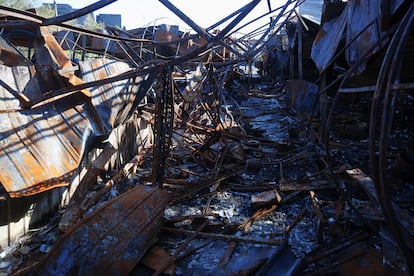
Vadym Glynarskyy’s collection of 25,000 vinyl records lies destroyed by fire at the Pochaina flea market, which was attacked three times this summer
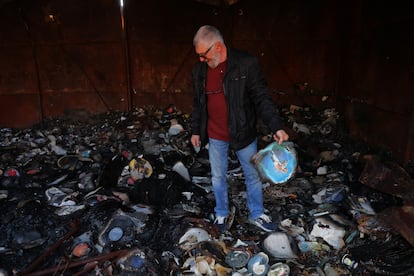

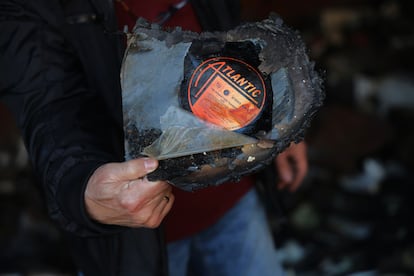
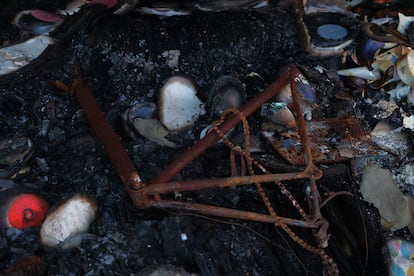
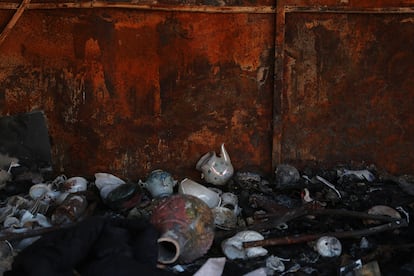
“Look, this one was by Manhattan Transfer.” Vadym Glynarskyy, 73, throws onto the scorched ground the remains of one of the 25,000 vinyl records from his collection that he estimates were ruined in a Russian bombing of the popular Pochaina market in Kyiv. “War is a disaster,” he laments as he surveys the desolate scene of dozens of businesses gutted by fire, including his own. He points out charred metal objects that only he can identify: a speaker, a mixing console, a turntable, an amplifier… even the frame of a bicycle he says was ridden in the 1978 Tour de France and had been given to one of his sons as a gift. In his assessment, the trader adds several thousand CDs and hundreds of cassette tapes that were also lost.
Glynarskyy’s footsteps over the blistered plastic mound of records are accompanied by a distinctive crunch, a sound different from the usual carpet of shattered glass or fallen leaves scattered across the ground after explosions. But almost immediately he returns to the front of his makeshift stall on a camping table at street level, standing before the ruins.
That said, the box where he sells his records no longer contains the prized items he used to proudly display until everything blew up on July 30. That day was the second of three missile attacks launched by the Russians in a few weeks. “I had autographed vinyl by The Doors, Led Zeppelin, Donna Summer, Toto Cutugno, Chicago, Spyro Gyra, Kool & the Gang, Diana Ross, Scorpions and others,” he lists with a grim and resigned expression.
He recalls that at 18 he obtained his first signed record: Duke Ellington’s, when Ellington performed in Kyiv during his Soviet tour in 1971. “I spoke with him at the Hotel Moskva. He signed the record I had and gave me another one that he also signed. A few days later I traded them for a pair of Levi’s jeans, which at that time in the Soviet Union cost far more than two signed records,” he adds with a mischievous smile.
His love of music goes back to early childhood. In 1959, aged six, a friend of his father’s, also from a Jewish family like his, returned from the United States with some records by The Barry Sisters, who sang in Yiddish. At night, with a Radiola transistor radio, he began to breach borders while tuning across the dial: the BBC, Radio Luxembourg, Voice of America and other stations “with great songs that drove me crazy.” “We had English classes at school, so I gradually started to understand,” he adds.
In 1968 he was in a supermarket with his parents when he noticed a man and a woman “wearing clothes unlike ours.” “I wondered if they were foreigners. He was holding a small record on which I read: The Beatles.” He still shows some emotion recounting how the stranger let him touch it because he was surprised that someone so young knew them. It was the soundtrack album for Magical Mystery Tour. He remembers well that it was not until about a decade later that he could buy it.
That was when he began to frequently visit a record shop near his home on the central Khreshchatyk street in Kyiv. Seeing him so often, the shop owner eventually offered him a job, and he stayed there for almost the entire 1970s, until 1980. During that time he not only expanded his musical knowledge and his collection, but also became known in the cultural circles of the Ukrainian capital. Many of his records came from foreign students who arrived in the USSR. “I was aware of everything,” he says.
After marrying, in 1978 he became a DJ at a nightclub, the Goldfish. “The dance floor was packed,” he recalls fondly. But political pressure and propaganda prevailed and they closed it two years later, he laments. “You’re Jewish and cosmopolitan,” agents used to tell him, he says.
“The truth is I was a dissident back then,” he admits. By that time he had become an expert in fartsovka, the Soviet black market trade in foreign goods that were hard to obtain, or even banned. “Certain clothing, perfumes, appliances, cultural products, and other Western items,” he cites as examples. If the police caught him, Glynarskyy explains, he would sweet-talk them and give them part of his merchandise for free. That is essentially what he did after he lost his job in 1981.
Later, in 1985, Perestroika, the movement pushed by Mikhail Gorbachev that led the USSR toward dissolution in 1991, began. In 1986, Glynarskyy traveled abroad for the first time and set foot in West Germany. “It was another world: people smiling in the streets, the possibility of buying whatever you wanted, and cheaply,” he recalls.
Drone factory
Two decades have passed since the vinyl collector settled in Pochaina. The market was attacked three times in a few weeks in summer: June 15, July 30 and August 16. Established three decades ago, it was best known for its dozens of book stalls, both old and new.
Most were completely devoured by the flames. Among the twisted metal lie charred paper remains or copies splashed with firefighters’ water and intact volumes, but covered in ash. The breeze spreads the putrid smell of desecrated culture across a scene that remains almost exactly as it was on the day of the bombing.
A little further on from where the book area used to be, the flea market begins where Glynarskyy and many other traders had stalls selling all kinds of goods: clothing, footwear, porcelain, furniture, military items and uniforms, paintings, postcards and photographs, Soviet memorabilia, musical instruments, food, radios, cameras, tools, toys… There are even vendors selling used dildos or objects bearing Nazi symbols and characters. An attraction that, since the Russian invasion began in February 2022, barely draws local citizens.
But despite the war and the attacks, activity resists disappearing on weekends in Pochaina, the market named for the metro stop where it is located. Stalls still abound on both sides of the street, like the one that houses Glynarskyy with the vinyl he has left, offering merchandise so diverse and unusual that it catches the eye of even the most seasoned flea-market visitor.
Nearly 10 million books were destroyed between June and July in attacks on different warehouses. On October 7, in Kyiv, facilities of the publisher Knyholove were hit by a missile strike. That same company had suffered an attack on July 19 and had moved tens of thousands of volumes to these other facilities that were spared then but did not survive the second strike.
In total, 2,138 cultural heritage sites and 2,640 cultural institutions have been damaged or destroyed in Russian attacks since 2022, according to figures from Ukraine’s Culture Ministry published last September. By region, most heritage sites affected were registered in Donetsk, with 369; Kharkiv, with 358; Kherson, with 304; Kyiv, with 272; Odesa, with 212; and Zaporizhzhia, with 115.
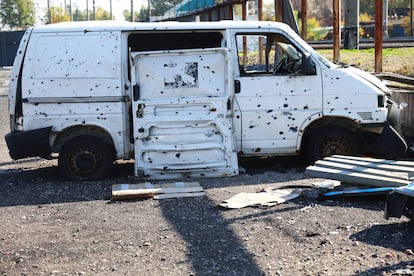
At the Pochaina market, next to a guitar seller, you can still see the impact mark of one of the projectiles on the asphalt. The blast sent countless shrapnel pellets at a van parked about 20 meters away, leaving its bodywork like a colander.
A wall lines the opposite side of the street. Behind it rise the flame-devoured remains of a large warehouse. It housed a drone factory, and everything points to that being the Russians’ actual target, sources close to EL PAÍS confirm. Local authorities rarely provide information or confirmation about strikes on military facilities or defense industry sites. The market is widely discussed. This other facility is not.
Sign up for our weekly newsletter to get more English-language news coverage from EL PAÍS USA Edition