
The desperate effort to send food via drones to a Ukrainian city starving under Russian occupation
Residents describe what it’s like to survive in Oleshky without supplies, surrounded by landmines and under the threat of drones, before managing to make a ‘life or death’ escape
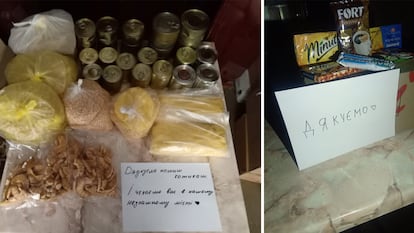

“Thanks to our beloved soldiers. We await you in our unbreakable city,” reads a handwritten note beside cans and other foodstuffs received to stave off hunger in Oleshky, a city occupied by Russia. “Thank you,” echoes another note next to a shipment of coffee, herbal teas, and chocolate bars. Photos of these messages and others showing various tokens of gratitude have reached the phone of Roman Chuhalov, 44, one of the Ukrainian servicemen who, by sending aid with drones, are trying to break the blockade in this town in the southern Kherson region, where about 2,000 people are holding out.
It is a city devastated by the conflict and by the 2023 floods caused by the collapse of the Nova Kakhovka dam. It is littered with mines and lacks essential supplies such as water, electricity, and heating on the cusp of a new winter. That combination has produced a severe humanitarian crisis and alarmed the international community. Getting in and out is complicated and dangerous.
Local authorities loyal to Kyiv who were consulted say neither the International Committee of the Red Cross nor the UN have been able to enter the city or open humanitarian corridors. “Residents are eating dogs, cats, or pigeons,” Chuhalov laments in a conversation with EL PAÍS in the city of Uman.
On his phone, which he takes from a uniform pocket, the serviceman stores horrific scenes that he shows the reporter to lend credibility to his account, such as a dog carrying part of a man’s head. His screen also shows the corpse of Fedir, born in 1953, whose body was collected from a street in recent days. He says they photographed him with his papers on his chest so authorities could certify his death remotely and add his case to investigations of crimes committed by Russia. Residents, Chuhalov explains, have marked the garden of the house where Fedir received a provisional burial.

Other testimonies collected for this report from people who managed to escape Oleshky also describe nightmarish scenes. Svitlana and her husband Oleg, 60, resisted leaving until the situation became unbearable. Their flight, five months ago, turned into a race “between life or death,” avoiding mines and Russian forces, they say by phone from a city they prefer not to name for security reasons. They are still in shock and suffer from afar over the fate of their former neighbors.
Those who remain there today try to keep contact with the outside despite the difficulty of finding coverage on Ukrainian phones and the danger of the Russians finding out. To communicate, “they have to climb trees or roofs,” says Chuhalov, a member of the 34th Marine Infantry Brigade.
Kyiv authorities have in recent days made two four-ton deliveries by drone. They fly in the dead of night to try to evade Russian forces. One took place on September 27; the other on October 4.
The first aid shipment did not reach its recipients in full: part of it ended up in the hands of the invading troops. The second — about 400 packages — was distributed: food, medicines, and baby supplies. On the return trip — which once again highlights the deep regard Ukrainians show for pets — one of the drones managed to bring back six cats in a cage.
“For months, Russia has been trying to isolate Ukrainians in Oleshky from the outside world, even obstructing the delivery of food to people facing severe shortages,” Ukrainian Foreign Minister Andrii Sybiha denounced on Sunday.
“There are problems distributing food and medicine. The Kyiv regime is doing everything possible to hinder these deliveries. There are drones flying constantly over the area, causing deaths,” Kremlin spokesman Dmitry Peskov claimed two weeks ago. That version of events has been partially challenged even by independent Russian outlets such as The Insider, which, while acknowledging the humanitarian crisis, adds that Oleshky is under Russian authority, surrounded by Russian checkpoints, mined, and subject to constant drone flights by both sides.
Alongside the two mentioned aid operations, smaller-scale efforts are underway to ensure that food shipments reach the exact addresses requested by recipients. A sort of wartime Amazon.
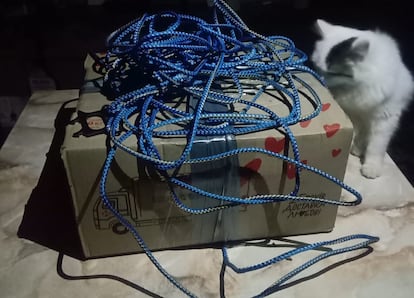
To achieve this, contacts and informants inside Oleshky that servicemen like Chuhalov — a native of the town — have provide the exact coordinates where the drone must deliver. The drones fly to that point and lower cardboard boxes of food by rope. Once received, recipients photograph themselves with the thank-you notes and messages of encouragement.
Human shields
The roughly 2,000 people estimated to still be in the city represent about 10% of the population that lived there in 2022, when Russian troops occupied it on February 24, according to Tetiana Hasanenko, director of the Ukrainian military administration of the city, who has lived outside it since the start of the invasion. She is particularly worried about the estimated 35 to 37 children she has identified.

The city lies almost on the banks of the Dnipro River, near its mouth, and is only 2.5 miles from Ukrainian positions in the city of Kherson, the regional capital. The large river, however, is a powerful natural ally of the invaders, who control the left bank. Ukrainian troops have tried, without success, to overcome that obstacle on numerous occasions, even with commando operations using small boats. The two bridgeheads they tried to secure in 2023 ended up falling. One was located at the level of Oleshky.
Chuhalov, who acknowledges that he can see his own home through the drones’ cameras, claims that Russian troops are setting up camp among Ukrainian residents to gain access to food from their basements, vegetable gardens, and the supplies being delivered to them. They are also using these residents as human shields, as Svitlana and Hasanenko explain. In this way, Kremlin forces seek to prevent a counteroffensive by Kyiv, which will avoid putting its own civilians in danger.
Videos, almost always recorded from the air, frequently appear showing people moving through the city despite the danger of mines. Some of these scenes show corpses, and Hasanenko reports two deaths in recent days.
Svitlana and Oleg say they saw dogs devouring human bodies several times. They had kept the keys to about 10 houses belonging to acquaintances who had left. They remember how, on one of the days they rode a bicycle to feed those neighbors’ dogs and cats, they saw a dog eating the remains of what they believe a Russian soldier. “Don’t look,” Oleg told his wife. “Why shouldn’t I look? It’s just pieces of meat,” she snapped, dismissing the remains. “How can they not even take the bodies of their own comrades?” Svitlana asks.
The couple pins the turning point to September of last year: since then it has become untenable to stay in Oleshky. To the humanitarian crisis and the mines — which have even been planted in playgrounds, they stress — has been added the constant drone activity at all hours. Many residents’ vehicles lie in the streets, wrecked by those drones. “You’d walk down the street and a drone would fly at face height. You can imagine: horror,” she recalls. “It could have been the last moment of our lives.” Her description matches that provided by the Russians.
A meeting in the diaspora
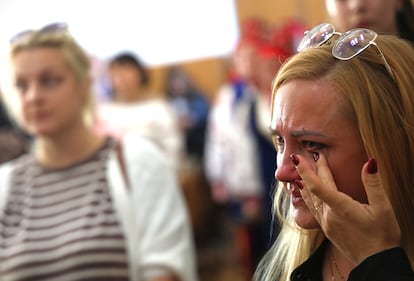
The city of Uman, midway between Kyiv and Kherson, hosted a festival last Saturday to honor Oleshky and its citizens, attended by some members of its diaspora. There were tears, hugs, tributes, songs and patriotic exaltation with the Cossack warlike ardor as a banner. Between 3.7 and 3.9 million Ukrainians, nearly 10% of the country’s total population, live as internally displaced people within the country’s borders, according to the International Organization for Migration (IOM). Fifty-nine percent originate from areas occupied by Russia.

Svitlana and Oleg could not attend the festival in Uman, but they use the interview to call on the international community to intervene in Oleshky. Both lost their mothers in recent months before escaping. They believe they did not survive the harsh living conditions. They regret not having been able to say goodbye to them at the cemetery amid the chaos of a dangerous escape operation like the one they experienced. They say the vehicle that took them out could not go above second gear because of the large number of explosive devices on the road.
They spend several minutes of their long testimony remembering and honoring as heroes the two men who risked their lives so they could leave Oleshky in their vehicles. It took place on May 1, after an earlier attempt. They were traders who, for several months, had come to sell their goods when there was barely any food left in the city. They recount a “terrible” journey through localities controlled by the Russians.
Now safe, in territory under Kyiv’s authority, Svitlana and Oleg follow their city’s news from afar as much as they can. That is how they learned that on June 2 those two vendors were victims of an explosion at the entrance to Oleshky. Both died. “They were the ones who saved our lives. We cried for two weeks.”
Sign up for our weekly newsletter to get more English-language news coverage from EL PAÍS USA Edition









































