Operation Comeback: Rhian and Julia’s push to deliver victory for Lula and Brazil’s left
After the disappointment of the first round, two history students are working to persuade undecided voters and defeat Bolsonaro on Sunday
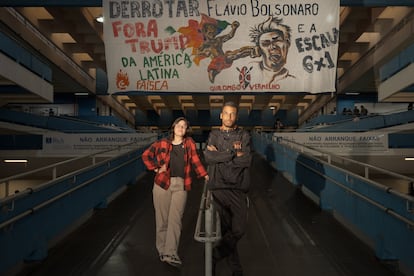

They went into the first round of Brazil’s presidential election full of optimism. They were enormously confident that the veteran Luiz Inácio Lula da Silva would secure a first-round victory. In fact, even an outright win did not seem far-fetched to them. But election night on October 4 ended in colossal disappointment for 23-year-old Rhian Silva, for Julia de Oliveira Szöke, 25, both history students, and for the Brazilian left as a whole. Shocked, Silva allowed himself only a brief period of mourning before springing into action after Lula called for mass mobilization.
“The first thing we told ourselves was: ‘We can’t give in to panic or despair. There are almost three weeks left. Let’s go for the comeback,’” Silva recalled on Wednesday at the campus of the University of São Paulo (USP), a public institution and one of the best universities in Latin America.
Winning means preserving the social gains achieved under the Workers’ Party (PT) governments. For Silva, it is a personal matter. “I am a direct product of those public policies. Whether I like it or not, I owe a debt” to Lula. Only a few years ago, someone with his background would have been the exception here.
Like millions of Brazilians — some working through political parties and others independently — Silva and Szöke have thrown themselves into the comeback effort: winning over new voters to secure Lula another term on Sunday. It is a mission that these close friends, who met at university and became both confidants and student activists, are pursuing in the real world, among friends and acquaintances, and on social media.
They are working independently. And Silva sees the campaign in distinct stages. The first step was for left-wing activists to convince themselves that a comeback was possible and to map out a strategy. The first conclusion: “Trying to persuade a Bolsonaro supporter is a waste of time. That vote isn’t going to change.” The second step was to sharpen the focus: “Those people who are uncomfortable with polarization and who didn’t vote out of apathy.” The goal was to find potential supporters among the 33 million Brazilians who abstained. Lula stressed the importance of paying particular attention to voters over 70 and teenagers aged 16 and above, who have the right, but not the obligation, to vote.
Then came a painful realization: a strategic mistake. “I realized I was very disconnected from people who aren’t on the left, from people who didn’t go to university,” explains Silva, a future history teacher who grew up in a poor household with his mother, grandmother and three siblings in Cachoeirinha, a working-class district on the outskirts of São Paulo. He got into this faculty from a public school thanks to Brazil’s racial quota system. It transformed his life. The academic transition was difficult, but the payoff was immeasurable. Horizons once limited to the boundaries of his neighborhood expanded almost without limit.
It is a background shared by millions of Brazilians like Silva, and very different from that of his friend Szöke, whose surname is one of those Hungarian names that seem impossible to spell. She comes from an agricultural town in Brazil’s interior, from a middle-class, right-leaning family. “I’m the little red dot in the family,” she says with a smile.
Over these past three weeks, Silva has campaigned among relatives, canvassed for Lula on the streets of Barueri, a city in the São Paulo metropolitan area, and taken part in several campaign events that provided a boost to progressive morale: the sea of red that filled Paulista Avenue and a rap concert “in defense of democracy and against regression” in a favela featuring Emicida and Karol Conká.
The overall assessment is positive. But unlike his friend, he has no confirmation that his efforts have translated into new votes, only hope. Szöke, by contrast, scored an unexpected win. “My mother, which really surprised me because she’s a classical liberal. Over the years she’s listened to me talk about how the far right comes here, to the public university, to harass us. And then one day she suddenly tells me she’s going to vote for Lula,” she says, visibly moved. A health problem prevented her from going out to canvass for voters, so she threw herself into the digital campaign instead. There is an army of seven million WhatsApp users, the Lula Army, mobilized by a sympathetic congressman who, the student explains, has exposed how the algorithm favors the right.
A degree from USP is an excellent calling card. Thanks to the affirmative-action policies introduced by the Workers’ Party, the young people crossing the faculty grounds look far more like real Brazil than the lawmakers in Brasília. In the central courtyard, a large banner calls on voters to “defeat Flávio Bolsonaro.” Nearby, a notice from the university administration reminds students that, out of respect for all opinions, campaign posters must not be torn down.
Shaken by the election setback, Silva, the eldest of his siblings, began talking politics with his family again. For years he had considered it either a waste of time or an unnecessary source of stress. He was pleased to see that the recently approved law guaranteeing workers a second day off turned abstract politics into something tangible for his mother and siblings, who work six days a week and have only one day off. Thanks to the new law, they will have more free time.
“I think the end of the six-days-on, one-day-off schedule [or 6x1 schedule as the reform is commonly known] was decisive for them,” says the student, who spends six hours a day on public transport commuting between home, university and the school where he is completing a paid teaching placement. “They came to see that Lula made it happen and that Flávio Bolsonaro is a threat to it.”
Respectful of their privacy, he has not asked his family how they plan to vote on Sunday. But he does point to one encouraging development that sustains his hopes: “Now my mother reposts on Instagram what I share about the 6x1 schedule.”
Both Silva and Szöke believe it is crucial, and “a success,” that the Brazilian left’s message now revolves around labor rights, purchasing power and pensions. They see the defense of minority rights as non-negotiable. Silva is gay and Szöke is a lesbian, and they met through the LGBTQ+ student orientation group. But they acknowledge that this is not the most effective battleground on which to take on Bolsonarismo. Nor is Lula their ideal candidate; both place themselves well to the left of him.
“We’re critical of the Workers’ Party, but right now we’re focused on what’s possible, on what’s feasible,” says Szöke. They believe that, in the current emergency, he is the best option for preventing the Bolsonaros from returning to power.
Silva admits that persuading his grandmother is a far greater challenge. “She’s 78 or 79 and hasn’t voted in a long time. My biggest challenge is simply getting her to vote. She’s convinced that no matter who wins, things will stay bad. She’s afraid of putting her faith in someone only to be disappointed. I want to show her that there is a difference between the two candidates and that her vote matters.”
To pollsters, his grandmother embodies a nightmare scenario: the swing voter. “She changes her mind in the heat of the moment. If something extraordinary happens on Friday or Saturday, she’ll change her opinion again.”
Both are acutely aware of the scale of the challenge. They know that no candidate in Brazil has ever won the presidency after losing the first round. But the prospect of the Bolsonaros returning to power, and “dragging Brazil back into obscurantism,” has sparked a wave of left-wing mobilization unlike anything seen in years. They have not lost hope. They say comeback victories taste sweeter, just as they do in soccer. On Friday, they will watch the Bolsonaro-Lula debate with their hearts in their mouths.
They still have not decided whether they will spend election night together. It depends on how things unfold between now and Sunday. They would love to celebrate a victory side by side, but if defeat comes, they are not sure whether they would rather grieve alone or with company.
Sign up for our weekly newsletter to get more English-language news coverage from EL PAÍS USA Edition