
Lula cuts Flávio Bolsonaro’s lead to two points as Brazil election remains neck and neck
With just over a week to go until the polls, the president is trailing the senator 49% to 51%, according to Datafolha

With just over a week to go until Brazil’s closely contested presidential election, the picture remains much the same as it has for months: a dead heat.
A Datafolha poll released on Thursday shows a slight gain for Brazilian President Luiz Inácio Lula da Silva, narrowing the gap with frontrunner Flávio Bolsonaro from four points to two. The far-right senator stands at 51% of valid votes, compared with 49% for the president. Another poll, by Quaest, painted a similar picture the previous day, with different figures: 47% to 45%. Lula’s campaign has accused tech giant Meta of favoring Bolsonaro on both WhatsApp and Instagram.
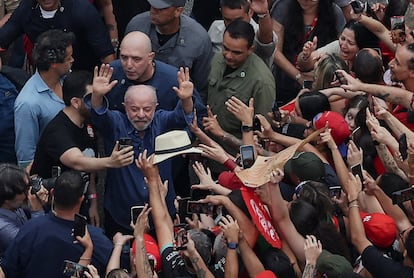
The left has spearheaded an unprecedented mobilization since Sunday, when it filled São Paulo’s Paulista Avenue with a sea of red. In the days that followed, it drew large crowds in Rio de Janeiro and other cities. The digital campaign has also intensified, with the addition of many young influencers from the progressive orbit. Meanwhile, the president has continued announcing high-impact measures, such as a one-time payment of 5,000 reais (nearly $1,000) to every micro-entrepreneur and free weekend bus services.
In an interview with the Brazilian newspaper O Globo on Thursday night, the president voiced support for lowering the age of criminal responsibility from 18 to 16 for the most serious crimes, including homicide, robbery resulting in death, and rape, among others. His opponent favors a broader reduction to 16, and to 14 in the most serious cases.
Lula also acknowledged that responsibility for the election results rests with him. “Look, I am the government. If I have not managed to make people understand the government I have delivered, I cannot blame anyone else; the fault is mine,” he said.
Meanwhile, the left-wing candidate’s team alleges that since the campaign began, “President Lula’s accounts on the company’s [Meta] platforms have experienced technical failures” that have harmed his visibility. The technology company, led by Mark Zuckerberg and owner of Instagram, Facebook, and WhatsApp, has been accused by the Workers’ Party of showing favoritism toward candidate Bolsonaro.
Internet users discovered on Wednesday that WhatsApp’s AI appeared to be blatantly favoring Bolsonaro. When asked to create a campaign poster supporting Lula, it responded: “I couldn’t generate the image you requested.” Yet the same request regarding Bolsonaro produced a campaign poster matching the specifications within seconds.
The leadership of Brazil’s Superior Electoral Court (TSE) met in Brasília on Thursday with several Meta executives. Present were Justice Kassio Nunes Marques, who presides over the court responsible for resolving election-related disputes, and Vice President Justice André Mendonça. According to a statement issued by the court, the electoral tribunal demanded that Meta “ensure a level playing field among candidates so that voters can make their choice freely.” One of its judges ruled that the company could be fined if it failed to guarantee neutrality between the candidates of the Workers’ Party (PT) and the Liberal Party (PL).
Meta, the statement added, pledged to the TSE that it would “make the necessary efforts to prevent the promotion of election-related propaganda content, whether paid for with foreign currency or disseminated by supporters.”
These elections have been defined not only by the statistical tie in the polls but also by the parallel legal battle being waged by the candidates’ campaigns, alongside the often contradictory rulings issued by different judges.
Returning to the latest Datafolha poll, it maps out the geographical and sociological fault lines where each candidate holds an advantage. Bolsonaro, the eldest son of jailed former president Jair Bolsonaro, leads Lula by 10 points in the Southeast, home to 40% of Brazil’s population. He also holds a 33-point lead among evangelical voters, a 15-point advantage among the middle class, and a 12-point lead among male voters.
Lula, by contrast, holds a 29-point lead in the Northeast, his home region, a 20-point advantage among less educated voters, 15 points among the poorest Brazilians, 10 points among Catholics, and nine points among women.
Lula’s campaign was due to meet on Thursday afternoon in Brasília with the Organization of American States (OAS) and other election-monitoring missions to present its complaints about developments in the digital sphere of the campaign. According to a statement from the president’s campaign, “Flávio Bolsonaro (PL) generates nearly three times as many interactions despite having 17% fewer followers than President Lula.” Zuckerberg’s company has attributed the string of incidents to technical glitches.
Lula’s campaign has also listed several other developments that have fueled suspicion among the left: “The temporary suspension of the advertising account; a reduction in the reported number of views on posts supporting the candidacy; a 24-hour ban on promoting posts in the Instagram feed; and, more recently, differences in treatment involving WhatsApp’s artificial intelligence and search functions.”
All of this is particularly significant because social media has become the campaign’s main battleground. With no head-to-head debate having taken place so far, online platforms have become one of the principal arenas in which candidates seek to win over voters.
Even so, neither Lula nor Bolsonaro is neglecting the campaign trail. Both are maintaining grueling schedules as election day approaches. This Sunday, they are finally expected to face off in the first debate of the campaign, which will be broadcast live by the television network Band.
Sign up for our weekly newsletter to get more English-language news coverage from EL PAÍS USA Edition









































