A visit to Laika, the animation studio where every detail is made by hand: Birds with 3,000 feathers and more than 100 sets
The Portland studio is releasing a new stop motion film, ‘Wildwood’ that they began conceiving almost 15 years ago. ‘I don’t think technically we could have made it then,’ says the film’s screenwriter

The magic of cinema is made in the most unexpected places. In an industrial park on the outskirts of Portland, Oregon, past small woods and residential neighborhoods, several gray warehouses hide eagles, castles, monsters and mice. You wouldn’t guess it, but there sits Laika which, alongside the British studio Aardman, is the most famous film studio specialized in stop motion animation.
Laika has achieved excellence and fame with this technique in which its animators move an object or figure they created 24 times per second—one per frame—to simulate motion. In 2009, its first major hit was Coraline, a film unlike most that had come before: for its subject matter, somewhere between a children’s story and a horror movie, and for its methods, as classic—stop motion is as old as cinema itself—as they are meticulous and innovative. That earned them an Oscar nomination (the statuette went instead to Pixar’s Up), nearly €190 million at the worldwide box office (it cost about a third of that) and renewed interest in the wonders of this method. Now Laika seeks to repeat the feat with its renowned “handmade” approach.
The Oregon studio—where, fittingly, a sculpture of Coraline greets visitors—has been developing its new film, Wildwood, for about 15 years; it opens in theaters this Friday. “It’s the best part, that you have the time to do everything right,” says Brad Schiff, head of animation design, among the studio’s 1:5 scale figures. The film tells the adventures of a teenager, Prue, who dares to venture with her friend Curtis into the depths of the forest surrounding Portland to find her little brother.
That forest really exists in the city of Portland—specifically a woodland trail that runs almost 50 kilometers among the trees. Not only that forest, but all of Portland is reflected in the film. Portland is a somewhat odd city; one of its emblems, seen on magnets, cafés and street signs, promotes staying that way: Keep Portland Weird! Its many parks, riverside walks along the Willamette, the iconic Powell’s bookstore, its pink donuts, its craft breweries, its karaoke bars crowded with proudly peculiar people... are settings in the film, the adventures of Prue and Curtis, but also locations for the magically touched characters who appear in it.
The film’s screenwriter, Chris Butler, recalls in a conversation with EL PAÍS—the newspaper was invited to Portland by the producer—that it was back in 2012 when he and the director, Travis Knight, began talking about making a film out of the bestselling novel The Wildwood Chronicles, by Colin Meloy (illustrated by his wife, Carson Ellis), which had been published the year before with Portland as the backdrop. Both were clear they would remain faithful to the illustrated novel—indeed a trilogy—and that was one of their main challenges given its more than 600 pages. Butler, who created the stories for Coraline and Kubo and the Two Strings (2016), had never adapted someone else’s work before. “I was excited, but a little nervous,” admits the Laika veteran.
The director gave Butler one rule: “Don’t let the medium’s limitations constrain the writing.” “So I wrote the movie exactly as I wanted to see it on screen,” he says, “and it’s clear that every time I did that many technical questions came up,” he laughs. “But we’ve learned a lot from each film [produced at Laika] since the first script in 2014. I don’t think that, technically, as a studio we could have made it then. We’ve learned a huge amount.”
Viewers will see stories, characters and landscapes, and, even if they don’t notice it, they will appreciate their essence—the delicate craft. Everything is made by hand; every tiny gesture requires two dozen takes and the artisans repeat that they have “the highest standards of quality” in the world. That is why, in mid-August, the team was still working on details for the late-October theatrical premiere, and why Portland’s large warehouses still housed characters, streets and landscapes from the film. Their designs are so praised they travel in exhibitions around the world: this September they showed the worlds of Wildwood in Annecy, France, home of the world’s most prestigious animation festival, and from October through January they will be at the Design Museum in London.
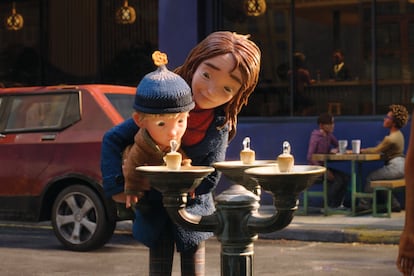
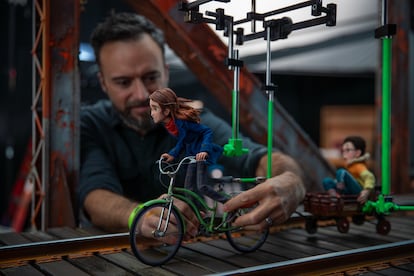
Around the studio you can see some of the film’s various Prues. First they are sculpted in clay and then 3D-printed in silicone, tailored for each shot. “You won’t find a face used twice in the film,” Schiff admits. In fact, there are several complete Prues. “We had 36; we’ve worked with up to 30 at once,” reveals the head of animation, who explains that although each one is exactly like the others, each animator then gives it a personal touch in movement, so they have strict and extensive guides—the so-called bibles—on how a character should act. “How they stand, how they walk, do they touch their hair all the time? Things like that,” he details. They always seek “natural performances.”
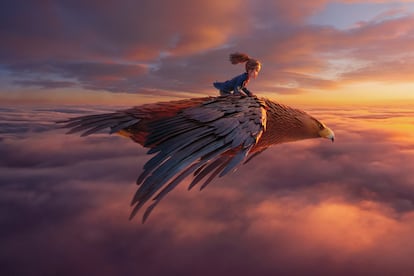
Beyond the siblings, there is another main character in the film: a huge orange eagle called General, voiced in the original version by Angela Bassett. One of the principal sequences shows Prue flying atop him. As the animation team says, that single scene probably took “four years to shoot; in fact, one animator was involved for five years, from start to finish,” Schiff recalls. General measures one and a half meters long with the same wingspan, and over its articulated body there is a silicone skin adorned with more than 3,000 laser-cut silk feathers, many of them wired to allow movement at the tips.
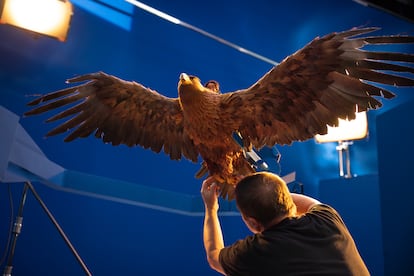
Not only is it complex to move him, but one of the biggest difficulties, Schiff explains, is gravity. “It’s what we always struggle with in stop motion,” he admits. They created new systems, tiny joints and an invisible mechanism where a crank on the bird’s back turns and “tilts it slightly forward and back” so it appears the diaphragm expands and breathes. The wings are also “a problem, because they have to spread, move and fold.” “The challenge was how to do that on a bird... and the answer was that you couldn’t. So we ended up making three birds: one for wing deployment and two for flying,” he explains.
The construction of General alone took around a year with more than 20 people involved, but then there were further challenges. When the protagonist flies on him, they had to get the movement of both exactly right, for instance something as simple as what to do with the teenager’s hair so it wouldn’t look as wild as it would in reality if she were flying. “We design based on past experiences, successes, failures, things that worked, things we want to improve, and everything always goes into the next film,” says the creator.
Another issue that, in principle, adds no extra difficulty to animation is the clothing. Deb Cook, head of wardrobe, breaks down the script, studies the characters and from there creates those designs at one-fifth the real size, taking into account that sometimes the joints and movements are not exactly those of a real person. “There are engineering structures under those costumes, we must account for them and leave space,” she explains. “You also have to consider fabric choice; everything is like one big puzzle.” For that, as for the style of their characters, she also drew inspiration from Portland’s streets.
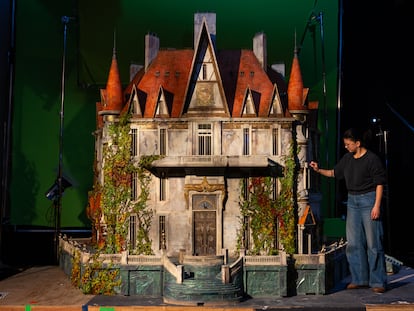
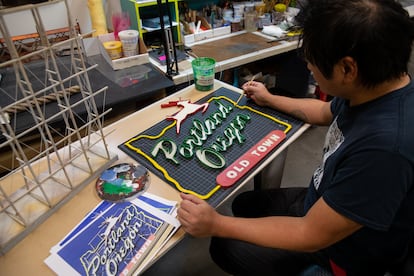
The tour of Laika leads to a conversation with Nelson Lowry, production designer, who for a year and a half created forests, mansions, caves, throne rooms... and a total of 136 locations for Wildwood, as well as dozens more sets for stop motion over his 15 years at Laika. “After working in television, film and theater, I found this is my passion, because I love building worlds,” he says enthusiastically. “And when you do stop motion, you have to build everything, literally—leaves, clouds, sofa cushions, the architecture... It’s fun, though overwhelming.”
Lowry speaks passionately about how he builds, with a team of more than 100 people, all the interiors but also every tiny house on every tiny street, “completely empty because, as in Hollywood, you go in from the back,” he laughs. And about how technological advances have helped them—their micro candles lit by LED last 10,000 hours—and how they’ve embraced 3D, scanning what the illustrators draw and turning those images into objects (and characters) that are more accurate to the imagination and more durable.
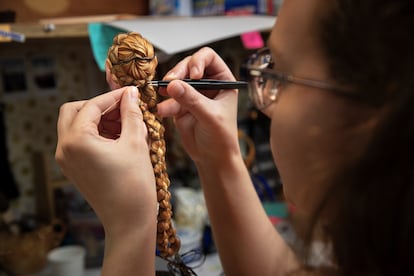
The person who makes the characters consistent and tries to keep their little silicone fingers from breaking as much as possible is head of characters and practical effects, Ollie Jones, with his team. “We make three pairs of hands per puppet,” he confesses. They produced thousands and thousands for the film. If a hand has a very important role in a sequence, it can be mechanical.
Jones was also involved in creating General. “It’s the largest figure we’ve made for the film, and probably the most complicated the studio has ever produced,” he says. They were asked to make it “beautiful, majestic, charming, with a sheen,” but not a decorative snow globe, he jokes.
Like so many today, Wildwood is an animated film not only for children, although they are its primary audience. That is why they always seek to give them the best and treat them with respect. “That’s vital,” the screenwriter admits. “It’s the reason I’ve spent 20 years at this studio: because that was the sort of thing that attracted me as a kid. Things that are more challenging, a bit more subversive.” With a solid story as a base, all that remains is to put it in the hands of a team seasoned in miniatures and eager to innovate. “I always know we will pull it off. We have the best team here. They are the best in the world,” he says proudly, empowering Portland’s oddballs.
Sign up for our weekly newsletterto get more English-language news coverage from EL PAÍS USA Edition