
3D printing returns hope to amputees in Syria
Years of war have left many people with life-changing injuries. Several centers are using new technologies to produce affordable, rapidly made prostheses to narrow the gap between needs and limited resources
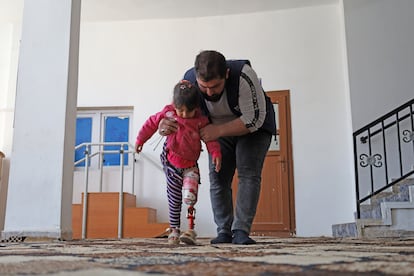
Salwa al Raslan never imagined that her walk home from school would end that way. The seven-year-old tripped and fell to the ground. The impact broke the prosthetic that had replaced the leg she lost in early 2025, when a landmine exploded. For weeks she sat by the window watching other children go to school, her disability keeping her from moving freely.
Her family knew that getting a replacement would normally mean months of waiting and costs far beyond their means. This time, however, the outcome was different. At a prosthetics center in Idlib province in northwest Syria, Salwa received a new artificial limb made using 3D printing technology. In a short time she was able to walk again, return to school and resume playing with other children.
Salwa’s story is far from isolated. Since the outbreak of the Syrian conflict in 2011, fighting, landmines and unexploded remnants of war have left many people with life-changing injuries. Estimates indicate that nearly three million Syrians have been wounded, of whom almost half live with permanent disabilities. There are about 86,000 amputees, many of whom have been unable to access prosthetics or receive ongoing rehabilitation and care.
Dr. Waddah Ghazi al Khatib, director of the Directorate of Physical Medicine and Rehabilitation at Syria’s Ministry of Health, says the number of prosthetics centers currently operating remains far too low to meet the country’s needs. They are divided among public, private and humanitarian organization-run facilities. Private centers typically charge high fees, while humanitarian organizations provide prosthetics free of charge or at a nominal cost.
Among the most urgent challenges are the shortage of qualified prosthetics and orthotics specialists, and the lack of essential materials and supplies needed to manufacture prostheses.
Local technology
In this context, several prosthetics centers in the country have begun adopting 3D printing technology to produce affordable devices with rapid turnaround, in an effort to narrow the gap between growing needs and limited resources.
Given the large number of wounded and amputees in Syria, prosthetics manufacturing can no longer rely solely on the traditional methods used in the pastAlaa Sabri, orthopedics technician
Currently, two centers depend entirely on this technology and serve between 100 and 150 patients a month, although numbers vary month to month. Four other centers are in development and operate partially, while the rest continue to use traditional methods.
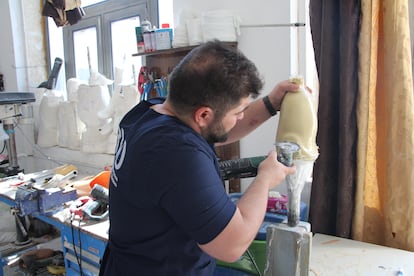
Alaa Sabri, 33, from the city of Idlib, is one of the volunteers involved in making prostheses. “Given the large number of wounded and amputees in Syria, prosthetics manufacturing can no longer rely solely on the traditional methods used in the past. We have shifted to a modern workflow that begins with digital scanning and ends with 3D printing,” he says.
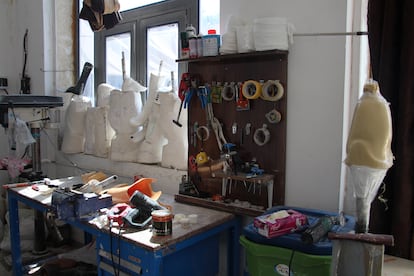
The workshop runs on two main power sources: solar panels and the national electricity grid. It also uses low-cost 3D printers imported from China because they are easy to maintain and their components can be repaired locally if technical failures occur.
At the same time, traditional plaster molds have largely been replaced by digital files, allowing prosthetic designs to be stored, modified when necessary and easily reproduced in the future without repeating the entire manufacturing process from scratch.
“The manufacturing process begins with a high-resolution scan of the prosthesis the patient uses to accurately identify pressure points and areas that need extra protection. The digital model is then refined—sometimes to an accuracy of less than a millimeter—before being printed layer by layer as a lightweight lattice structure that reduces weight without compromising durability,” he explains. Finally, all mechanical components are assembled to produce the patients’ new prostheses.
“Faced with the challenges years of war have imposed on Syria’s health sector, this model aims to establish more sustainable rehabilitation services based on locally developed technologies that can be maintained, improved and scaled up to meet the growing needs of the wounded,” Sabri adds.
Despite its potential, the system is still in an early stage in Syria and has not yet achieved widespread adoption, acknowledges Rawan al Beirouti, 29, a prosthetist and physiotherapist.
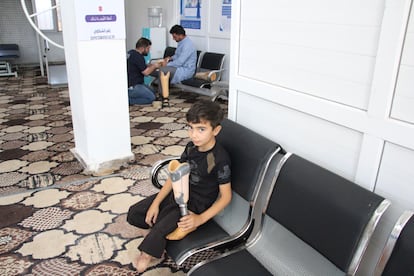
It still faces challenges related to the availability of equipment, raw materials and technical know-how, as well as the need to train more specialists capable of operating and further developing the technology.
Each printed prosthesis does much more than replace a lost body part; it restores a measure of dignity, confidence and hope to people whose lives have been deeply scarred by warRawan al Beirouti, prosthetist
So far, experience shows that 3D printing has reduced production costs, shortened manufacturing times and expanded access to prostheses, especially for children who need frequent replacements as they grow.
That reality is familiar to the family of Abdullah al Aqdi. His father says the boy lost his foot at seven months old as a result of the bombing of his village. “Since then he has undergone continuous surgeries to shorten the leg bone, with constant adjustments to the prosthesis to accommodate his growth,” he says.
“Digital labs can produce a customized prosthesis in about a day, compared with the weeks required by conventional methods,” al Beirouti explains.
“Each printed prosthesis does much more than replace a lost body part; it restores a measure of dignity, confidence and hope to people whose lives have been deeply scarred by war,” she adds.
Adnan al Raslan, Salwa’s father, says the technology has reduced the cost of his daughter’s prosthesis to about $100 (€87), compared with roughly $500 (€436) for the conventional articulated prostheses they had previously purchased. It has also significantly shortened manufacturing times, which he says is critically important. As her father speaks, little Salwa takes her first steps with her new prosthesis, assisted by prosthetics technician Muhammad al Ismail, who describes his work in Syria as “a major humanitarian mission facing many challenges.” “But helping amputees restores life and hope to the wounded and relieves their pain, and that is our motivation to carry on,” he concludes.









































