
Ukraine needs Starlink satellites to fight the war, but the Pentagon holds the reins
Data from Elon Musk’s communications network helps Ukrainian forces intercept Russian projectiles more effectively and carry out precision strikes along the front line. Europe has no comparable alternative
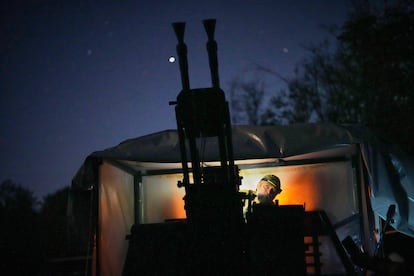

The clearest example concerns Ukraine’s air defenses. One of the biggest challenges currently facing Ukraine’s air-defense units, whether mobile teams or surface-to-air missile systems, is Russia’s jet-powered Geran drones. These can now exceed speeds of 300 kilometers (186 miles) per hour, although they do not always fly at the same speed. Bringing them down requires munitions fast enough to intercept such targets and guided by highly accurate tracking data. That is why Ukraine’s access to the satellite network operated by Starlink, the company owned by tech billionaire Elon Musk, is so critical.
Until now, Ukrainian forces were able to use data from the system to guide projectiles traveling at the necessary speeds. But earlier this week, Washington imposed a speed limit of 160 kilometers (100 miles) per hour. The result: the country’s air defenses are weakened, as is the front line, where Starlink connectivity is also essential.
The alarm was raised on Tuesday by Ukrainian presidential adviser Serhii Beskrestnov. According to the defense technology specialist, SpaceX, the parent company of Musk’s technology empire, had introduced new restrictions on speed thresholds without prior notice. In practice, this meant that when medium-range drones, for example, exceeded 100 or 120 kilometers (62 or 75 miles) per hour, the transmission of satellite data slowed dramatically or was interrupted altogether. In a war where lives hang in the balance, that is no minor matter.
Musk’s satellites transmit heavily encrypted data at extremely high speeds, enabling reliable communication between a drone operator and the unmanned aircraft while largely overcoming the jamming and signal-blocking tactics employed by electronic warfare systems. “Starlink is vital to both the civilian population and the armed forces,” Ukrainian military analyst Oleksandr Kovalenko said in a message exchange. “So depriving us of the ability to use this tool fully will have negative consequences.”
There was no advance notice of the new restrictions, nor has Washington confirmed that it imposed them. However, in an interview with the Financial Times in London on Thursday, Ukrainian President Volodymyr Zelenskiy confirmed the partial disruption and insisted it was no accident. “It was not a technical problem, it was the will,” he said.
The episode comes amid mounting tensions between Washington and Kyiv. U.S. President Donald Trump has grown increasingly frustrated with his Ukrainian counterpart for continuing to target Russia’s energy sector, while Zelenskiy regards the diesel deal between Moscow and Washington, along with cuts to intelligence sharing, as a betrayal. Seeking to dispel any ambiguity, Elon Musk said on Wednesday that decisions on whether wartime satellite data is made available are taken by the government, not by him.
The billionaire has a point. His company, SpaceX, holds a contract with the Pentagon for the use of Starshield, Starlink’s military and defense-focused division, which operates a network of around 250 satellites. Since late 2024, the service has been available in Ukraine through some 3,000 mobile terminals.
“Thanks to its low Earth orbit, at about 550 kilometers [341 miles],” Kovalenko added, “Starlink offers signal latency [the time it takes to travel from one device to another] of between 20 and 40 milliseconds. That allows data from drones to be transmitted in real time, working with battlefield awareness systems, such as the Ukrainian Nettle and Delta, and controlling high-precision weapons.”

The reference to Delta is no trivial detail. Developed by the Ukrainian organization Aerorozvidka, the battlefield-mapping platform tracks enemy positions by combining data from thermal sensors, reconnaissance drones, civilian reports and satellite imagery relayed through the Starshield network. Delta has proven so effective that it has already drawn the attention of NATO.
The results on the battlefield have been remarkable. Since the Ukrainian military gained access to Starlink on the eastern front, it has not only managed to withstand Russian assaults but also to strike strategic targets, including command posts and ammunition depots, while securing major victories. In February, in another twist, Musk authorized a major blackout of the signal for Russian users in occupied territories, so that only Ukrainian terminals could receive data.
Few people understand the relationship between the satellite network and Kyiv better than Mykhailo Fedorov, Ukraine’s former defense minister. Thanks in part to his close ties with Musk, he was instrumental in securing exclusive Ukrainian access to the connection in Donbas. Just weeks ago, Fedorov revealed that he was in talks with Musk to allow Ukrainian drones to remain connected to his satellites after crossing into Russian territory, with the aim of carrying out precision strikes against ballistic-missile launchers. But Washington, which ultimately calls the shots, does not want to approve such a move.
On Wednesday, Fedorov announced that Starshield was once again operating at full capacity for projectiles traveling at speeds of up to 160 kilometers per hour. “Now we need to work on completely removing the speed limit,” he wrote on his Telegram channel.
European allies, meeting in Brussels on Thursday, threw their full support behind Zelenskiy in the latest round of tensions with Washington. But while Europe has managed to compensate for the near-total absence of new U.S. military aid to Kyiv, it remains far from matching the United States as an intelligence partner. The communications system that comes closest is France’s Eutelsat OneWeb.
“It offers a fairly stable and fast internet connection and is deployed in Europe, but it uses larger, more expensive and less portable terminals for a soldier or a small unit,” Kovalenko explains.
Kovalenko also points to alternatives such as the U.S.-based Viasat and Luxembourg’s SES. “They are standard geostationary satellites, but they have a very low data-transfer speed. Latency can exceed 500 milliseconds!”
In wartime, even such seemingly imperceptible delays can matter. “There are alternatives, but each option has its own disadvantages, which generally Starlink does not have,” Kovalenko concluded.
As things stand, Zelenskiy will continue to rely on Musk, provided Trump lets him.
Sign up for our weekly newsletter to get more English-language news coverage from EL PAÍS USA Edition









































