
You fear it, I love it: the Trump–Xi summit will address AI with opposite mindsets
Most Chinese citizens find this technology exciting, while more than half of Americans fear it will destroy humanity

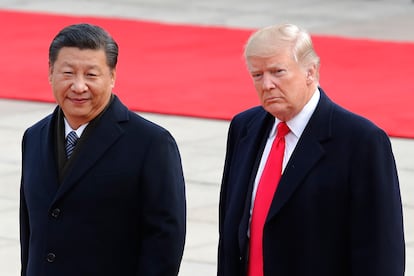
Artificial intelligence will be one of the central subjects at the White House summit on Thursday between U.S. President Donald Trump and Chinese President Xi Jinping, the leaders of the two most powerful countries in the world and the ones that have made the most progress with that technology. Both governments view advances in these models as crucial to their economic and military competitiveness. The differences are not only geopolitical, but also in their nations’ mindsets. Their populations hold very different perceptions about the risks and benefits of AI: while a majority in the United States regard them with concern, in China they are embraced with enthusiasm.
The road maps of each country’s industry also diverge. Silicon Valley favors closed models in which their training systems are closely guarded trade secrets. China champions an open-source model as a tool for AI development, an attitude that threatens the competitiveness of its U.S. rivals amid American accusations of possible industrial espionage.
Anthropic CEO Dario Amodei linked his recent appeal to slow the development of the more powerful models to a blockade of Beijing’s access to the most advanced semiconductors. Former Trump adviser Steve Bannon this week poured more fuel on that fire at a symposium where he appeared alongside his ideological opposite, progressive Senator Bernie Sanders, to warn of the risks of the new technology.
“We should immediately quarantine every aspect of the ecosystem of artificial intelligence ecosystem away from the Chinese Communist Party,” said Bannon, the former ideologue of the Trump movement. Many of the leading U.S. giants will be present at the summit’s gala dinner on Thursday: Sam Altman, CEO of OpenAI; Jensen Huang, CEO of Nvidia; Elon Musk, founder of xAI; and Sundar Pichai of Google.
For now, the United States is winning the race against its rival in cutting-edge technology —“frontier” technology in industry jargon— and in the capability of its models. China, whose products appeal to a Global South that cannot afford the most advanced and expensive American-made AI, is ahead when it comes to consumer adoption of systems that its domestic tech giants embed directly into the most popular apps.
A Morgan Stanley survey makes that difference in attitude clear between the two ecosystems and, above all, between their users. In the Asian giant, 80% of respondents said they use artificial intelligence at least once a week. In the United States, that figure falls to 54%. In China, the base of generative-AI users grew from 249 million in December 2024 to 602 million a year later, a pace even faster than the early adoption of smartphones in that country, according to the report.
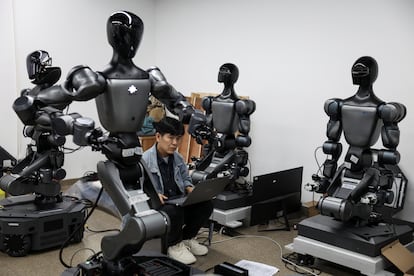
The same nation that stages Olympic-style events for robots and enthusiastically adopted apps that let you buy anything online and have it at home within minutes, make a call, or reserve a bike to get from A to B, has readily embraced generative AI features —capable of producing text, images, video or code— embedded directly in those messaging and entertainment apps. Users can take advantage of that technology without downloading additional software. It is already in places that seemed impossible just months ago: in August the first television series generated with AI was released.
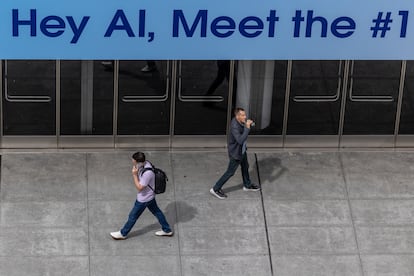
In the United States, by contrast, distrust keeps rising. Sixty-three percent of citizens believe there is at least a “moderate risk” that artificial intelligence could destroy humanity, compared with only 22% who think the risk is slight or nonexistent, according to a Politico poll. Another YouGov survey shows similar results: two-thirds say the models are advancing too quickly. Only 2% believe they are progressing too slowly.
The reasons for Americans’ apprehension are varied: fear of job losses; concern about environmental impact, especially the large data centers the sector requires and their heavy electricity consumption; fear that it will trigger even greater social inequalities; and distrust of the companies in the sector and of their regulation.
In China the opposite occurs. The ubiquity of AI in everyday apps has made it familiar. Eighty-three percent, according to an Ipsos survey, consider AI-powered products or services exciting. That perception is partly based on individual experience: the country’s economic boom coincided with a huge expansion of the tech sector, and each new adoption of a tool —whether the spread of the internet, the use of mobile phones or online payment platforms— has been accompanied by a rise in personal prosperity. At least until now, when the economy is showing signs of slowing and job creation is faltering, especially among young people.
But the difference in attitudes depends on another major factor: trust in their respective governments. In the United States, a tendency toward skepticism, embodied by Ronald Reagan’s slogan, “The nine most terrifying words in the English language are: ‘I’m from the Government, and I’m here to help,’” deepened after the Iraq War and has collapsed today: only 17% trust that their authorities will do the right thing. By contrast, in the Asian giant, marketing firm Edelman reports that 86% of citizens say they trust their government to make appropriate decisions.
To their eyes there are precedents: in 2020 the Beijing government launched an antitrust investigation into the country’s largest e-commerce company, Alibaba, which evolved into a sweeping regulatory campaign that affected all kinds of tech firms, from distance-education companies to video-game makers, in a reform that wiped $1.5 trillion off those companies’ market value.
In the United States, leaders of the top companies are now split over whether to slow the rapid growth of the most advanced systems to allow time to develop safety tools and avoid losing control. Amodei heads the camp calling for a pause. Jensen Huang, CEO of chipmaker Nvidia, urges full speed ahead. Donald Trump insists that going all out is a matter of national security: “Whoever wins AI, wins,” he keeps repeating.
In China, advances in the technology are seen as a matter of national pride. They confirm that the country has definitively left poverty behind and what it calls the “century of humiliation,” and has taken a leading position on the world stage.
With that kind of support, Chinese President Xi Jinping will walk into the White House summit on Thursday with great confidence. The United States is seeking tighter restrictions and controls on exports of the most advanced semiconductors, AI models and the infrastructure around them. China, for its part, wants to protect its companies from what it sees as an extraterritorial attempt to “choke” its technology.
“A lot of people in the U.S. don’t grasp that China really sees AI as the new internet, and that this represents a once-in-a-lifetime opportunity… China has never been in a position where it was so close to the United States — as the second power trying to catch up in new technologies,” explains George Chen, director of the digital division at consultancy Asia Group. “The internet was created in the 1980s as something essentially American. China never had the chance to join the U.S. in setting internet rules. Beijing really missed the entire internet era in terms of global governance. It didn’t do very well in semiconductors either. So now comes the AI era,” the expert adds.
The challenge for the two governments is twofold: to manage AI as a source of strategic competition between them, and, at the same time, because each perceives the other’s tech ecosystem as a risk to its own security, to establish communication mechanisms to reduce the risk of cyberattacks, miscalculation or unintended escalation.
“There are many incentives for the United States and China to have a substantive AI discussion at this summit,” says Aalok Mehta, director of the Wadhwani AI Center at the think tank CSIS. “The most likely form this could take is that both countries address a limited set of related issues, first, around basic security practices. Second, by establishing some kind of hotline that would allow the U.S. and China to be in contact over AI-related issues that arise or are already developing. And third, something more specific around cyber incidents. That is probably the most concrete thing that could come out of the summit.”
Sign up for our weekly newsletter to get more English-language news coverage from EL PAÍS USA Edition









































