
Rain threatens Cali’s improvised shelters: ‘We have nowhere to go’
Citizens have built informal refuges with their own hands to help hundreds of people who have not received support from local authorities

In Cali, life depends on it not raining. In front of a pile of rubble that until three days ago was a seven-story building, residents of the Cuarto de Legua neighborhood make the sign of the cross and look to the sky, as if salvation or doom might come down from there. Others lift their eyes to the treetops, hoping the clouds will keep passing by. In Colombia’s third most populous city, and one of the hardest hit by Monday’s earthquake, at least two weeks have gone by without a drop of water. Now, amid the city’s worst emergency in decades, the weather determines fates: those of the displaced who spend their nights outdoors, and those who may still be trapped under the rubble.
The capital of Valle del Cauca has yet to grasp the scale of its crisis. Authorities report 74 people dead and more than 150 missing, who could still be trapped under collapsed buildings. Those figures are only a fragment of what the city does not know: the mayor’s office has not completed a census of families left without housing or determined how many resources it will need to deal with the tragedy.
Cali now faces a long-term task. It will have to care for hundreds—perhaps thousands—of displaced people, respond to the families of the dead and the missing, relocate those who lost everything, and support businesses, enterprises and associations. For now, the mayor’s office has set up one shelter at Canchas Panamericanas for about 60 families. Citizens have built other informal shelters to assist, with their own hands, the hundreds of people who are being neglected. One of the largest sites is located to the north, in the Chiminangos neighborhood, where a section of an outdoor staircase collapsed and left a woman dead within the structure.
The image shook the whole neighborhood and the city. The woman remained exposed for 32 hours while no authority recovered the body. Her daughter, pleading, asked the community to respect her family and begged people to stop spreading the image that, for hours, became the face of the tragedy in the city. In this traditional, working-class neighborhood, local residents self-organized to care for about 300 people who had to evacuate their buildings because of structural damage. As a warning, an improvised graffiti on the walls reads: ‘Risk of collapse. Do not enter.’ The building’s structure remains cracked, and its fissures appear to have been patched.
Francisco Manrique, 76, has spent the night there. He did not know the neighborhood, but someone offered him shelter in a donated tent, and food prepared by the neighbors themselves. He comes from Pereira, another city severely affected by the quake, located more than four hours away, where his house collapsed. He is helpless. In his right pocket he carries a small, crumpled paper with the phone number of one of his sisters who lives in Cali. It is the only lead he has to reach her.
At that informal shelter dozens of families have already spent two nights, waiting for local authorities, the National Unit for Disaster Risk Management or an engineer to take pity on them and assess their buildings. Katherine Varela, one of the displaced people, says the risk of the staircases collapsing is visible and terrifying. ‘The structure is detached. The apartments didn’t suffer as much, but the stairs are coming down.’ She has already climbed up to her apartment to rescue some clothing, following the instructions—and her intuition—to go up on tiptoe, very slowly. ‘We go up one at a time when needed.’
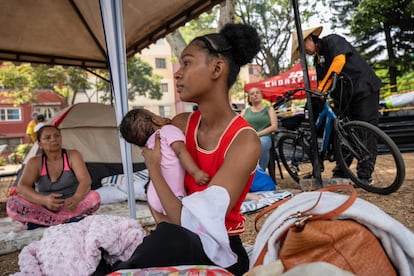
Her anguish and that of her whole family stems from knowing that all their belongings remain trapped in there and because, although solidarity is abundant now, it may run short in a few days. Luisa Mosquera, 20, nurses her baby Milagros in her arms. Originally from Buenaventura on the Pacific coast, she arrived two months ago to make a home with her daughter’s father. ‘The ground sounded like it was going to swallow us up. Everyone evacuated and we haven’t been able to return,’ she says.
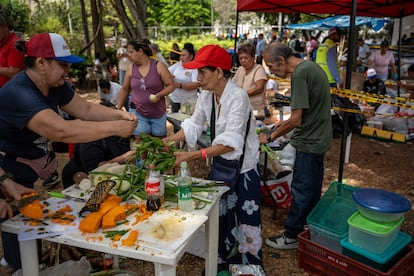
In Chiminangos, a neighborhood to the northeast, three days after the tragedy no official entity had shown up yet. Dozens of families flocked to an improvised shelter built with whatever was at hand: tarps, sticks, scraps of fabric and bags. No local official has shown up to register their presence, they say, and because they do not show up on any official list they were almost left out of the small amount of aid beginning to trickle in. But the neighborhood organized itself. Community pots boil over makeshift stoves, hot food is passed hand to hand, and donated clothing and medicines people pile up on tables and sheets spread on the ground.
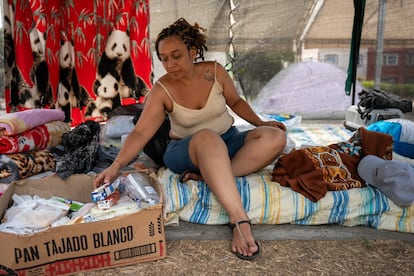
Neighbors arrive with pots of coffee, hot sandwiches and nonperishable food. The abundance is such that they have begun sending aid to the department’s north and to the port of Buenaventura. ‘We don’t need more food; it’s going to spoil. We need institutional help: censuses, alternatives, a risk assessment to know if we can return home,’ says Andrés Pérez, as he sits with his two children and their mother on the mattresses that make an improvised home.
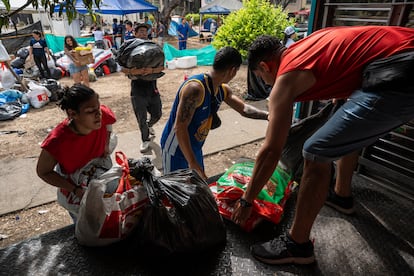
Franklin Bernal says improvised, high-risk trips back home to retrieve belongings have already started. No one wants to lose their possessions. ‘Yesterday a neighbor began taking things out through the third-floor window because he can’t carry anything down the stairs.’ A human chain formed in seconds to create a makeshift pulley to lower appliances.
Not everyone is so lucky. Several apartments have bars on their windows and many owners have refused to remove them. On Wednesday morning Bernal’s landlord came by the shelter. ‘He didn’t even ask how we were. He just came and charged me for the month, fully knowing the house is uninhabitable.’
His reality is that of many. Andrés Pérez, 44, sleeps in the tent and during the day goes out to work to earn money and pay the monthly rent. ‘Nothing has stopped, least of all the bills,’ he says, interrupting the conversation to take a call from his workplace, where he has continued to show up despite having lost everything.
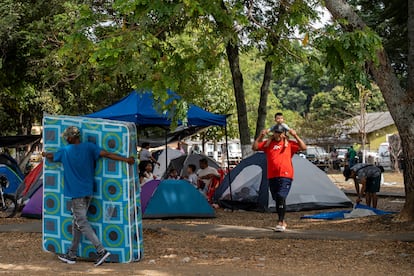
The mayor’s press office explains it has not begun the census nor managed to help all the displaced people. ‘The office is focused on search and rescue for survivors. It is the top priority,’ it replied to a query by this newspaper. In the meantime, people feel abandoned. They have no certainty about the future, beyond the fact that they will spend one more night outdoors.
In the middle of the improvised shelter, a woman has gone into labor. There is no clinic nearby, no ambulance; only familiar hands and a quiet solidarity. Katherine, without saying much, takes a white candle and places it on the dirt floor as if asking something larger than herself for a favor. ‘We’ve had it lighted since Monday so it won’t rain, because we have nowhere to go and people stuck in the rubble could sink further,’ she says, and looks back. Her priority is that her family be whole. ‘We’re missing Tomás, our cat, my son.’ A downpour could be the final loss. In Cali still, life depends on it not raining.
Sign up for our weekly newsletter to get more English-language news coverage from EL PAÍS USA Edition









































