
Colombia earthquake shakes its largest diaspora in the United States
Colombians living in South Florida are searching for news about their loved ones and coordinating aid shipments. Some will be unable to travel to see relatives as they are undocumented and risk deportation
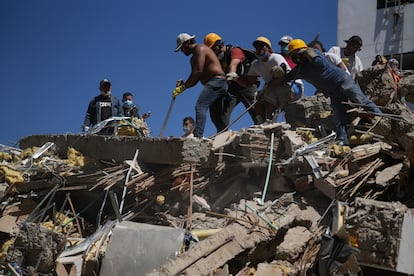

Víctor Andrés Quintero, a Colombian man from Cali who has lived in Miami for seven years, learned about the earthquake through his family’s WhatsApp chat group. The first messages were from his uncles in Spain, including a video circulating on social media showing several people running out of a clinic in Cali as pieces of nearby buildings break off and fall on them. In the images, Quintero recognized his aunt Myriam, the relative who raised him after his mother died when he was nine.
“I immediately knew it was her. She was at the doctor’s at that moment. You can see things falling and they hit her and another woman who was helping her get out,” Quintero, 42, told EL PAÍS. He began frantically calling his father and two other uncles, all elderly men who also live in Cali, but the calls didn’t get through. “I couldn’t talk to anyone. Nothing. There was no signal,” he explains.
He was finally able to reach a cousin who lives in Spain and was visiting Cali. She told him she had gone to the clinic in the Tequendama neighborhood and confirmed with police that his aunt had died. “Only her message, crying and telling me that, and that’s it. I haven’t been able to speak to anyone else.”
The magnitude-7.4 earthquake that struck western Colombia at 7.34 am on Monday left more than 130 dead, hundreds injured and thousands of homes damaged, according to preliminary estimates, while rescue teams, neighbors and authorities kept digging for survivors under the rubble. At least 61 buildings collapsed, said the country’s new president, Abelardo de la Espriella.
Quintero’s anguish as he tried to contact relatives was shared by thousands of people in South Florida, home to the largest Colombian diaspora in the United States. Of the 1.3 million Colombians living in the U.S., more than 400,000 live in that state, with the largest concentrations in Miami-Dade and Broward counties, Census figures show. The Migration Policy Institute estimates the area is home to 35% of all Colombians in the United States, a Hispanic demographic group that’s among the fastest growing in recent years, according to the Pew Research Center.
Cristhian Mancera, a councilman and Colombian community leader in Miami-Dade, said phones “didn’t stop ringing all day” on Monday. People also messaged him on Instagram. Most were Colombians from Cali and the Valle del Cauca who live in Miami and were worried about relatives. During the day they managed to get through to affected families in Cali, Pereira and Manizales, he said.
Others asked him: “Tell me what you need so I can help.” Mancera says that from his office in Miami-Dade’s Area 11 in Kendall, in the southwestern part of the county, he has been coordinating with local organizations to collect humanitarian aid. Initially they are gathering nonperishable food, water, medicine, diapers and other basic supplies, but Mancera says they are waiting for information on the most urgent needs on the ground. The councilman says they are in contact with organizations in Colombia to distribute donations and with Global Empowerment Mission (GEM), a South Florida-based humanitarian aid group.
Carlos Naranjo of the community organization Semillas Colombia says they are coordinating with churches in Fort Lauderdale and Oakland Park in Broward County to collect donations, and that on Saturday they will hold a community meeting in Fort Lauderdale “so the community can express its concerns and organize further actions.”
For Quintero, the tragedy poses an additional dilemma. “I don’t have legal papers here; I’m undocumented,” he admits. If he returns to Colombia, he risks not being able to come back. He lives alone in Miami, where he came to work to send remittances and help his family, especially his aunt. “I sent everything to her. I’m here because of her,” he says sadly.
“There are many people in that same situation, unfortunately,” Mancera says. If they have a family emergency, someone gets sick or dies, “they have to choose” between going to Colombia or trying to help from afar.
Naranjo says they have received “many calls from people without legal status who cannot travel to see relatives who have lost their lives today.” “We are taking down the names of people who can’t locate family members to connect them with authorities in Colombia,” he added.
Quintero, for his part, still doesn’t know what he will do, but at least confirmed his father and uncles were safe thanks to a neighbor who was able to reach them. “My head is spinning; I don’t even know what to do,” he admits. “The person I was helping, well, she isn’t there anymore.”
Sign up for our weekly newsletter to get more English-language news coverage from EL PAÍS USA Edition









































