
Luxury housing or historical memory: Controversy in Berlin over a real estate project atop a former Nazi bunker
An investor plans to build on a site that holds the vestiges of the New Reich Chancellery, next to the Memorial to the Murdered Jews of Europe
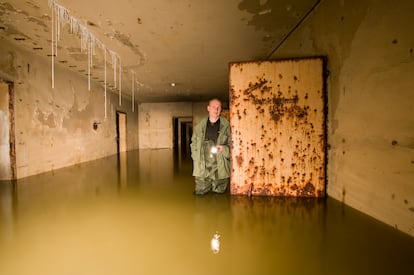

Dealing with the Nazi past has always been complicated. Germany has long invested in historical memory with exhibition and documentation centers. But unearthing traces of a history some would rather see buried forever is not easy and sometimes destroying what remains can seem simpler under the pretext of preventing a neo-Nazi pilgrimage site. That is what has happened now with a vacant lot in central Berlin that conceals the last architectural vestiges of Adolf Hitler’s former center of power. An investor plans to build housing there that would destroy the last bunker of the New Reich Chancellery, a move that has unleashed widespread criticism.
After World War II the main buildings associated with Hitler in Berlin were destroyed. Government districts were razed and earlier schemes such as the university works for Germania — the megalomaniac plan to remake Berlin as an imperial capital — were buried under tons of wartime rubble and soil that later became the famous Teufelsberg hill, where the Americans established an espionage center during the Cold War. Hardly any remains of that era survive in the capital. One of the few is this bunker in the former government quarter, which now also faces the threat of disappearance.
On Vossstrasse, next to the famous Memorial to the Murdered Jews of Europe, stands the so-called Great Bunker of the New Reich Chancellery. Located during the former German Democratic Republic in the heart of the “death strip” — the area between the two walls that separated East from West — this nondescript vacant lot was closed to the public between 1961 and 1989. Now, decades later, a Hamburg investor wants to build a six-story office building and a seven-story residential block with 66 apartments on the site, according to regional newspaper B.Z., based on an urban plan approved in 2006.
Symbol of the Nazis’ defeat
Reiner Janick, head of research at the Berliner Unterwelten association, criticizes these plans and recalls that the region’s heritage authorities have recommended listing it as a protected monument. “The New Reich Chancellery was the place where World War II was planned and launched and it also symbolizes the catastrophic end of the Nazi regime,” the Regional Council for Cultural Heritage — a body of experts — wrote in a recommendation published in March last year.
“However, the Berlin Senate has opposed it, because this area is likely to be very valuable and offers great potential for luxury housing,” Janick says by phone about a highly desirable site given its proximity to the Brandenburg Gate. Berliner Unterwelten, which since 1997 has explored and documented the city’s underground architectural heritage while running guided tours, complains that all recommendations to preserve the bunker have been ignored.
“The Senate told us it did not want to turn it into a pilgrimage site for neo-Nazis, but that is not our intention,” he says. He also considers that assumption “complete nonsense,” because, as the thousands of tourists who visit the city each year and take an interest in this period show, it ultimately “comes down to providing information.” “For us it is very important that, precisely in this spot, many aspects of the city’s history can be well documented,” he says of plans that would include both the Nazi past and the history of the Berlin Wall route that ran through here.
The Berlin Senate press office tells EL PAÍS that there has been an urban plan for this area since 2006, which was already approved by the regional parliament. “The project developer wants to build housing on this site and Senator Christian Gaebler has made clear that he prioritizes housing construction at this location,” it said. Nevertheless, “the landowner is obliged to properly document the bunker before its demolition,” it added.
A colossus underground
What Berliner Unterwelten is calling for, however, is a modification of that urban plan, which “is already fairly outdated,” so that the planned location of the residential block can be moved slightly and the underground complex preserved. “If in doubt, theoretically this building could also be constructed on top of the bunker’s roof. It is so massive it could even support a current load, since the load at the time — that is, the registry office that once stood above it — would have been heavier than what is foreseen today,” Janick says of a bunker of which 1,200 square meters still survive.
The aim is to preserve one of the last bunkers. “Almost all of them have disappeared. At one time we catalogued a total of 14 such facilities, which were actually intended for the Reich government. Of those, only three remain,” he says of what is also the last prewar bunker that still survives in the Nazi government quarter of Berlin and that is still accessible. “Our intention is to also show future generations what really happened there.” In the end, as he points out, “it would, so to speak, be the last opportunity to preserve a building that should remain for the next generation.”
However, these plans by the Berlin regional government are not a surprise to Janick, who recalls that the policy of removing, more or less, all those Nazi vestiges is one the German capital has followed for 80 years, a course he believes is counterproductive. “When a place no longer exists it always gives rise to myths, legends and who knows what else,” he explains, citing Hitler’s bunker as an example — which was very small but still creates a stir “precisely because it no longer exists.”
The famous Führer bunker, where Hitler and Eva Braun killed themselves on April 30, 1945, was completed in April 1944. In its place, on Gertrud-Kolmar-Strasse, very near the New Reich Chancellery, there is now a parking lot. In 2006, the Berliner Unterwelten association installed an information panel there about its history.
According to the German Historical Museum in Berlin, the New Reich Chancellery was a monumental government and representational building of the Nazi regime in Berlin, which Hitler commissioned as an architectural symbol of his claim to domination. According to architect Albert Speer’s plans, construction began in early 1938 on Vossstrasse and was largely completed in about 12 months, by January 1939, after entire blocks had been demolished.
The building, whose façade stretched along 420 meters, was a demonstration of power and, like other monumental Nazi buildings, was meant to impress by the value of the materials used and by its enormous size. In 1945 it was taken by the Red Army and demolition began in 1949.
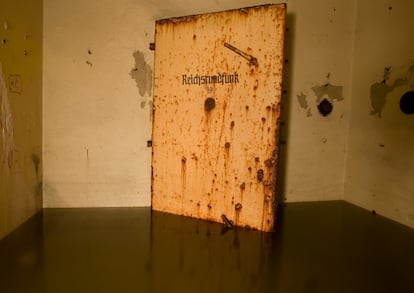
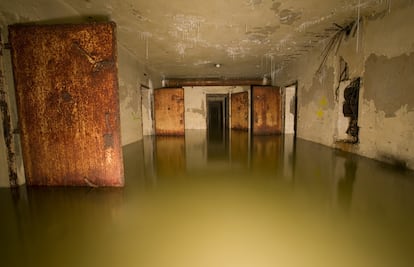
Beneath the partially concreted surface lies the enormous bunker, six meters below ground, of which just under half is preserved. It was only one of the many bunkers in the former Nazi government quarter around Wilhelmstrasse. Initially it was conceived as the future Führer bunker, but not foreseeing that Hitler would spend little time in his office at the New Reich Chancellery.
The installation had walls and ceilings 1.70 meters thick, an interior length of 106 meters and a width of 28 meters. It was connected to other parts of the basement through adjacent underground rooms. From here you could also access stairs that led to the north sidewalk of Vossstrasse, which could be closed with hydraulically operated concrete slabs.
In fact, a famous Red Army photograph shows the last commander of the Wehrmacht in the capital of the Reich, General Helmuth Weidling, leaving this bunker on May 6, 1945. That image is often used to illustrate the surrender of Berlin four days earlier, although it has nothing to do with that event itself and Weidling did not have his command post in this bunker. Beyond that image, Berlin will now have to decide which carries more weight: historical memory or the real estate market.
Sign up for our weekly newsletter to get more English-language news coverage from EL PAÍS USA Edition









































