
Who are the ‘cockroaches’ behind the mass demonstrations in India, and what do they want?
What began as a rhetorical question from an Indian university student has resulted in brutally-suppressed protests on the streets of New Delhi
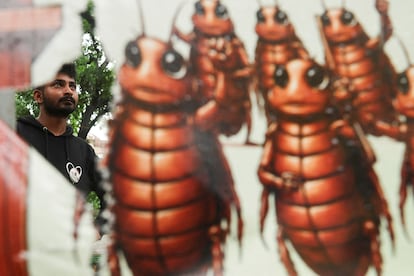

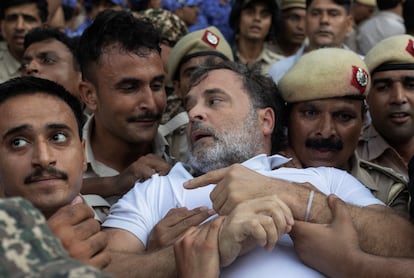
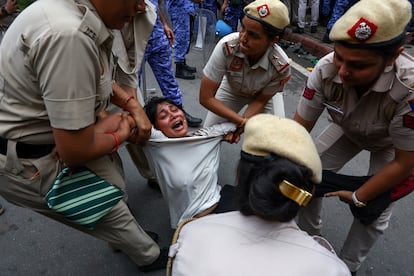
Two massive protests rocked India’s capital this past week. Dozens of police officers and demonstrators were injured during Monday’s march toward Parliament, while arrests also took place. Opposition leader Rahul Gandhi was also briefly detained on Tuesday, after he joined the march outside Prime Minister Narendra Modi’s residence to denounce police violence that took place the previous day.
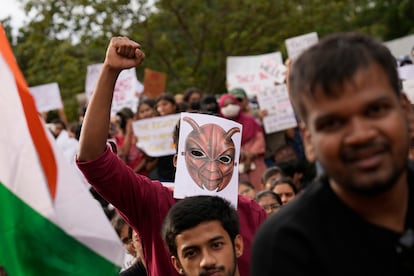
The organizers of Monday’s protest, the Cockroach Janta Party (CJP) youth movement – which began as an online act of satire, playing on the name of Modi’s Bharatiya Janata Party (BJP) – have denounced the use of tear gas and violence against the crowd of young people, who were marching “peacefully” toward Parliament. Reuters reports that at least 150 civilians were treated in hospitals. Authorities, however, say that about 180 people – including 118 police officers – were injured in the clashes in the center of the capital.
Beyond the war of numbers regarding the wounded and detained, to understand the origin of the discontent among young Indians — which has culminated in an explosion of street protests — one must go back to May 3. On that day, reports began circulating that the entrance exams for India’s medical schools — taken by millions of students each year — had been leaked. These suspicions were confirmed by an investigation, forcing the authorities to repeat the exam. But the damage had been done. For a large segment of the country’s youth, it represented confirmation of the corruption within institutions that benefits the children of the elites.
The criticism was not well received in Modi’s inner circle. And, on May 15, Chief Justice Surya Kant — the top judge in the country — described unemployed young people as “cockroaches” who, unable to find work, use social media, journalism and activism to “attack the system.” In a hearing, he called them all “parasites of society.” Two days later, he issued something resembling an apology, but the seeds of discontent had already been sown.
Abhijeet Dipke, a 30-year-old Boston University graduate in Public Relations, who was looking for a job, felt personally attacked by the insult. And, the next day, on May 16, he posted on his X account: “What if all cockroaches came together?” That rhetorical question was the spark that ignited a movement among Indian youth. The avalanche of responses he received — some 11,000 in the first 12 hours after posting — encouraged him to go further. That same day, according to what he told The New York Times, he founded the satirical Cockroach Janta Party (CJP), complete with its own website, which he designed with the help of AI and a friend in just a couple of hours. “The voice of the lazy and unemployed” is its founding motto.
“India is a very young society with few opportunities,” explains Ana Ballesteros Peiró, a professor at the Complutense University of Madrid and a nonresident senior researcher at the Elcano Royal Institute, specializing in Asia. Approximately half of India’s 1.4 billion inhabitants are under 30. For them, she says, “education is sacred,” because access to the best schools or universities is the only means of social mobility “to escape the low social class into which they were born.”
The expert isn’t surprised that the leak of exams triggered one of the biggest crises that Modi has faced since he was first elected in 2014. “Nepotism has been on the rise; increasingly, elites close to the prime minister and the ruling party are benefiting,” Ballesteros notes. “Either the demographic [reality] is properly managed and jobs are provided for the millions of young people entering the labor market each year, or discontent will eventually erupt.”
This already happened back in 2019, when Modi’s BJP – thanks to the absolute majority it held at the time (which it lost during the 2024 elections) passed a new citizenship law in Parliament without any consultation. The law created a path to citizenship for immigrants belonging to six religions — Hindus, Sikhs, Buddhists, Jains, Parsis and Christians — from Pakistan, Afghanistan and Bangladesh, who had arrived in the country before the end of 2014. Muslims were not included in this expedited process.
“It marginalizes a large part of the migrant population in India and basically only grants citizenship to non-Muslim [immigrants],” Ballesteros explains. The law was criticized by human rights organizations and sparked protests from segments of society disillusioned with the government and social inequalities. Those protests, like the ones taking place today, were also violently repressed and met with insults by the authorities. “That outburst was silenced by the arrival of the Covid pandemic, but it left a residue of frustration,” the researcher notes.
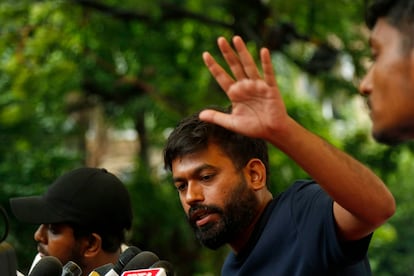
But this time, Dipke has turned the insult into a symbol: cockroaches. And he has channeled his exasperation into a movement that has grown exponentially every day. According to its own figures, the organization now has over a million members.
To become a member, you only need to meet four requirements: “We do not check religion, caste, or gender,” the CJP clarifies on its website. And, with a touch of irony, it states that, to join, you must be unemployed, whether “by force, by choice, or by principle… we don’t ask”; you must be lazy (“physically only; the brain may continue to spiral”); you must be chronically online — “minimum 11 hours a day, including bathroom breaks” — and you must have the ability to “rant professionally, as long as the content is sharp, honest and points at something that actually matters.”
In addition to its members, the movement has garnered tens of millions of supporters on social media. In just five days, it amassed 18 million followers on its Instagram account, double the number of followers of the ruling BJP’s profile on the same platform. And over the course of the past two months, it has reached over 24 million, despite repeated attempts to shut it down. Dipka claims that the group’s Instagram account was also hacked.
The Cockroach Party’s main demand is the dismissal of Education Minister Dharmendra Pradhan. In office since July 7, 2021, the protestors hold him responsible for the exam leak. They also demand that the government provide financial compensation to the families of the students who, according to an open letter to Modi, took their own lives “due to the [exam] leak crisis.” Many families invest heavily in study materials and private tutoring — a big sacrifice — while the prospect of starting over after months of preparation is psychologically devastating.
The Cockroaches have quickly moved from the internet to the streets. Since June 20, they have organized several protests in New Delhi, as well as in other major cities, such as Bangalore, Mumbai and Pune. In all the demonstrations, they have insisted on their “peaceful” nature and have denounced the police violence through their social media channels, with photos and videos.
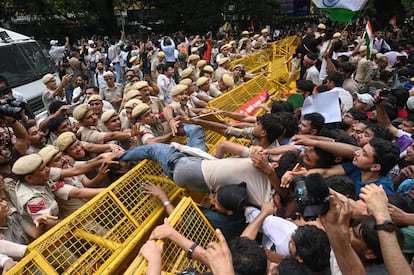
But the crackdown by security forces on Monday, July 20, crossed a red line. It led representatives of the Cockroach Janta Party to cancel Tuesday’s march to Parliament. Urging people to remain peaceful, they told them to gather only at the epicenter of their protest: in front of the Jantar Mantar astronomical observatory, also in the capital.
Opposition leaders, however, planned to gather the following day in front of the Prime Minister’s residence, in order to protest the Modi government’s harsh response and demand his resignation. The security forces claimed that the location posed a national security risk and detained Rahul Gandhi, leader of the main opposition party in Parliament, the Indian National Congress.
The CJP founder publicly apologized to those injured and asked anyone who had been assaulted to contact him privately, so that they could speak one-on-one. The Cockroaches movement also offered legal support to those detained who were facing charges. By Tuesday night, they confirmed that all the arrested protestors had been released.
“Whether this crisis escalates depends on how it is managed,” Professor Ballesteros notes. In neighboring countries like Bangladesh and Nepal, similar youth and student movements brought down their governments. But the researcher points out that India is a country that’s “too large, diverse and complex to predict what might happen.”
For now, Ashutosh Ranka and Saurav Das, spokespeople for the CJP, reported that they met with Health Minister Jagat Prakash Nadda on Monday, July 20, to convey their demands, “including the resignation/sacking of Mr. Dharmendra Pradhan.”
“The minister assured us he will discuss this at the appropriate level. However, no commitments have been made so far. The peaceful protesters will not rest until the demand is met!” they announced on their social media accounts, later describing the meeting as a “waste of time” due to the lack of response.
Translated by Avik Jain Chatlani.
Sign up for our weekly newsletter to get more English-language news coverage from EL PAÍS USA Edition









































