
Kushti, the ancient Indian wrestling discipline that demands abstinence and celibacy
The wrestlers live in boarding schools, many of them since childhood. EL PAÍS visited them during their training sessions, to learn about their lives and their dreams
It’s dawn in Kolhapur. The streets, still dark, remain deserted while almost the entire city is asleep. There are still a couple of hours to go before the shutters of the shops begin to rise and traffic takes over the streets of this pleasant municipality in the state of Maharashtra, in southeastern India.
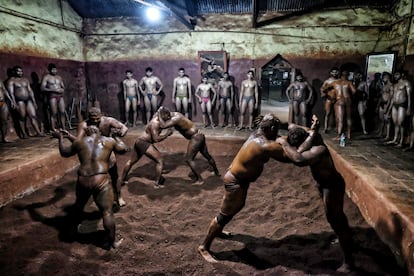
Ashutosh Patil, however, has been up since 4:00 a.m. The 22-year-old has already begun the first training session of the day. He and his teammates are gathered around a pit of reddish earth, barely lit by a dim bulb and presided over by a small altar with the image of the Hanuman, a Hindu deity. Hanuman is considered to be the god of wrestling in India, as he represents strength, courage and self-discipline.
Ashutosh and his teammates reside and practice at the Gangavesh Talim, a wrestling academy. The city of Kolhapur, with a population of about 800,000, attracts thousands of Hindu pilgrims from across the country, who visit the Mahalakshmi Temple, but Kolhapur is also known as an important center of worship for kushti, a traditional style of mud wrestling in India.
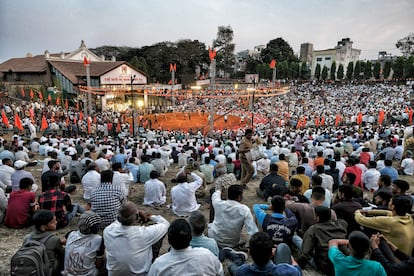
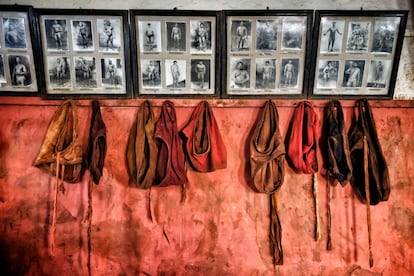
Talims are kushti training centers with basic accommodation facilities, where wrestlers of all ages coexist under a strict regimen. They devote their days to the practice of this centuries-old sport, whose origins date back to ancient Persia. “This is one of the oldest talims in Kolhapur,” Ashutosh proudly declares, drenched in sweat and dressed only in a langot, or brown loincloth. “It was founded by [the king] Shri Chhatrapati Shahu Maharaj more than 100 years ago,” he adds. Remembered as a progressive ruler who ushered in social reforms and promoted education, art and sports, the monarch built hundreds of talims throughout the city during his 28-year reign, from 1894 to 1922. Legendary talims — such as Gangavesh, Sahapur and Motibag — are still active from that era, producing great wrestlers.
For two-and-a-half hours, Vishwas Hargule, guru of the Gangavesh Talim, authoritatively directs the training. A wrestler in his younger days, the 44-year-old master enjoys great acclaim. He’s now in charge of training new wrestlers, who stay focused as they perform countless repetitions of squats and push-ups around the pit. During the first part of the practice, groups of four wrestlers alternate inside the ring, turning the reddish earth with a huge hoe, performing strength exercises… and preparing the ground for combat.
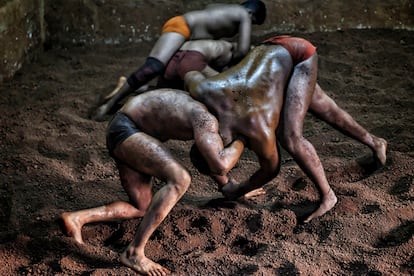
In the talim — which has gradually been illuminated by a few rays of sunlight — the only sounds are the roars of exertion echoing in unison, the shouts from the trainer, as well as the occasional sharp blow to the back with a bamboo cane, received by one fighter or another as a reprimand. The air becomes increasingly dense: the temperature rises as the training progresses. Six of the fighters jump into the earthen pit. They stand in pairs, face-to-face: they lean slightly as they stare at each other for a few seconds. Then, they rush at their opponent, trying to grab them and knock them onto the ground. There’s no time limit: the one who manages to pin their opponent’s shoulders and hips to the ground wins the fight.
The soil — a mixture of clay, yogurt, clarified butter (ghee) and powdered turmeric — sticks to the wrestlers’ bodies. They spar under the watchful eyes of their companions, who continue exercising around the well. Another group trains in the courtyard, lifting weights and climbing ropes that are tied to a tree.
They all respect the guru. Once they enter the talim, they’re under his tutelage. He’s the one who will decide their training schedule and the diet they must follow to increase their strength and muscle mass.
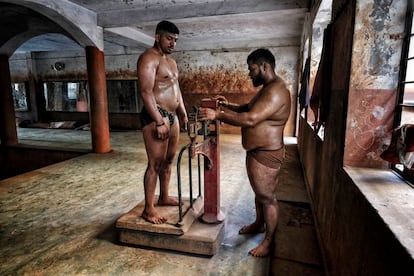
Ashutosh has prepared a huge smoothie: he needs to recover from the tough session that ended just after 7:00 a.m. All the wrestlers drink this energy shake (made from almonds, poppy seeds, rose petals, cardamom and buffalo milk) twice a day, after each workout. The high protein content helps with muscle recovery.
Afterwards, Ashutosh will have breakfast with a couple of colleagues in the same room where they sleep, cook, eat and socialize. “After breakfast, we rest, [then] eat at around eleven in the morning. And, at 3:30, we start our second workout of the day, which ends at six in the evening. Then we shower, prepare dinner and, at ten at night, we turn off the lights for bed,” he explains, while sipping his tonic.

“We follow this same routine every day, except Thursdays, when there’s no training.” Ashutosh began training as a child in Jeur, a small village in the Solapur district, which is about 155 miles from Kolhapur. His family still lives there, but he barely sees them a couple of times a year since deciding, at the age of 18, to move to the Gangavesh Talim to improve his technique and advance his career as a kushti wrestler. “My dream is to win the Maharashtra Kesari competition title,” this burly young man says, smiling. He weighed 176 pounds when he arrived here four years ago. Today, he weighs nearly 203 pounds.
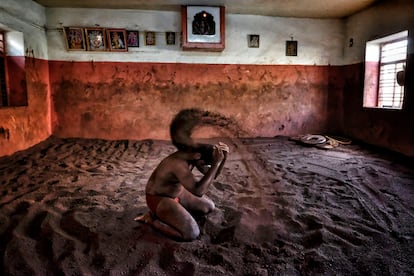
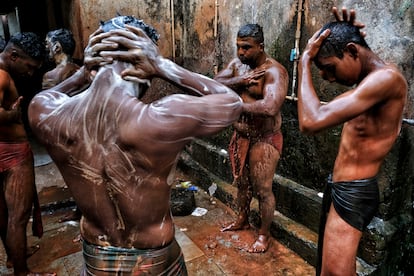
Nearly two miles east, in an old, three-story building behind the Kolhapur train station, lies the Sahapur Talim, where about 100 boys and young men between the ages of six and 28 rest from the day’s first training session, which ended at 7:00 a.m. with the first rays of the sun. At one end of the courtyard, there’s an outdoor cold-water shower: several wrestlers, covered in dirt and sweat, are waiting their turn while chatting animatedly. Later on in the day, the same showers also serve to wash dishes and clothes, which are left hanging around the courtyard. Another group rests on the brick bench that occupies the side wall of the courtyard, overlooking the train tracks. Among them is 19-year-old Rushi Patil, who has lived at the Sahapur Talim since he was nine, following the strict training routine and discipline required to practice this sport.
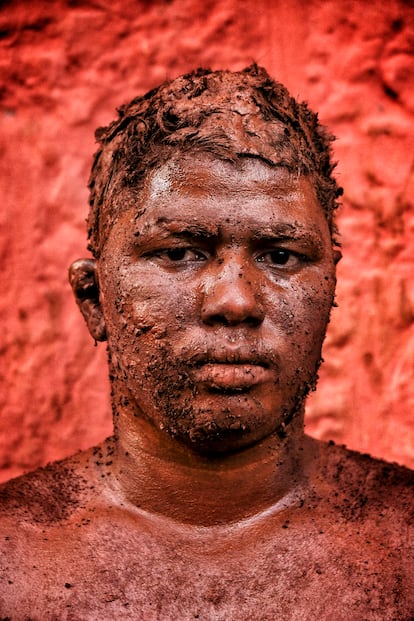
“Kushti means everything to me… and even though it requires a great sacrifice, it’s an honor to be part of this talim,” Rushi says proudly. He has already won several competitions.
In addition to the routine they must follow daily, when it comes to both exercise and diet, the wrestlers are instilled with moral and ethical values that include celibacy, as well as abstinence from alcohol and tobacco. They must seek the purity of the fighter’s body and spirit. These young men choose to spend their youth in brotherhood, leading a spartan and almost monastic life, in order to become respected kushti fighters.
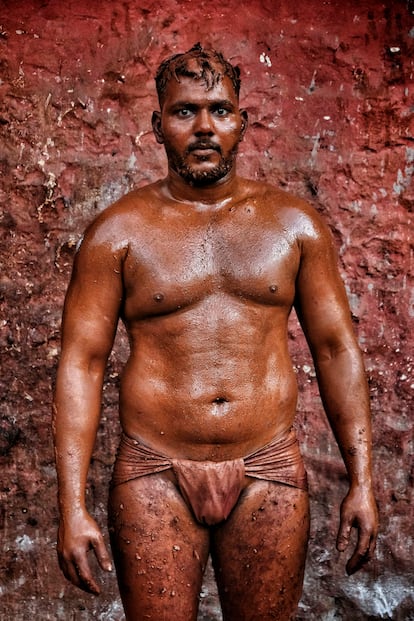
The smell of spices and onions wafts from the first-floor bedrooms. “I came here because I want to become a great wrestler,” says Pavan Bhandigare, 22, while he prepares his meal in another century-old talim. He arrived two years ago from Walva, a small rural village just over 20 miles from Kolhapur. He became the first from his village to train at the renowned Motibag Talim. The son and grandson of wrestlers, Pavan hopes that his future children will also carry on the family wrestling tradition.
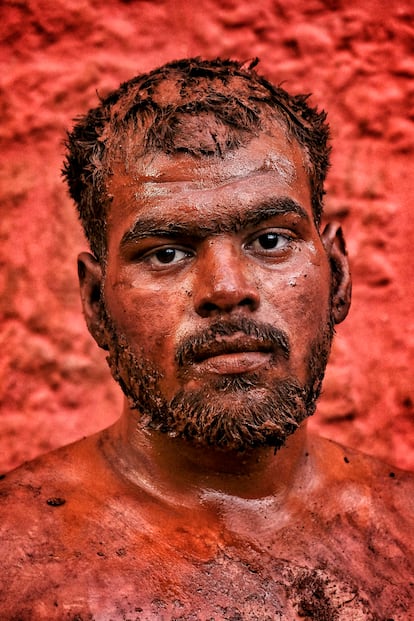
Like Pavan, most kushti wrestlers come from farming families and begin training at a young age. Many hope for one of their children to become a wrestler, given the great prestige it entails. However, the first years of training mean a financial sacrifice for the families, especially during years of poor harvests. Although accommodation at a talim only costs about 500 rupees a month ($5.63), each wrestler must buy himself the necessities to cook and live. Even the youngest wrestlers must take care of themselves.
“Now, during the entire competition season [from October to May], I already earn between one-and-a-half and two lakhs (between $1,650 and $2,200). And, every month I spend about 16,000 rupees ($180), so my family no longer has to send me so much money,” Pavan explains with satisfaction. Still, he’s aware that he has a long way to go to become a great wrestler.
The men and boys compete during the monsoon season. And, in the remaining months of the year, they continue living and training in their talims, preparing for the next tournament season.
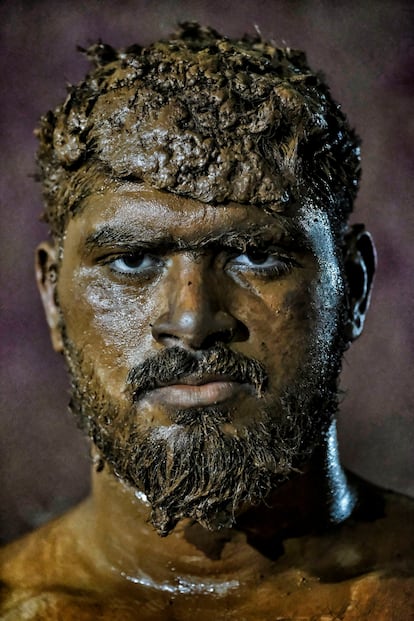
The Indian government has tried to promote wrestling on the mat, hoping to bring Indian wrestling up to par with that of other countries and make it more competitive internationally. But the truth is that most wrestlers prefer kushti as a symbol of identity and respect.
Avishkar Patil, 14, has yet to start competing. “I joined the Motibag Talim seven months ago and I’ve already gained a bit of weight,” he says shyly, as he folds his school uniform and stores it in the wooden trunk that contains his few belongings.
“I go to school from [noon] until five in the afternoon, so I can do all the morning training and part of the afternoon training, which I join when I get home from school,” Avishkar explains, with a serious air. While his family lives in Kolhapur, he only sees them every two months since, like the rest of his classmates, he’s immersed in the strict disciplinary routine that governs the lives of kushti wrestlers, with days divided into well-defined times for exercise, food preparation, rest, bathing, washing and sleeping. “Even though I rarely see my family, I know they’re very proud of me.”
Sign up for our weekly newsletter to get more English-language news coverage from EL PAÍS USA Edition









































