
The portrait shedding light on Spain’s decisive role in US independence: ‘This is proof that we are founders, not outsiders’
Growing recognition of the military leader Bernardo de Gálvez is helping highlight the role played by Spain and Latin America in the founding of the United States
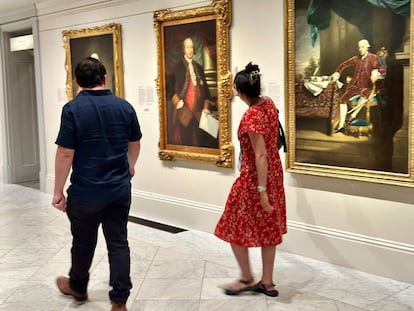

A young woman in a red dress and sandals turns to her companion and says: “Look, this is Bernardo de Gálvez, the Spanish general who helped the colonies in the war against the British...” It is midday on a Tuesday, and visitors to the National Portrait Gallery — one of Washington D.C.’s busiest museums — appear eager to escape the sweltering heat of late June. In the museum’s new exhibition, opening this week, the Spanish hero is attracting as much attention as Benjamin Franklin and Alexander Hamilton. Only Pocahontas seems to rival him for the spotlight.
The portrait of the Spanish military leader who fought in the American War of Independence is hanging in a U.S. national museum for the first time. Its display reflects growing interest in both Gálvez and the contribution of Spaniards and Latin Americans to the founding of the United States on July 4, 1776, which marks its 250th anniversary on Saturday. In recent months, there has been a surge in books, essays, exhibitions and conferences highlighting the role played by Spanish and Latin American figures in the independence of the 13 British colonies that gave birth to the United States.
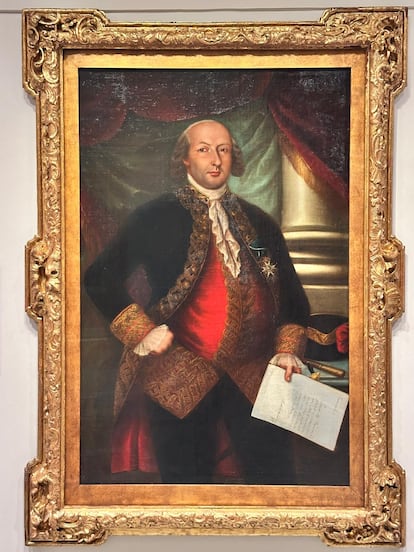
The painting is remarkable. Only two or three portraits of Bernardo de Gálvez are known to exist. One is held by Madrid’s Naval Museum, another by Casa de América, also in the Spanish capital, and a third has hung since last Friday on the walls of one of the United States’ most visited art museums: the Smithsonian National Portrait Gallery, part of the Smithsonian Institution’s network of 21 museums in Washington.
“We had been searching for a portrait of Bernardo de Gálvez for a long time. Fortunately, we learned last year that one had surfaced in Spain. It was an extraordinary opportunity,” says Taina Caragol, a Smithsonian curator and collaborator of the exhibition Out of Many: Portraits from 1600 to 1900 at the National Portrait Gallery.
The show brings together portraits of Native Americans, European settlers, clergy, soldiers, writers, artists and scientists who helped shape the nation — an indication of the significance the museum attaches to Gálvez’s contribution.
Founders, not outsiders
“This is proof that we are founders, not outsiders,” says Teresa Valcarce with evident pride. She is the driving force behind the campaign to secure recognition for Bernardo de Gálvez. Valcarce is something of a force of nature. She has done more than anyone to raise the profile of the Spanish hero and win him the place she believes he deserves in U.S. history.
“I’m no longer talking about the past 250 years. I’m talking about today and tomorrow — the future that belongs to my children and to the 68 million Hispanics in this country, whose history is also tied to this story,” says Valcarce, whose enthusiasm is infectious.
“This has become unstoppable. The dominant narratives are wrong. We didn’t arrive in this country yesterday in the back of a truck. We have been here since the beginning, and we played an active role in its creation. We deserve that recognition.”
Just over a decade ago, this 57-year-old native of Ferrol, in northwestern Spain, embarked on what seemed like a quixotic quest after discovering the story of Bernardo de Gálvez through a newspaper clipping from Málaga written by the historian Manuel Olmedo. Working for an educational association in Washington D.C., where she has lived for nearly 23 years, she became determined to persuade the U.S. Congress to recognize the Spanish military leader, a figure who was virtually unknown in the United States at the time.
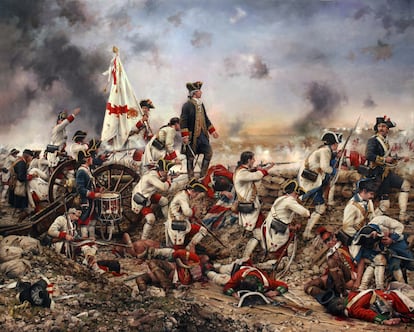
Gálvez served as commander-in-chief of Spanish forces in North America. His role proved crucial to the victory of the 13 colonies, led by General George Washington, over the British Empire.
“The military campaign against British settlements along the Mississippi River, followed by operations against Mobile [Alabama] and Pensacola [Florida] was critical in preventing Britain from concentrating all of its military and naval resources in North America against George Washington’s Continental Army,” writes the diplomat and historian Gonzalo M. Quintero Saravia in the first comprehensive biography of Bernardo de Gálvez.
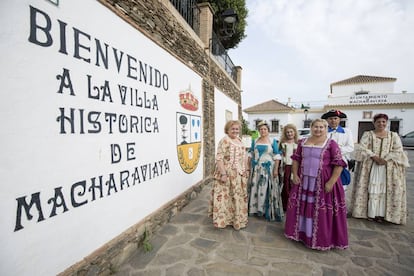
The Spanish hero, born in the Andalusian town of Macharaviaya in July 1746, also played a key role in channeling much of the secret aid that the Spanish Crown provided to the American rebels. He helped deliver money, weapons and ammunition that enabled Washington’s forces to sustain a war that their own finances could not support.
A quixotic quest
For more than two years, Valcarce devoted her time and money to roaming the halls of the Capitol. She knocked on the doors of dozens of lawmakers, trying to persuade them that Congress should honor a commitment made by the Continental Congress in Philadelphia to hang a portrait of Gálvez in the legislature in recognition of his support for the colonies.
Thanks to her persistence, and after overcoming numerous setbacks, Valcarce eventually succeeded in having a portrait of Gálvez installed in the Senate’s Foreign Relations Committee room. A few days later, then-president Barack Obama granted the Spanish military hero honorary U.S. citizenship, one of the highest distinctions the American people can bestow.
“Given the significance of the impact he had, his portrait can be displayed at the Smithsonian,” explains Caragol, emphasizing that the country’s largest museum network “is pleased to contribute to greater recognition of his role in U.S. history through the display of his portrait.”
The curator is delighted that the work is on exhibition at the Smithsonian.
“Having this portrait allows us to highlight Bernardo de Gálvez’s crucial contributions to the American War of Independence and the role played by Hispanic peoples in that historical process,” says Caragol, a Puerto Rican and one of the leading experts on Latin American art, speaking by video call.
Her account helps trace the painting’s remarkable journey. It descended through four generations of a family whose original owners acquired it in the early twentieth century, when one family member realized the significance of the figure depicted and persuaded the others to put it up for sale. The work is an oil portrait of the Spanish hero attributed to the Cuban painter José Nicolás de Escalera and dated to 1781, the same year Gálvez captured Pensacola. The Recuperando Memorias initiative, sponsored by Iberdrola, acquired the painting through an art dealer.
“It is probably the finest portrait by Escalera, the first great Cuban painter whose work has survived to the present day. It has a very special fluidity. Its historical value is immense, but it is also hugely important from an art-historical perspective. It helps us better understand how the cultural world of the Americas took shape during that historical period,” says Caragol.
A discovery at just the right moment
The new owners set out to find an 18th-century frame worthy of the work and began arrangements to loan it to the Smithsonian for an initial five-year period, with the possibility of an extension. The museum had spent years searching for a portrait of the Spanish hero.
“It’s not often that a portrait of such an important historical figure turns up. These are truly rare finds. Fortunately, it was in very good condition. It had already been restored by the family that owned it. All we had to do was fit it with a special protective glass,” says Caragol.
Although the initial agreement covers a five-year loan, both sides appear interested in extending it. “It’s very possible that the loan will be renewed beyond the five years,” says the restorer.
One question raised by the story is why the Hispanic contribution was forgotten for so long.
“Interest in Spain’s role in the American Revolution has grown over the past decade or so. Before that, there was practically nothing,” says Gabriel Paquette, a history professor at the University of Maine, in an email. “Interest in Spain’s role in the revolution has ebbed and flowed with broader cultural trends and geopolitics (for example, Pan-Hispanism, the Spanish-American War). The international dimensions of the American Revolution were comparatively neglected.”
The rediscovery of Bernardo de Gálvez and Teresa Valcarce’s efforts to restore his place in the historical record have helped bring renewed attention to the role of Spaniards and Latin Americans in the struggle for American independence.
“The blame lies somewhat on both sides: with the American political and historiographical elite, and also with the Spanish, because we have never known how to share our own history,” says historian José Manuel Guerrero Acosta, who collaborates on Iberdrola’s Recuperando Memorias project.
Guillermo Fesser, a journalist and author who has lived in the United States for 23 years, offers another explanation: “Spain had no interest in letting it be known that it was collaborating in the independence of territories in the Americas. On the one hand, it did not want to go to war with the United Kingdom, and on the other, it sought to prevent its own overseas provinces and territories from being tempted to declare independence,” he says.
As Gonzalo Quintero Saravia writes in his biography of Gálvez: “Although Spain was never a formal ally of the colonies during the American Revolution, its entry into the war decisively tipped the balance against Great Britain.”
Yet, he notes, Spain’s motives were strategic rather than ideological. ““While Spain’s participation in the American War of Independence has sometimes been portrayed as a contribution to that independence — even as a gift — the reality is that the Spanish decision was based solely on imperial political considerations: beyond the opportunity to avenge the defeat suffered in the Seven Years’ War and the traditional rivalry between Great Britain and Spain in the Americas, Spain’s objectives in the conflict were to weaken the British Empire as a whole and to recover specific territories, especially Gibraltar.”
A decisive intervention
Paquette argues that Spanish America’s role was pivotal: “Spanish American troops helped expel Great Britain from North American territory along the Gulf Coast... Spain’s entry into the war catalyzed the Franco-American alliance, which made possible a colonial victory that until 1778 had seemed unlikely.”
He recalls a remark by Thomas Jefferson: “Our connection with Spain is already important and will become daily more so. Besides this, the ancient part of American history is written chiefly in Spanish.”
“For generations, the Anglo-American version of history taught that the war was won by the colonists alone. Until very recently, it was not recognized that without the help of France and Spain they would not have won the war,” says Guerrero.

Fesser, who has spent years researching Spain’s imprint on American history, is equally emphatic. “We must remember Gálvez’s 12,000 soldiers in an operation from Florida to Louisiana. The 140,000 soldiers and sailors who prevented the world’s greatest naval power from landing on the mainland. Thanks to the Spanish navy, which forced them to divide and disperse their forces,” he says.
Guerrero agrees: “Spain entered the war at a very critical and decisive moment for securing the American victory. When Bernardo de Gálvez captured the Mississippi and then Pensacola, he completely disrupted British strategy in the South. Spain sent twice as many soldiers to the Americas as France, although they fought in different theaters.”
Fesser recalls that when George Washington declared independence in 1776, he had nothing: no army, no money and no strategy. The only route he had to strike at the British was the Mississippi River. Bernardo de Gálvez secured it and kept it open so that supplies could reach the colonists. Tons of pieces of eight — the currency of the era — were sent to them, worth the equivalent of about $3 billion today, he argues. They also received muskets, uniforms, boots, gunpowder and ammunition. Even quinine from Peru.
In those days, malaria killed more people than bullets, notes Fesser, who this autumn is publishing A 55 millas por hora (At 55 Miles an Hour), a book in which he travels America’s back roads in search of the Hispanic roots of North America. After that journey, the author reaches a striking conclusion: “Without the contribution of Hispanics, the United States would never have achieved its independence,” he writes in the book.
Gálvez’s army itself reflected the diversity of the Spanish Empire. As viceroy of New Spain, he commanded not only Spaniards but also Indigenous people, mestizos, creoles and Black soldiers from places including Cuba, Puerto Rico, Peru and Guatemala.
“All of this shows that Hispanics were here from the very beginning,” says Fesser. “This country is what it is because it is not a geographical or ethnic union. It is a union built around an idea, the Declaration of Independence, which would not have been written without the contribution of Hispanics.”
Guerrero, the author of a dozen books who has advised on historical and military matters for several films, is hopeful that Spain’s role in the independence of the United States will gradually receive greater recognition.
“Together, we are ensuring that this story attains the prominence it deserves,” he says. “In recent years, there has been a very significant movement involving historians, institutions and companies that is changing our understanding of this episode. Hispanics carry ever more weight in the United States, and there is also growing interest in reclaiming those historical roots.”
Sign up for our weekly newsletter to get more English-language news coverage from EL PAÍS USA Edition









































