
The heat wave is suffocating Germany and turning bike trips into a survival test
In a country where homes rarely have air conditioning, the German Weather Service forecasts that temperatures could reach 104ºF this coming weekend
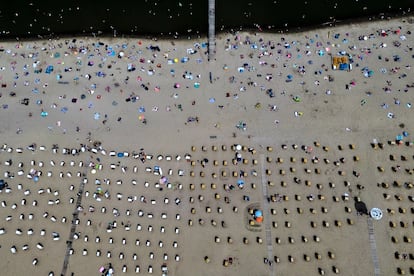

The heat wave hitting parts of Europe is stifling countries where people are not used to these temperatures and often live without air conditioning, such as Germany, which is better prepared for extreme cold than extreme heat. For that reason, German authorities have spent days warning of the danger of heatstroke and urging people to drink plenty of water, stay well cooled and be careful when out in the sun.
According to the German Weather Service (DWD), temperatures well above 30 degrees Celsius (86ºF) will be reached widely over the course of the week. In the western and southern regions of the country, temperatures will climb to 39ºC (102ºF) and, on Thursday, even 40ºC (104ºF) in some areas.
The high temperatures are leading many citizens to plunge into one of the countless lakes and rivers across the country. However, last week the German Life Saving Association (DLRG) urged people not to underestimate the dangers of swimming in this heat. Their fears were confirmed. Just between Friday and Sunday, there were six fatal incidents at five lakes and one canal. The victims were mostly young men.
The heat wave also brings a high risk of storms and raises the danger of wildfires. Meteorologists have forecast intense storms like the one on Sunday in Berlin and Brandenburg, which prompted numerous calls to the fire brigades. Emergency services had to pump water from basements and clear streets of broken branches and fallen trees. Meanwhile, Berlin’s suburban rail network suffered temporary interruptions on some lines. Wind gusts also damaged stalls at traditional street markets and some of the 300 stages set up for the Fête de la Musique concerts.
Temperatures above 30ºC in June are no longer unusual, but it is rare for them to persist for so many days. Given that the heat is likely to last through the weekend, in some places this could be the longest June heat wave on record. The hottest period usually runs from mid-July to mid-August.
The heat also led several hundred people in Berlin last weekend to take part in a new protest against the blanket ban on swimming in the River Spree through the city center. Being allowed to do so is a demand they have been making for some time. About 500 people, according to the Flussbad Berlin association, plunged into the water on Saturday to call for an end to the 101-year ban on bathing in that stretch of the river, which was imposed at the time because of increasing water pollution. The association says that now, more than 80 percent of the time, water quality is good enough for safe swimming. But authorities view it differently and warn that water quality can deteriorate in the short term, for example after a storm.
Recommendations on how to survive the heat are widespread in the mainstream media and on social networks. “I took off last Friday and this Friday from work to be able to go to the garden we have near a lake,” says Zeno, a man from southern Germany who has lived in Berlin for years and, like many Germans, has a small cabin with a garden by a lake.
He admits to being “a little worried” about the high temperatures, especially for his two young children, although he is the one who suffers the most because, as he says, he sweats a lot. “Right now I’m thinking of buying a portable air conditioner for my office to cool the room,” he says, adding that his wife opposes the idea because she says Germany already consumes too much energy. Lacking air conditioning, he copes with the heat by taking a cold shower before bed and ventilating “strategically” at night. “Fortunately we don’t live in an attic.”
Lisa, 43, is not so lucky. She and her husband live on the fifth and top floor of an old building without air conditioning in south Berlin. “That means it doesn’t cool at night. There are nights when the temperature in our bedroom reaches 28ºC (82ºF) and, even with a fan and the window open, it doesn’t go down,” she says. “We have trouble sleeping and, in fact, after nearly six years in this apartment we can see that each summer there are more nights when we can’t sleep well.” She, like many other Germans, complains that buses and trains are not equipped for this weather. “The air conditioning often breaks down or they don’t even have it,” she criticizes. “I think the problem is that there are almost no transitional seasons anymore. For a long time it was very cold and rainy, and now suddenly it’s constant heat and it doesn’t cool down at night. The weather is becoming more extreme.”
High temperatures also turn cycling commutes into a real survival test. “What tires me most in this heat is the bike ride to the office,” explains Alexander Eckstein, who at least is one of the lucky ones with air conditioning at work. “What I do is take a spare shirt to change into at the office. That’s my tactic,” adds the East German who, like many others, escapes to one of the lakes around Berlin on weekends.
Peter H. also flees to the lake with his wife and young daughter, or at least that’s what he plans to do this weekend. “Luckily, our apartment faces north, so it stays cool. This weekend, at 40 degrees, we’ll see whether it remains cool or if we sweat a lot.” He says he is an avid tennis player, but laments that a long winter and a very rainy spring have been followed by such high heat that it’s impossible to play the sport. “It’s a shame.”
Sign up for our weekly newsletter to get more English-language news coverage from EL PAÍS USA Edition









































