
Scenes of a waning Trump
The Iran deal reinforces a pattern already seen in the appeasement of China or the backpedaling on Greenland. Verbal bluster cannot conceal the multiple reversals

The scene was telling. Donald Trump took the podium to hold a press conference after the G-7 meeting and, before taking questions, he launched into a 31-minute tirade defending the merits of his deal with Iran. Four senior figures from his administration, including Marco Rubio and Scott Bessent, stood behind him. Everything—words and image—seemed designed to project strength. Instead, it projected weakness.
The words—unconvincing arguments, rambling asides and outright lies—could not hide the truth of a deal in which the U.S. only secures the reopening of the Strait of Hormuz—closed after America’s attack on Iran—and a promise to dilute Iran’s highly enriched uranium. In return, Tehran gets a lot: permission to export crude oil, a demand for a ceasefire in Lebanon, a pledge for an investment fund and the lifting of sanctions.
The man therefore resorted to verbal contortions to sell a nonexistent success. He repeatedly boasted of having killed, during his first term, General Suleimani, head of the Revolutionary Guard’s external operations, and spouted brazen lies about the deal Obama sealed with Tehran. Without that feat, we wouldn’t be here, Trump said. And where are we then? Certainly not in a position of American might.
The image—those five men standing—(women are of little account in the Trumpist worldview)—was no better: it conveyed his top aides’ submission or powerlessness when it comes to stopping their boss’ mistakes. Looking closely, it seemed clear that none of them really wanted to be there, backing what was being presented.
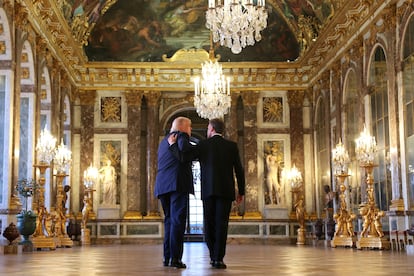
From there Trump went straight to Paris, where he signed his copy of the Iran deal at the Palace of Versailles, in an ironic historical nod to the signing of a capitulation treaty. It is likely that neither he nor anyone around him thought about that, though: they don’t seem very attentive to history. The U.S. was unable to bend the Iranian regime to its will and is now backing down. It is not a capitulation per se, but it smells like failure. Trump had literally demanded unconditional surrender and had pushed for regime change. The reality is that Iran concedes almost nothing. Moreover, right now Washington is even struggling to rein in the recalcitrant Netanyahu.
The scene is not the only flash that illuminates the reality of a Trump in trouble. A few weeks ago he appeared exceedingly deferential to Xi Jinping in China, sealing a stabilization of the bilateral relationship that is nothing more than an acceptance of the failure of his trade offensive.
The G-7 summit offered other variations on the same theme. After enraging India with a tariff salvo a few months ago, Trump held a very cordial bilateral with Modi in an obvious attempt to mend ties.
The Europeans, for their part, chose to make several formal and substantive concessions at the summit, which at times felt like submission, and Trump taunted them by telling them to their faces that he was “the boss” after arriving late to a session. But on substance, Trump joined the commitment to turn the screws on Putin. Whether he follows through remains to be seen, but the political shift is notable.
And that too is a sign of his weakness. The bully who trapped Zelenskiy in the Oval Office in February 2025, telling him he had no cards to win the war, now has no choice but to acknowledge that the Ukrainian leader does have cards—and has secured them on his own, because the U.S. no longer helps him. Trump had to admit that the Kremlin dictator he so admires, with whom he sees himself as part of a kind of triumvirate of strongmen leading great powers, is actually losing, and getting refineries in the Kremlin’s backyard blown up.
Trump’s backtracking extends to other areas. On AI, the laissez-faire prophet already concedes that some control is needed. The guru of indifference to climate change has halted the dismantling of an ocean monitoring system after coming up against bipartisan rejection in the Senate. The champion of revenge for the wronged has put on ice the ludicrous $1.8 billion fund to compensate alleged victims of state injustices. Even the notorious ICE appears somewhat more restrained regarding the worst excesses of its actions against immigrants. Previously, Trump had reversed course on Greenland, precisely during another visit to Europe, in Davos.
None of this amounts to redemption. It is simply the product of impotence, not a conversion to decency. Therefore, it does not mean there will not be further assaults. He still has considerable power, and there are many things he can do. He can initiate reckless actions in Latin America—Cuba?—he can reduce his deployment in Europe—although he faces tight limits on what he can do without Congressional support. Power remains. But it is waning.
Sign up for our weekly newsletter to get more English-language news coverage from EL PAÍS USA Edition









































