
The US considers a deal with Iran to reopen the Strait of Hormuz to be within reach
Trump tempers expectations of an imminent announcement, but his administration believes it will come in the next few days
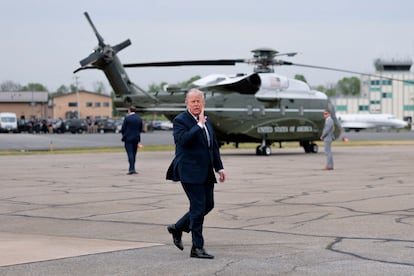

A window for peace between the United States and Iran has opened. Nearly three months after the attack that killed the supreme leader of the Islamic Republic, Ali Khamenei, and set off a campaign that has produced uncertain results, Washington is confident it will be able to announce soon an agreement with Tehran to reopen the Strait of Hormuz. Since the start of the war, this has been one of the thorniest issues. The waterway has become a choke point threatening to suffocate the global economy. Iran, fully aware of the leverage it holds, has used it to its advantage.
Despite Washington’s optimistic messages — which assume an official announcement is only days away — the deal is not yet sealed. According to the Tasnim news agency, which is linked to the Iranian Revolutionary Guard, several issues remain unresolved, including Iran’s frozen assets, which could derail the talks entirely.
According to teams familiar with the negotiations, the emerging framework is a two‑step arrangement: an immediate reopening of the Strait of Hormuz, coupled with additional time — some sources say 60 days — for Tehran to settle the details of its nuclear program. A senior official cited by U.S. media says the agreement would also include an Iranian commitment to dispose of its stock of enriched uranium, though neither the timing nor the method is clear. Other major issues — such as Tehran’s timeline for suspending its nuclear program and the fate of its missile arsenal — would be left for future rounds.
A senior White House official told Axios he believes the deal to unblock Hormuz will come in the next few days. According to this account, Iran’s supreme leader, Mojtaba Khamenei — son of Ali Khamenei, who was killed by the United States three months ago — has approved the broad outline, but details remain open, and decision‑making within the Islamic Republic is a slow process.
Contradictory messages
As all this unfolds, President Donald Trump has been sending mixed signals. On Saturday, he all but declared that the deal was done — the details “will be announced shortly” — but on Sunday, he cooled expectations of an imminent end to the war. “I have informed my representatives not to rush into a deal in that time is on our side,” the Republican wrote on his social network, Truth Social.
Even on Saturday, it was clear that an agreement hadn’t been settled. Trump announced that the deal included reopening the Strait of Hormuz — through which 20% of the world’s oil flows — a claim Tehran’s authorities denied within minutes.
That sense that things are moving, but will still take time, is also the line taken by Marco Rubio, the U.S. secretary of state. “You can’t do a nuclear thing in 72 hours on the back of a napkin,” he said in an interview in New Delhi.
If this plan does go ahead, it would cap off months of Trump’s mixed messages. He has alternated between saying Iranian leaders were eager to please him and that the negotiations were going very well, with threatening to wipe out a “whole civilization,” only to walk back the threats.
Details remain unknown, and doubts persist about whether either side will follow through, given the deep-seated mistrust. But if it holds, the deal would offer significant relief to both Washington and Tehran. The big loser would be Israeli Prime Minister Benjamin Netanyahu, who has made little effort to hide his discomfort with an agreement between his main patron and his arch‑enemy — a deal that does not address Israel’s core concerns and that had been used to justify the February 28 attack.
Over these days, Pakistani negotiators — led by field marshal Asim Munir — and Arab leaders have played a crucial role, worried that a large‑scale conflict in Iran could drag them in as well. Trump himself has been eager to move on from a war conceived as a short‑lived operation, but that, once bogged down, pushed up oil prices and, worse for him, dragged down his popularity.
The rush to reach a deal is also shaped by the U.S. political calendar: Trump has less than six months before the November midterms, which will define the second half of his time in the White House.
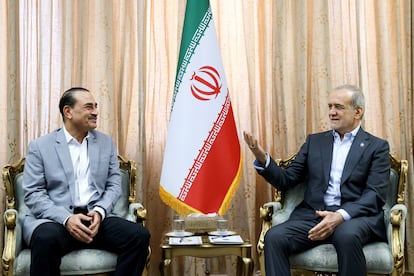
It is worth asking what Trump has actually gained from this campaign, which has cost him considerable political capital at home and put him at odds with part of his party’s base —the conservatives who backed him on the promise of focusing on domestic problems rather than getting entangled in endless wars in far‑off places the average American knows little about.
But a deal with Iran that fails to meet the goals set at the start of the campaign — neither dismantling the nuclear program nor eliminating Tehran’s military capabilities — also risks inflaming the hawks who wanted to finish off their great enemy in the Middle East. Some are already speaking out. Senator Thom Tillis, for instance, has criticized the ceasefire plans. “Now we’re talking about a posture where we may accept the nuclear material remaining in Iran? How does that make sense at all?” the conservative senator told CNN.
Democrat Chris Van Hollen, a member of the Senate Foreign Relations Committee, believes the details emerging look very similar to the situation in Iran before February 28. Even so, he defended the agreement on the grounds that the initial mistake was going to war in the first place. “When you’re digging a hole, you should stop digging. That’s what this agreement sounds like,” he told CBS News.
After months of contradictory accounts and circular negotiations, the main question that remains is what objectives the United States has actually achieved in a campaign that has cost at least $29 billion. The major accomplishment the Trump administration now points to is the reopening of the Strait of Hormuz. But the paradox is that Hormuz was functioning perfectly normally before the war.
Sign up for our weekly newsletter to get more English-language news coverage from EL PAÍS USA Edition









































