
Washington describes protests in Bolivia as an attempted ‘coup d’état’
Deputy Secretary of State Christopher Landau spoke with the Andean country’s president, Rodrigo Paz, in a show of support
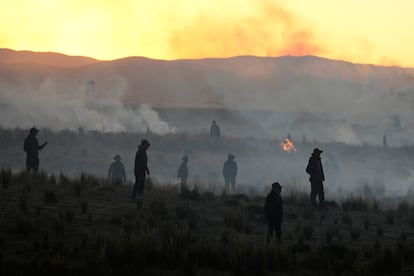

The protests in Bolivia against the government of Rodrigo Paz — which began with a series of strikes earlier this month and have erupted into a nationwide movement, particularly in La Paz, the seat of government — represent an attempt at a “coup d’état.” That was the unequivocal statement made on Tuesday by U.S. Assistant Secretary of State Christopher Landau, after revealing that he had just spoken by phone with Bolivia’s conservative president.
“I am very concerned about Bolivia,” noted the number two at the State Department, who just six months ago attended the inauguration of the Andean nation’s president, one of the member states of the Shield of the Americas, the coalition of Latin American countries under conservative governments sponsored by the United States. “I mean, it cannot be that you have a democratic process where [Paz] was elected overwhelmingly by the Bolivian people less than a year ago and now you have violent demonstrators blockading the streets,” he added during a talk organized by the Council of the Americas at a Washington hotel.
He continued: “Make no mistake about it. This is a coup that’s being financed by this unholy alliance between politics and organized crime throughout the region.”
The senior diplomat called on other countries on the continent to condemn the events in Bolivia. “I would hate to see, you know, this very promising opening go down the drain. It’s bad for all the countries in the Americas to see this kind of incivility,” declared the deputy secretary of state, after praising the support Argentina has expressed for its neighboring country.
Argentine President Javier Milei was the first in the region to express his support for Paz. “Argentina stands with the Bolivian people and supports the democratically elected authorities against those who seek to destabilize and obstruct the path to freedom and progress,” Milei wrote on Saturday on his X account.
Colombia’s Gustavo Petro, on the other hand, described the protests in Bolivia as a “popular uprising.” He offered, should the opposing parties so desire, to act as a mediator to “seek peaceful solutions to the Bolivian political crisis.”
OAS Meeting
Washington is preparing to host a special meeting of the Organization of American States (OAS) this Wednesday to address the situation in the Andean country. Former Bolivian President Evo Morales, now the leading figure in the opposition to Paz, rejected the role of this organization: “The OAS has no moral authority to address the crisis in Bolivia because it is just another one of Trump’s offices.”
Landau, who as a diplomat has spent most of his career in Latin America, considered it a “mistake” to analyze the region through the political prism of left and right. “The great divide lies between those countries that have institutions capable of tackling organized crime and those that are complicit in that criminal activity. I believe we must understand that this is a reality. In this regard, I want to ensure that the anti-constitutional forces, those linked to organized crime, will not succeed in imposing themselves in Bolivia.”
Protesters in Bolivia are demanding the resignation of Paz, who accuses Morales (2006–2019) of being behind protests that are growing increasingly violent and involve unions, miners, transportation workers, and rural organizations. The demonstrations demand an end to the austerity measures imposed by the conservative leader and call for steps to reverse the runaway rise in prices.
Morales has capitalized on the social unrest caused by rising inflation and the crisis over low-quality gasoline to tighten the noose around Paz. The Indigenous leader is operating from the coca-growing region of Chapare, in the Cochabamba highlands, where he has established a stronghold to evade the arrest warrant issued against him for refusing to appear in court in a case of alleged child trafficking, charges he denies.
Paz is a center-right reformist who won last year’s election on the promise of “capitalism for all.” He won over the new Aymara bourgeoisie that emerged over the past two decades and shattered the hegemony of the leftist MAS, which had previously controlled the country.
Sign up for our weekly newsletter to get more English-language news coverage from EL PAÍS USA Edition









































