
EU intensifies its diplomacy in Greenland amid a new Trump offensive to control the island
Brussels seeks to solidify political and commercial ties with Nuuk, a key point in its new strategy for the Arctic region, amid rivalry from China, Russia, and the US
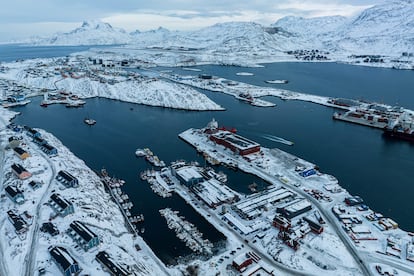

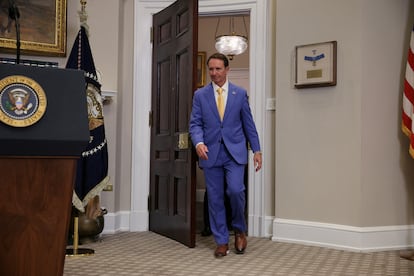
The European Union is stepping up its diplomatic offensive over Greenland. Amid new moves by U.S. President Donald Trump to gain control of the vast Arctic island, Europe is making a play to strengthen cooperation with the self-governing territory, part of the Kingdom of Denmark and a strategic asset for its potential in raw materials, energy, and its location. Brussels keeps sending signals to the Greenlandic government and its citizens. One example is the visit this week by the European commissioner for International Partnerships, Josef Síkela, to take part in a business forum that aims to present the island as a land of major opportunities. The EU official’s trip coincides with that of controversial U.S. special envoy Jeff Landry and with the opening of a new U.S. consulate in Nuuk, Greenland’s capital, this Thursday.
Brussels has doubled European funding for Greenland (population 57,000) to €520 million ($603 million) in the next multiannual financial framework; this represents 45% of total funding for overseas countries and territories. In addition, the European Commission has not ruled out increasing that injection of money, which is seen as a political response to Washington and to Trump’s threats to annex the island, the world’s largest.
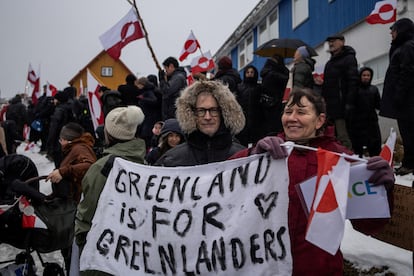
The U.S., which maintains a Cold War–era base on the island, is now negotiating with Nuuk and Copenhagen to open three more in southern Greenland. But the Trump administration’s demands go further: it wants sovereignty over the territory that future bases would occupy, seeks veto power for Washington over future Chinese and Russian investments, and aims to sign favorable cooperation deals to exploit Greenland’s extraordinary natural resources, according to investigations by outlets such as The New York Times and the BBC, which have probed the three-way negotiations.
Trump has even threatened to take control of the island by force, although lately his maneuvers have been primarily commercial and political. However, they still worry Brussels. The EU has by no means closed the Greenland chapter, another very hot point of tension with the Trump administration. “Washington has made it clear that it will do everything in its power to take control of Greenland, which would be a direct attack on Europe. The question is how it will react if that actually happens,” says a senior EU official.
Greenland has thus become a key theater in the geopolitical competition between the EU and the U.S., notes Penny Naas of the German Marshall Fund. “More than Ukraine, the island could be the biggest short-term challenge to Europe’s newly acquired determination to build a European military power capable of deterring military aggression,” the veteran expert emphasizes by email.
Until a few years ago, Greenland was a relatively peripheral issue for Brussels. The island — because it belongs to the Kingdom of Denmark — joined the European Economic Community in 1973. However, in 1985 it left the bloc after a referendum heavily shaped by the Community’s fishing policy, European vessels’ access to its waters, and the perception of a loss of control over natural resources.
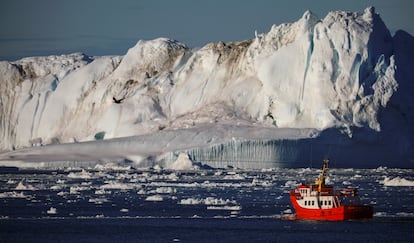
Since the geopolitical contest over the Arctic intensified and the rivalry between the U.S., China, and Russia in the region grew, Europe regained political and strategic interest in Greenland. That focus expanded and turned into concern with Trump’s threats. The Republican magnate’s renewed appetite has accelerated a sense of urgency in a European Union that reality often rushes past.
Washington’s approach, says Marc Jacobsen, a professor at the Royal Danish Defence College, has reminded European actors that Greenland is not merely a remote Arctic territory but a society with a strategic location and direct importance for Denmark, NATO, the EU, and the transatlantic relationship in general.
Some even speak of a “Europeanization of the island.” “Both from Brussels’ point of view and from Nuuk’s, which has moved closer to the Union,” says a senior EU source, where Greenland has become a recurrent topic.
Commissioner Síkela’s visit this week, and those of dozens of businesspeople and ambassadors, also shows that the Arctic giant is increasingly a hot spot. He was preceded by other senior EU officials — and even leaders, such as Emmanuel Macron in June 2025 in a significant gesture — who wanted to demonstrate that the EU is present in Greenland, that the island matters. The head of the European Commission, Ursula von der Leyen, plans another visit before the end of the year after the one she made in 2024 following Trump’s electoral victory. And the conservative German will not arrive empty-handed, Brussels sources say.
With the Arctic island, the European Union operates in a delicate balance, says Anne Merrild, a professor at Aalborg University (Denmark). “Growing U.S. pressure places Greenland in a very delicate position. On one hand, this attention can give it greater political influence and attract investment. On the other, if the pressure is perceived as aggressive, it risks increasing distrust and resistance,” the expert reflects.
“For Denmark and the EU, the challenge is to support Greenland without giving the impression of controlling its decisions. Greenlandic self-determination is fundamental in this regard. For Greenlandic society and politics, this context can intensify existing debates about independence, economic development, and external dependency,” Merrild says. “Greenland should not be treated primarily as a strategic instrument in a power struggle.”
The EU is becoming more attractive to the island because it offers economic and cooperation opportunities, regulatory frameworks, and a less militarized form of engagement, Jacobsen also notes. “Greenland has a strategy of diversification and autonomy and uses the growing geopolitical attention to strengthen its negotiating position while avoiding becoming merely an object of competition between great powers,” adds the Royal Danish Defence College professor.
The vast territory is a clear example of the blows to the global geopolitical board. It also illustrates the crucial change in the Arctic that will shape the EU’s new strategy for an increasingly important region, both economically and geographically. Brussels is reviewing its Arctic policy to ensure it can respond to multiple challenges — from every front.
Underlying this is the reality of the diminishing umbrella of U.S. security for Europe and Washington’s, along with Russia’s and China’s, interest in the Arctic as a stage for geopolitical competition. “The EU has always known this region was important, but it relied on cooperation with the U.S. to drive allied efforts. Not anymore,” Penny Naas says. And that represents a paradigm shift that changes everything.
Sign up for our weekly newsletter to get more English-language news coverage from EL PAÍS USA Edition









































