
Iran’s oil sector weathers US pressure from Hormuz blockade
Refining capacity, reservoir characteristics and long experience in the field give Tehran a margin of months before suffering serious damage, experts say

Before Russia’s 2022 invasion of Ukraine turned it into the new pariah of the West, Iran was the most sanctioned country on Earth: more than 3,600 economic sanctions imposed by the United States, the United Nations, the European Union, and various other countries, measures that forced the Islamic Republic to reshape its economic policy to circumvent these obstacles. That included its vital oil sector, which U.S. President Donald Trump hoped to choke through the U.S. blockade of the Strait of Hormuz, the route through which Iran exports 90% of the crude it sells abroad.
On April 27, Trump predicted that with tankers stranded in Hormuz and oil storage facilities full, Iran’s pipelines and wells would begin to “explode” within three days. Two weeks later, there is no sign of such a cinematic scenario. Meanwhile, several experts warn that the timeframe for truly crippling Iran’s oil sector by depriving it of the bulk of its exports is not measured in days but likely in months.
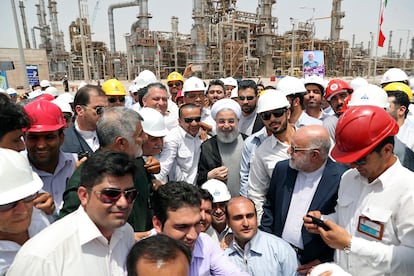
A photograph taken almost 10 years ago, on April 30, 2017, offers clues as to how Iran’s hydrocarbons sector is, for now, weathering the Hormuz blockade without any sign — at least none publicly known — of the permanent infrastructure damage Trump predicted. In that image, Iran’s then‑president, the moderate cleric Hassan Rouhani, smiles flanked by helmeted workers. In the background stand the facilities known as the Persian Gulf Star, in the southern city of Bandar Abbas —the world’s largest gas‑condensate refinery, designed to produce fuel for Iran’s domestic market and thus reduce the country’s gasoline and diesel imports. Very close to its stacks rises another crude‑processing and petroleum‑products plant: the Bandar Abbas refinery, Iran’s third largest.
In the weeks leading up to the start of U.S. and Israeli airstrikes on February 28, Iran was producing around 3.3 million barrels per day of crude and another 1.3 million barrels per day of condensate and other petroleum derivatives. Yet most of that output was neither destined for export through Hormuz nor for storage. According to the energy consultancy FGE, cited by Reuters, 2.6 million barrels per day were being processed before the war in Iranian refineries for domestic consumption.
Even so, the country was far from meeting — and is even further now, with Hormuz closed — its high domestic fuel demand, and has to import supplies. Last Thursday, a member of the Iranian Parliament’s Energy Commission, Mostafa Nakhai, said the country is facing a daily gasoline shortfall of around 20 million liters due to the blockade of the strait, reports Ali Falahi.
A significant share of Iran’s crude is refined; another portion is exported. The Islamic Republic also sells other petroleum products abroad, such as liquefied petroleum gas (LPG) and bitumen — the main component of asphalt. Some of these products, especially LPG, are exported by ship through Hormuz, while others are transported by road to countries like Pakistan and Afghanistan, though that route has far more limited capacity than shipping.
“Iran’s strategy over the past decade has been to increase its refining capacity in order to reduce its dependence on crude exports,” which are subject to sanctions, by using its own oil to produce domestic fuel, explains Bijan Khajehpour, an Iranian energy economist speaking from Vienna. That capacity, which “Iran developed in response to the ‘maximum pressure’ campaign” announced by Trump during his first term, is helping the country withstand the drop in exports without having to cut production as sharply.
“In the last 10 or 15 years, Tehran has also expanded its crude oil storage capacity,” adds Nikolay Kozhanov, an expert on the Iranian oil sector and associate professor at the Institute of Arab Gulf States at Qatar University, speaking by phone from Doha.
This does not mean the country isn’t being forced to reduce its hydrocarbons production as it becomes unable to export part of it and faces the prospect of running out of storage capacity. U.S. Energy Secretary Chris Wright said a week ago that Iran has cut output by 400,000 barrels per day. The question is whether that reduction — or the potential scenario of shutting down production at certain wells — will cause significant and lasting damage to Iran’s oil sector. That is the outcome Trump appeared to expect would finally push the country to capitulate, judging by his statements.
Several experts have pointed out in recent weeks that an oil field is not a faucet that can be opened and closed at will. To greatly simplify a complex technical explanation, they have warned of how difficult it can be to restart production at a field once it has been shut down. The most frequently cited case is that of oil wells with a high water cut, which may stop flowing naturally — or flow at much lower rates — if production is halted and later restarted.
A study on the resilience of Iran’s oil sector, published by the Center on Global Energy Policy at Columbia University, directly rejects that widely cited scenario: “Excessive ingress of water from the reservoir into the well, is a possible consequence of over-production, not of shutting in wells as some commentary has suggested.”
After analyzing the characteristics of Iranian oil fields, the report also concludes that, in general, they “do not include most of the cases where production restarts could be difficult.” This analysis “suggests that the U.S. blockade of Iran’s oil exports will not cause catastrophic, or even very serious, damage to its upstream oil industry. If and when the blockade is relaxed, Iran will probably be able to resume production promptly [...] and regain most of its pre-war capacity within a few months.”
More than 70 deposits
Bijan Khajehpour notes that “the key factor” in Iran’s ability to withstand the blockade is that the country has “more than 70 oil fields in active production. This allows it to distribute production cuts across different fields.” In addition, “maintenance work” can be scheduled in ways that help manage output, the energy expert says.
In a recent article for the regional outlet Amwaj, Khajehpour highlighted how “smaller [Iranian] fields are periodically taken out of production due to maintenance and technical operations,” and that these pauses can now be staggered while slowing production at larger fields without shutting them down entirely.
Iran faced a similar situation in 2018–2019, the specialist adds, when Trump launched his “maximum pressure” policy and reimposed U.S. sanctions after withdrawing from the nuclear deal Tehran had signed with Western powers. Washington’s goal then was to drive Iran’s crude exports to zero. The country’s output fell from 4.7 million barrels per day in 2018 to 2.3 million barrels per day in 2020, yet this did not prevent Iran from later recovering its previous production levels, the economist argues.
The Columbia University report likewise notes that “required production cuts can, to some extent, be allocated between fields, and Iran will likely prioritize those fields that have output that can be reduced without serious problems.”
Khajehpour believes Iran will reduce “its production at a slow and manageable pace, so that none of the major fields are damaged.” The expert argues that the Hormuz blockade “would have to last more than six months for it to become critical for Iran’s oil production.” Nikolay Kozhanov, for his part, estimates that it would take “two months or more” before Iran’s oil sector begins to feel the significant impact Trump hopes to inflict.
A very different issue is the impact on the country’s economy from the collapse in revenues caused by the halt in hydrocarbon exports — a blow ordinary Iranians are already suffering. Khajehpour believes the main consequence of the Hormuz closure will not be the severe damage to oil fields that had been predicted, but rather “the fiscal pressure that will result in a budget deficit, high inflation, and a lack of necessary investment. That pressure spiral will lead to a deeper deterioration of the economy.”
Kozhanov agrees that the drought in oil‑export revenues will worsen the severe socioeconomic problems facing an Iranian population already weary of poverty and lack of freedoms — and now enduring the fallout of a war that could resume if the fragile ceasefire with the United States breaks. What remains to be seen, the Qatar University associate professor stresses, is “how the Iranian regime manages” the consequences of this crisis.
Sign up for our weekly newsletter to get more English-language news coverage from EL PAÍS USA Edition









































