
Bullets in Teotihuacán: ‘Tourism will be scared off a little’
The death of a Canadian tourist at the hands of a gunman caused chaos at one of Mexico’s most important archaeological sites
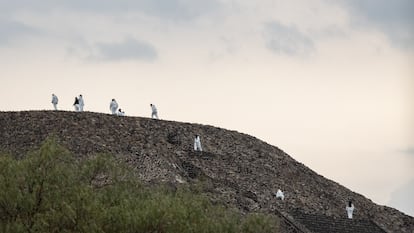

Edgar Pérez, 34, was tending to the flower beds at the entrances to the famous pyramids of Teotihuacán, in the State of Mexico, when he heard the first two gunshots. “We were terrified. I told my coworkers, ‘Let’s see where we can go!’ We ran down that way,” he says. Inside the archaeological site, an armed man walked across the top of the Pyramid of the Moon with the unsettling calm of someone who has just unleashed terror and hasn’t yet processed what has happened. Minutes later, he took his own life, according to authorities. It is the macabre scene that on Monday left two dead — the attacker and a Canadian tourist — and 13 wounded. Two of the injured were minors, aged six and 13.
The gunshots sparked terror among the tourists strolling through the site, which soon descended into chaos. “The patrol cars started arriving and began evacuating people,” says Pérez, who, a few hours after the incident, continued to tend to the flower beds. He says it’s the first time something like this has happened there and feels it’s the kind of event that strikes fear into tourists. “I don’t think they’ll stop coming, because it’s the first time it’s happened, [but] tourism will be scared off a little,” he predicts.

Yesenia Espinoza, a 26-year-old employee at the site, was inside the complex when the shooting began. She was at the Pyramid of the Sun, and although she was just a few meters away from the Pyramid of the Moon, where the shooter was located, she didn’t hear the gunshots because of the noise from “the construction work being done in the area.” She says she saw people start running along the Avenue of the Dead: “We heard the police and the information booth staff broadcasting over the radio that we needed to evacuate because they couldn’t catch the attacker.” Espinoza, who has been working in Teotihuacán for about 10 years, states that “it took quite a while for the authorities to arrive,” and complains that the private security guards at the entrance are unarmed and ill-eqipped to handle situations like Monday’s.
A couple of hours after the shooting, at the entrance to the site, there was an air of strange calm. There were no tourists, and the few confused visitors who did arrive got back into their vehicles, their faces contorted with dismay at finding the iconic attraction closed. Tour guides and employees from nearby restaurants stood on the street trying to catch the attention of the few remaining visitors, who were already preparing to return to the capital.
On the cobblestone street surrounding the pyramids, tour operators’ vans milled about, hoping to find a tourist to whom they could offer an alternative tour. Meanwhile, locals zipped by on motorcycles, oblivious to the unusual deployment of police, the Mexican army, and the National Guard in the area.
The pyramids, located in the heart of the country in the State of Mexico, are one of its major tourist attractions. Last year, they welcomed nearly 1.8 million visitors, a figure surpassed only by Chichén Itzá in Yucatán, which received around 2.2 million visitors. The site’s fame led James Cheng, 36, and Christina Ching, 33, to plan a visit. They arrived a few days ago from Los Angeles to tour the country, and on Monday they wanted to stop by the pyramids early (“we were going to arrive around 10:30,” he says), but time got away from them. Upon arrival, they found the site closed. “Thank goodness we weren’t here. [If we had left early], we might have been,” she reflects now.
The shops, which would normally be packed with people on a Monday afternoon, were deserted. Dozens of chairs and tables were set up to welcome tourists who aren’t coming — and won’t be coming — now that one of the country’s biggest attractions is closed.
At one of the nearby restaurants, José Manuel Ramírez, 56, was attempting to entice customers to come inside. He hadn’t heard anything and didn’t know what had happened until one of his customers told him that people were running. “Usually they run because they’re going to miss the bus. But here they were running too — all the way out here. People left the area quickly,” he said. He came across the news through posts that quickly spread on social media. “Right now, with all this, well, the truth is that everyone has left and abandoned us. It does affect us as restaurant owners.”
Near the entrance to the pyramids, Pérez took a brief break. He has weathered the emotional rollercoaster of a critical moment. He views the future with uncertainty in a place that, until now, he saw as a safe source of livelihood. “Many street vendors and workers here depend on tourism. What we really don’t want is for a World Heritage Site to be ruined because of crime,” he says, his voice breaking. And he concludes: “What kind of example is this going to set for the younger generation, for the children? I’m talking about the legacy I’m leaving my daughter. With what we’re seeing now, it’s worrying.”
Sign up for our weekly newsletter to get more English-language news coverage from EL PAÍS USA Edition









































