
Boris Nadezhdin, Russian opposition figure: ‘From Putin’s perspective, the only possible end to the war is Ukraine’s capitulation’
The veteran politician, who is preparing his bid for the State Duma after being barred from the 2024 presidential elections, seeks to ‘overcome the post-imperial syndrome and bring Russia back into Europe’
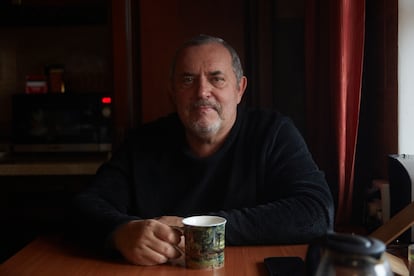

Nothing stood between Vladimir Putin and his fifth term when Boris Nadezhdin [Tashkent, Uzbekistan, 62 years old] challenged the Russian leader by running in the March 2024 presidential elections. This veteran politician, a critic of the war against Ukraine and until then a regular on Kremlin television, gathered around 250,000 signatures in just three weeks to register as an independent candidate. His name was increasingly mentioned as the elections approached and the Kremlin, which had stopped publishing opinion polls, invalidated his signatures, thus blocking his candidacy. But Nadezhdin, whose surname sounds like the Russian word for “hope,” is not giving up and will run again in the 2026 parliamentary elections to try to bring a critical voice — within his means — to the subservient State Duma.
“From Putin’s perspective, the only possible end to the war is Ukraine’s capitulation,” he emphasized during an interview at his home in late December, on the outskirts of the Russian capital. “Capitulation means that Ukraine will be governed by political forces completely under Moscow’s control.”
Nadezhdin has a long and distinguished career. He was a deputy for the Union of Right Forces during Putin’s first term; in the 1990s he worked as an assistant to Sergey Kiriyenko, the powerful current deputy chief of staff of the Presidential Office; and in the 2000s he was second-in-command to opposition leader Boris Nemtsov, who was assassinated in 2015.
“A long-term truce and the establishment of a lasting peace are unlikely while Putin is in power,” Nadezhdin elaborates, adding that “as long as [Volodymyr] Zelenskiy holds power in Ukraine and Putin in Russia, it is extremely unlikely that an agreement will be reached.”
Most Russian opposition figures are in prison, in exile, or, as in the cases of Nemtsov and Alexei Navalny, dead. The big question is why Nadezhdin hasn’t even been officially labeled a “foreign agent,” a designation used to silence opponents and organizations deemed troublesome by the regime.
“I don’t know, I don’t have an answer, but I can guess why. It’s significant that both Putin and Kiriyenko know me personally,” the opposition leader replies. “I’ve criticized Putin and his policies since 2003 [...] but I never insulted him personally. I never incited anyone to do anything bad to him. I never crossed those lines, and they’ve known me personally for 30 years,” he adds.
Nadezhdin wants to offer voters two major proposals. One is to change the priorities of a state where 40% of the budget goes to the military and security, compared to 25% for social spending and 10% for infrastructure. The other is to “overcome the post-imperial syndrome and bring Russia back into Europe.”
“Putin is convinced that Europeans cannot be trusted, and that is a very poor foundation for negotiations. That is why I say it is extremely unlikely that the conflict will end with Putin [in office],” he asserts.
However, he considers it “absolutely impossible politically” for Moscow to start a war with NATO, unless there is some kind of incident involving European forces in areas like the Kaliningrad exclave. “Russia has many problems, both economic and internal, and there are many problems with the attitude of the people. Two-thirds of the population want an end to the current military conflict,” the opposition leader maintains.
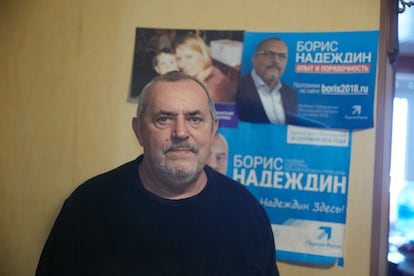
Nadezhdin has an enormous task ahead of him. On the one hand, the party that supported him in 2024, Civic Initiative, was dissolved. On the other, the authorities have stripped his campaign manager, Dmitry Kisiev, of his Russian citizenship, and some of the 4,000 staff members who worked on his federal and regional teams “have been targeted with fines, searches, or arrests.”
He has also lost “a great deal of money” and a house. Authorities declared him bankrupt a couple of months after the 2024 presidential elections in a case dating back to 2011, when a banker gave $300,000 to the party he belonged to, Just Cause. The bank went under in 2017, and the businessman disappeared. “It wasn’t a personal loan [...] This sum wouldn’t have been a disaster for me, but they calculated the late payment interest and charged me 112 million rubles, about €1.2 million ($1.4 million),” he explains.
However, Nadezhdin is confident he can assemble a new team and secure the necessary funding to run for the State Duma. “My main asset is my reputation and the trust of millions of people. This is my most valuable asset; they can’t take that away from me,” he asserts, noting that he reached over 15% support in the polls, representing more than 15 million potential voters.
Profiles of those under Francoism
“We have a classic authoritarian regime in Russia,” the politician states. “The same thing happened in Spain under Franco, a personalist regime,” Nadezhdin points out, emphasizing that these types of systems “can disappear very quickly” and debunking the myth that Russians need to be governed by a strong leader.
“Spain had Franco and Portugal had Salazar. Both claimed their countries were on a special path [...] in the sixties they said we had to look at how bad things were in Europe. That there were riots and hippies were rebelling while everything was stable there,” Nadezhdin explains. “But in the seventies, Portugal and Spain were far behind France and Germany in economic development,” he adds before emphasizing that corruption exists everywhere, but in an authoritarian regime “it is monstrous,” while in a democracy “power shifts and there isn’t a single figure who controls all the positions and privileges.”
Few Russians feel represented by the opposition in exile anymore, he argues, although within the country, besides Nadezhdin, there are still some alternatives to Putinism that could channel this disillusionment. Among them are the opposition party Yabloko and the Communist Party.
Yabloko is currently the target of a severe crackdown. After years on the brink, its leader, Nikolay Rybakov, has been barred from any political candidacy after being fined for having a photo of Navalny on his social media, and other prominent members have been arrested.
“Yabloko poses a major problem for our leaders because [as a party] it can nominate a list without having to collect signatures,” Nadezhdin explains. “Many say it’s not dangerous because in the last Duma elections [in 2021] it obtained a very small percentage of votes, but that was a different reality. The reality now is that Russia is in a military conflict with Ukraine, and the vast majority of citizens want it to end.”
Regarding the Communist Party, Nadezhdin believes it is trapped by its own inconsistencies, as its loyalty to Putin at the federal level and its support for the war are incompatible with its criticism of the economic crisis. “Education, healthcare, and so on are deteriorating because the state is spending all its energy on military actions. The communists have a unique opportunity, but they are unlikely to seize it. This is understandable.”
The pandemic as a pretext
Authorities have banned Nadezhdin and his team from organizing demonstrations, using the Covid-19 pandemic — even now — as an excuse to deny permits. However, according to the politician, “social tension has not reached the level necessary for people to be willing to organize mass protests against Putin.”
The opposition figure also emphasizes the limited tradition of protest in Russia and the hierarchical nature of its society. “Russians express their discontent by recording appeals to President Putin,” he explains. “People believe they can ask Putin to change everything and he will listen. But this illusion is fading, although not as quickly as some would like.”
Sign up for our weekly newsletter to get more English-language news coverage from EL PAÍS USA Edition









































