
Denmark strengthens its position against Russia in the Baltic with eyes on Greenland
In ‘a world on the brink of collapse,’ Danes sense threats from the East in Bornholm and from the West via Washington
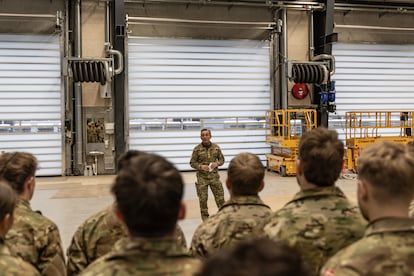

A Danish tourist island, roughly the size of Ibiza, is preparing in case an enemy decides to attack. More soldiers have arrived in recent months. New hangars are being built at the military base. Last week, 11 new armored vehicles were deployed, intended to deter any invasion attempt. Denmark is a small country and doesn’t want to risk a nuclear power seizing a piece of its territory.
“We are getting better prepared all the time, and we have already reached a certain level,” General Peter Boysen, head of the Danish Army, told EL PAÍS. “We will fight with what we have, but we need to accelerate and reinforce our forces, and that is what we are doing.”
Bornholm Island, in the Baltic Sea, is Denmark’s easternmost point. Russia is 300 kilometers (186 miles) away, and that’s where the threat General Boysen is concerned about originates. But the Danes face another danger at the same time. At the other end of the kingdom, its westernmost point, and on an island 3,700 times larger than Bornholm, the threat comes from its closest ally, the United States, and its president, Donald Trump, who intends to seize Greenland “the easy way or the hard way.”
And that is how Denmark and these two islands — tiny Bornholm and Greenland, the largest in the world — find themselves caught between Russia, the old Cold War rival, and the U.S., the (theoretically) protecting power. “For the first time in 80 years, we are threatened from both sides,” observes Jonas Parello-Plesner, executive director of the Alliance of Democracies Foundation and a former Danish diplomat, from Copenhagen. “We are in a world on the brink of collapse.”
The flight to Bornholm — located south of Sweden and north of Poland — from Copenhagen takes 25 minutes. Echoes of Greenland reach the capital, Rønne, a laboratory for the remilitarization of Europe, where people say, half-jokingly, “I hope Trump doesn’t set his sights on this island.” The mayor, Frederik Trolstrup, speaks more seriously: “The United States used to be a beneficial force in the world. Now they want a part of this kingdom. It’s sad.”
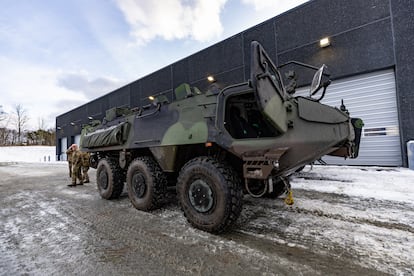
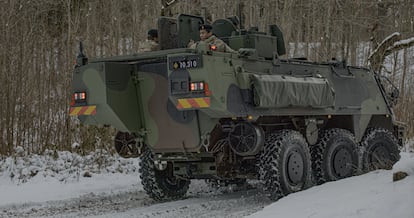
Friday, January 9. Almegaards Kaserne, the barracks that, since last summer, has housed the Bornholm Regiment. That day, in Washington, Trump reiterated that he is not ruling out the use of force to conquer Greenland. Meanwhile, in one of the barracks’ hangars, still under construction, the newly arrived Patria 6x6 vehicles are being presented to the press and military authorities. These are Finnish-made infantry fighting vehicles intended to protect the island from another president with territorial ambitions: Vladimir Putin.
“We need soldiers on Bornholm Island. It’s the closest point in the kingdom to the enemy,” says Colonel Lars Nygaard, the regiment’s commander, in the hangar. “This is like an aircraft carrier, but stationary,” says the army Chief of Staff, General Boysen, adding: “We’re in the middle of the Baltic Sea. It’s a sensitive area. That’s why it’s important for us to show any potential enemy that we’re prepared to defend Bornholm.”
Bornholm Island has always been a sensitive area. During the years of Nazi occupation, it was “a sleepy place, with more horses than cars,” as Ken Follett describes it in his novel Hornet Flight (2002), which is set during that time and in this location. With Adolf Hitler’s defeat, the island came under Soviet control. “In Soviet head-quarters at Roenne there were pictures of King Christian and Queen Alexandrine, but none of Stalin,” a correspondent for The New York Times reported in 1945. “The Danes retain the civil administration on Bornholm, but the Russians’ control of all military matters is tantamount to Moscow sovereignty over the island,” he added. It was called “Russian Denmark,” and it lasted for 10 months, between 1945 and 1946, until the Soviets agreed to leave and return it to Copenhagen. From that era remains a Russian cemetery and the awareness that one day this could once again become a weak link in the Danish Kingdom.
At the end of the Cold War, the Danish military presence was reduced. But with Russia’s invasion of Ukraine in 2022, tensions returned to the Baltic Sea. The signs were visible: the explosion, in September of that year, of the Russian Nord Stream gas pipeline, a few kilometers from Bornholm; the proximity to the Russian exclave of Kaliningrad; and the phantom fleet that furtively sails these waters.
At the Almegaards Kaserne, where hangars are being built, soldiers arrive, and the Patria 6x6 vehicles are being tested for the first time. General Boysen gets behind the wheel of one and drives us across the steep, icy, and bumpy terrain. Back at the barracks, he explains: “There are no direct threats against Bornholm at the moment, but we must be ready. It’s the best way to avoid war.”
When asked about Greenland, Boysen replies, “It’s a political issue, so I’ll refrain from discussing it.” When the 1952 Royal Decree, cited in the Danish press, is mentioned, which obliges Danish soldiers to fight if their territory is attacked (and this also applies if the aggressor is an ally), he states, “If you are a soldier, anywhere, and you are attacked by a foreign country, you have the right to defend yourself and your country.”
Denmark, after World War II, was neither neutral, like its neighbor Sweden, nor pacifist. A visit to the war memorial in Copenhagen’s Citadel is enough to understand this. “A time, a place, a human being,” reads an inscription on the stone. The list of names reflects this, as do the places where they fell, from Gaza in the 1950s to Afghanistan and Iraq, where 52 soldiers died — a testament to the price of loyalty to the United States. But today, the White House is pressuring Denmark, and the priority of the armed forces is no longer distant wars, but the protection of national sovereignty.
“We gave very little thought to territorial defense,” Parello-Plesner reflects. “Now, suddenly, with Ukraine, we’re not on the front line [against Russia], but we are on the second line, precisely in Bornholm. And on the other side, in the west, we were used to having our friend, partner, and ally.”
Not anymore, and all of this is very much present on the Baltic island. “If we want to send a message to the United States,” says a soldier during an informal conversation, “we could send our guys from Bornholm to Greenland.”
Sign up for our weekly newsletter to get more English-language news coverage from EL PAÍS USA Edition









































