
Mexico struggles to contain escalating violence in Sinaloa
The attack against two lawmakers and the mass kidnapping of miners are further proof that violence continues unabated in the Mexican state
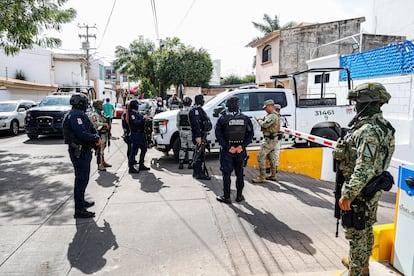

In just 24 hours, all eyes have once again turned to Sinaloa. The shooting attack in the state capital against two Movimiento Ciudadano (Citizens’ Movement, MC) lawmakers and the kidnapping of 10 miners in the south of the Mexican city are the latest proof that the violence shows no signs of letting up. For more than a year, Sinaloa has caught in the crossfire of an internal war between factions of organized crime. The trigger — the alleged betrayal of veteran kingpin Ismael “El Mayo” Zambada — coincided almost exactly with the start of Claudia Sheinbaum’s administration, which made the Sinaloa powder keg one of the top priorities of its security strategy.
The results of the federal security deployment, heavily reliant on the military, are far from encouraging. Beyond increased drug seizures and the arrest of several traffickers wanted by the United States — yet another source of pressure in an already volatile mix — the hard data show that violence has not gone down. If anything, it continues to rise, as high‑impact crimes with strong symbolic weight keep piling up, including those of recent days.
Sheinbaum’s response to this latest spike in Sinaloa’s security crisis was to announce an imminent trip to the state to meet with authorities, business leaders, and civic groups. The president also announced the deployment of 1,600 additional troops, including a roughly 90‑member Special Forces unit. The military operations — responsible for the arrests of high‑profile cartel figures — are also producing a more troubling backlash.
Over the weekend, hundreds of people took to the streets of Culiacán, the state capital, to protest the killing of a young man shot by a military unit. The victim, a 24‑year‑old lawyer, was driving to the gym with his partner when soldiers allegedly mistook him for a criminal target. The case echoes that of two girls, ages seven and 11, who died in May in Badiraguato, north of Culiacán, after being struck by military gunfire in another alleged case of mistaken identity.
The latest events also point to a more complex map of violence, one that goes beyond score‑settling between rival groups or the disappearances and killings — more than 4,000 combined — that have turned Culiacán, above all, into a major battleground. Carlos Flores, a security expert at the Center for Research and Higher Studies in Social Anthropology (Ciesas), argues that Mexico is witnessing a “general breakdown of the security environment in Sinaloa” and highlights the multiple lines of investigation opened by the recent crimes. Hanging over the shooting attack in the capital’s downtown area against the two lawmakers is, for instance, the specter of political violence ahead of the “electoral process that will renew the governorship next year.”
One of the victims, Sergio Torres Félix — who remains hospitalized in critical condition after being shot in the head — is a veteran figure in local politics. After a long career in the Institutional Revolutionary Party (PRI), during which he served as mayor of Culiacán, he is now the state leader of MC and was its recent candidate for governor. “The factions of organized crime have their counterparts in deeply entrenched power groups within the institutions, a constant in Sinaloa’s recent history,” the scholar adds.
Regarding the kidnapping of the 10 employees of a U.S.‑owned mine in the south of the state — among them geologists and environmental technicians — Flores points to extortion as the likely motive. “If confirmed, we haven’t seen an incident of this magnitude linked to extortion in recent years.”

The six‑year security strategy — spearheaded by Security Secretary Omar García Harfuch, working in tandem with the Army — is, for now, producing results: a substantial drop in homicide figures (though they remain high), increased drug seizures, and blows against top organized‑crime leaders. These moves are largely in line with demands from the United States, which has Sinaloa squarely in its sights, viewing it as the main source of fentanyl production and distribution.
But zooming in on Sinaloa itself, last year ended with its worst figures on record, making it the fourth‑most violent state in the country. The war between Los Chapitos — the sons of Joaquín “El Chapo” Guzmán — and the supporter of El Mayo — an old ally of El Chapo — which began in September 2024, has unleashed the state’s worst security crisis in years. Killings rose 66%, disappearances another 44%, and femicides more than 130%.
In this turbulent context, authorities have kept up constant pressure on the leaders of both factions. One of the most emblematic recent cases is that of Pedro Inzunza Noriega, known as El Señor de la Silla or El Sagitario. A veteran trafficker, 62, active since the split within the Sinaloa Cartel led by the Beltrán Leyva brothers, he is accused by U.S. prosecutors of running “one of the largest and most sophisticated fentanyl‑production networks in the world.”
The charges made him the first Mexican to be accused of narcoterrorism, following Donald Trump’s decision to designate several Mexican cartels as foreign terrorist organizations. Inzunza was arrested on New Year’s Eve, and less than a month later he was flown north, slumped in a wheelchair, to a federal prison.
Flores believes that “the massive deployment of the military is yielding results in the arrest of operatives, but this strategy is often not very effective because these figures are relatively easy to replace within criminal organizations. However, the links and alliances between authorities and criminals do not appear to be being challenged, and with the political contest of the upcoming electoral process, there is a risk that the violence will intensify.”
Throughout this long year of crisis in the state, Sheinbaum has closed ranks with the governor, Rubén Rocha — her fellow party member — who has been at the center of the storm amid accusations and suspicions that his administration may be involved, to varying degrees, with organized crime in the state, birthplace of the powerful Sinaloa Cartel. The Mexican president continues to stand by the governor, even though some voices in her inner circle believe she should keep a prudent distance from Rocha, given the potential risk that Sinaloa kingpins with outstanding cases in the United States could reveal possible political dealings.
Sign up for our weekly newsletter to get more English-language news coverage from EL PAÍS USA Edition









































