
Netanyahu rewrites the terms of the ceasefire in Gaza
The Israeli prime minister is using his position of strength to implement the truce with a different approach than initially planned, with Trump’s approval
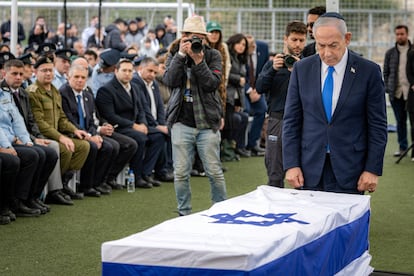
He said it twice, to leave no room for doubt. on Tuesday, in the Israeli parliament, Prime Minister Benjamin Netanyahu made it clear that, following the recovery of the body of the last hostage in Gaza, the next phase of the ceasefire “is not the reconstruction” of the devastated Strip, but “the disarmament of Hamas and the demilitarization of Gaza.”
The father of that same ceasefire, Donald Trump, has been supporting it in his latest statements: in December he said that he was not worried about “anything Israel is doing” and has threatened Hamas with destruction if it does not disarm, even though the plan was initially presented in parallel with the deployment of an international force (the ISF, which has not yet been announced) and further Israeli withdrawals, with the IDF still controlling more than half of Gaza.
Netanyahu, who for months has used his position of strength to violate other aspects of the ceasefire and force Hamas into full compliance, is now making disarmament a prerequisite, while reiterating that “there will never be a Palestinian state” and ordering daily bombings. Israeli and Palestinian experts predict that this approach will lead the ceasefire to a dead end.
When Israel allows the reopening of Rafah, the border crossing between Gaza and Egypt, in the coming days, it will be one of the few pieces of good news for the more than two million inhabitants of the Gaza Strip (most of whom are still displaced) since the ceasefire began last October. The rest has been, rather, a partial respite. Israeli airstrikes are much more limited, but they have killed more than 500 people during the ceasefire.
The presence of a final hostage in Gaza (whose discovery was guided by Hamas and involved the opening of more than 200 graves) was one of the arguments Israel used to justify keeping Rafah closed. Pressure from the U.S. has now led to its opening, and, as stipulated by the ceasefire, allowing passage in both directions.
But Netanyahu also intends to appease Washington and his more radical coalition partners (who aspire to the ethnic cleansing of Gaza) by ensuring that more people leave than enter. Although the crossing will be managed by Palestinian forces with a European Union presence, Israel will control the lists of who can and cannot cross. This violates the spirit of the ceasefire agreement, Point 12 of which stipulates: “No one will be forced to leave Gaza, and those who wish to leave will be free to do so and free to return. We will encourage people to stay and offer them the opportunity to build a better Gaza.”
The concept of disarming Hamas and demilitarizing Gaza is also vague enough to keep hundreds of thousands of Palestinians living in squalor in tents for years. These displaced people occupy the more than 40% of the Strip still under Hamas control. However, reconstruction (according to the grandiose, Dubai-style plan presented last week in Davos by Trump’s son-in-law, Jared Kushner) will begin in Rafah, in the south, which Israel controls and continues to demolish, despite the truce. Kushner — like Trump, a real estate mogul — stated in Davos that there will be no reconstruction without demilitarization, distorting the original content of the plan and effectively bringing water, electricity, and infrastructure to areas where virtually no one lives and where the Israeli army holds sway.
Point 16 of the agreement (more specific regarding the first phase, which allowed Israel to recover the hostages, than the second, which seeks to make the temporary ceasefire permanent) outlined disarmament within a framework of three factors progressing in unison: “As the ISF establishes control and stability, the Israel Defense Forces (IDF) will withdraw based on standards, milestones, and timeframes linked to demilitarization that will be agreed upon between the IDF, ISF, the guarantors, and the United States.” The text envisions the deployment of an international force — still being formed — that is to expand its presence in the enclave as Palestinian militias disarm and Israeli troops withdraw to a demarcation line that Israel intends to control permanently.
“All these factors are intertwined,” warns Yehuda Shaul, co-director of Ofek, an Israeli think tank that seeks a peaceful resolution to the conflict. He argues that Hamas will not surrender its weapons without a sovereign future for Palestinians, which is absent from the plan, thus preventing the deployment of the international mission. “And without that force in Gaza, the Israeli army won’t leave. So I don’t see how all this can come to an end,” he explains by phone. Shaul wonders “what incentive does Netanyahu have to back down now” and criticizes the fact that the international community should have “increased the pressure” on the parties when the truce was first established, but “the opposite” has happened.
Suhail al-Hindi, a member of Hamas’s Political Bureau, spoke Tuesday on Al Araby television regarding the demand for disarmament. “Before discussing the surrender of weapons by the resistance [the Palestinian armed factions], we must ask: ‘What has the occupation [Israel] committed to?’” he argued.
Hamas is now seeking to integrate its 10,000 police officers into the new U.S.-backed Palestinian technocratic administration for Gaza, to which it has pledged to cede power, according to Reuters. It is also willing to agree to a long-term truce and surrender some of its weapons, and neutralize others, but fears being left vulnerable and demands a different outlook for its supporters than a near-unconditional surrender.
This January, the U.S. presented some of the bodies that are to constitute the transitional governance of the enclave, independent of Hamas. The aforementioned Palestinian technocratic committee will assume day-to-day management of Gaza, and the Board of Peace, chaired by Trump, will oversee the Strip’s government. However, the inconsistencies and caveats of the plan itself, which legitimizes the occupation as long as Gaza remains “a threat,” discourage Palestinian disarmament.
“This process should have a parallel security channel and a parallel political channel,” says Xavier Abu Eid, who advised the Palestine Liberation Organization’s negotiating team for more than a decade until 2020. The security channel is Palestinian disarmament. “But what are the political guarantees?” he asks by phone from Ramallah.
The ceasefire agreement also explicitly stated the “immediate commencement of the full entry” of humanitarian aid, with a minimum of 600 trucks per day. Israel, however, has adjusted this figure based on progress in the release of hostages. The Hamas government currently puts the number of trucks entering the Strip at 261 per day. Israel maintains that it is fulfilling its obligations.
Gazans also complain that a large portion of the goods are not part of the humanitarian aid channel, but rather the commercial one, which doesn’t always meet the needs of the majority. Today in Gaza, basic goods and medicines are lacking, but other non-essential items can be found — at exorbitant prices. Only now, for the first time in more than two years of occupation, has Israel allowed the entry of learning kits for children in schools, including pencils and exercise books, as reported Tuesday by the UN Children’s Fund, UNICEF.
“What we are seeing may be the new status quo,” says Shaul, referring to the supposedly temporary Yellow Line that separates the area held by Israeli troops from the other, where two million Palestinians remain trapped. “Can you imagine the Gazan people in that reduced territory without an explosion of violence? For me, it’s difficult.”
Sign up for our weekly newsletter to get more English-language news coverage from EL PAÍS USA Edition









































