
The end of the American dream gives way to Guatemalan opportunity
Indebted and traumatized by the abuse of human smugglers and mistreatment by US authorities, migrants who returned without hope have managed to start a new life in their country of origin
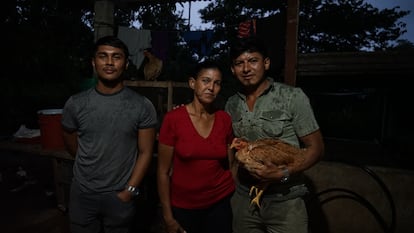
At 29, Astrid crossed the border separating Mexico from the United States, slipping through the semi-arid landscape of the Chihuahuan Desert. On her journey, she was accompanied by other migrants under the leadership of a coyote (a human smuggler) to whom she had paid $17,000, a sum she had raised through loans from relatives in the municipality of Coatepeque, in western Guatemala. “The hardest part for me was crossing the desert,” she recounts, her voice trembling and her eyes watering after what she endured in July 2023. “We had to stay among the garbage, risking being bitten by an animal, or being found by a cartel and losing our lives.”
Through tears, she recounts that the human trafficker who was transporting them didn’t know the route well. As a result, they walked for three days under the scorching sun. “We went a day and a half without water, without food... We couldn’t even speak, our mouths were so dry, our knees couldn’t take any more, we were completely broken, we were almost dying,” confesses Astrid, who adds that one person in the group who couldn’t carry on was abandoned to their fate in the desert.
“We were only half an hour away from the place when immigration — U.S. customs police — stopped us. We begged them to let us go. Even though we pleaded, they didn’t let us go,” she says, wiping away her tears.
After kneeling and being handcuffed, Astrid was taken to a detention center in Texas. Two weeks later, she was informed that she was going to be deported, and she was handcuffed again with a chain around her waist that connected to ankle shackles, making her feel like a dangerous criminal. She boarded a plane and returned to Guatemala.
Like Astrid, 79,697 Guatemalans were deported from the United States and Mexico in 2023, one of the recent years with the highest number of returned migrants, surpassing the 76,768 of 2024. Paradoxically, in 2025, when the average was expected to increase with the promise of “mass deportations” by the Trump administration, the figure decreased to more than 53,000 — from January 1 to December 22 — according to the Guatemalan Migration Institute.
Returning is not the end of the journey
Over the last 40 years, Guatemala has topped the list of Latin American migrants living illegally in the United States. This diaspora laid the foundation for a remittance economy that now accounts for approximately 20% of the Central American country’s gross domestic product (GDP).
However, those who “fail to cross the border and are deported return to their country frustrated and devastated, and once again face structural barriers to reintegrating into the economy,” explains Sindy Hernández Bonilla, head of the Avina Foundation in Guatemala and coordinator of the Migrant Voices for Change program. According to Hernández, returned migrants urgently need “to rebuild their lives without stigmatization, so that their return is not an end point, but a starting point.”
Among the voices of migrant resilience in Coatepeque is that of 25-year-old Roberto Barán, who was deceived by a coyote in Ciudad Juárez, just steps away from crossing the border into El Paso, Texas: “He told us we had to stay in a warehouse and that he would give us the next ‘tip’ to leave at dawn. There were 16 of us, and none of us made it across because he never came back. We waited a total of four days in the warehouse, and we decided to leave because we ran out of water and food.”
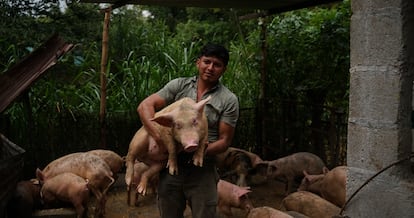
Back in Guatemala, Roberto thought, “If I could scrape together enough money for a coyote, I know I can scrape together enough to build my house.” Little by little, he managed to buy six pigs, raised them, bred them, and now has 42 animals, which sell for $9,000 at the village market — the same amount he paid the coyote who swindled him.
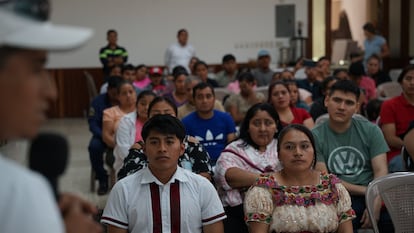
Roberto’s experience has inspired dozens of migrants from his municipality to start local businesses as a way to reintegrate socially and economically. But unlike his solo venture, Cynthia Loría, director of the Hame Foundation, which works to empower the most vulnerable populations in Coatepeque, argues that the businesses they promote are community initiatives that rebuild the social fabric. “We believe that community-based businesses have a better chance of survival than individual ones,” she asserts.
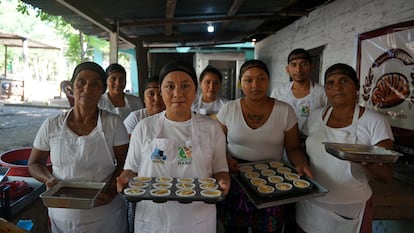
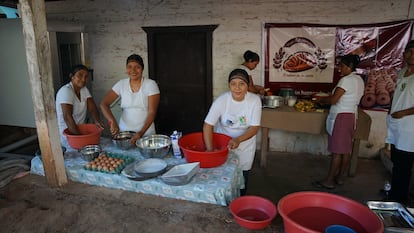
In Astrid’s case, her need to pay off her debt led her to enroll in the foundation’s Productive Entrepreneurship program, where she received four months of training in baking. She established the business with her neighbors in the hamlet where she lives, and they received $5,000 in seed capital, which they used to purchase industrial equipment.
Thanks to the bakery, Astrid earns a modest salary, with which she manages to deposit $200 a month to pay off the $17,000 debt for a migration trip that, she says, she would never repeat in her life.
From the American dream to the Guatemalan dream
Although thousands of Guatemalans continue to migrate each year due to the acute poverty that affects more than half the population, for some the American dream has turned into a nightmare: “Believe me, being in the United States is not a luxury. I’ve been there, I’ve come back, and I don’t plan to return. In the end, the best thing was coming here,” confesses Verónica Tomás Gómez, 35, another migrant from the municipality of Coatepeque who lived for six years in Kansas, working in Italian and Mexican restaurants, where she suffered discrimination because of her Mayan heritage.
During her stay she developed a mental illness that was diagnosed and for which she was medicated: “I fell into depression because of the confinement, so the little I earned was used for medicine, and I said that, if I was going to die, it was better that it be in Guatemala, where we are used to going to the rivers, to being free, to going to the fields... That is why I came.”
Back in Coatepeque, Verónica joined other entrepreneurial women who were trained in sausage-making techniques, specializing in the production of chorizo and longaniza: “We’re doing well. We’re not going to say it’s amazing, because the country is going through things that affect us, but we have enough for our daily food,” says Verónica, who hopes that with the money she earns, her two children can do what she never could: study and get ahead in Guatemala.
Sign up for our weekly newsletter to get more English-language news coverage from EL PAÍS USA Edition









































