
Venezuelan exiles in Madrid scramble to salvage Christmas plans after flight cancellations
Following Trump’s call to consider the airspace closed as part of his pressure campaign against the Maduro regime, many members of Spain’s large Venezuelan community will be unable to spend time with their loved ones


Andreína Crepsac, 29, had been counting down the days for weeks. She had bought her ticket in early October: departure on December 17, return on January 7. This was not just another trip. Since arriving in Madrid almost six years ago, she has only returned to Venezuela once, at Christmas. This would be the second time, and it had special meaning: for the first time in years, her whole family was going to be together. Her parents would travel from Venezuela, her brother—who recently became a father—from Mexico, and her sister-in-law’s relatives, scattered across other countries, would also join them. “It was a collective effort,” she says. But no one will be able to fly.
The cancellation and reduction of flights between Spain and Venezuela accelerated at the end of November following a series of warnings. The US Federal Aviation Administration (FAA) issued a statement about deteriorating conditions in Venezuelan airspace and recommending extreme caution in view of the risks to civil aviation. As a result, several international airlines suspended or reduced their operations.
In Spain, Iberia extended the suspension of its flights to Caracas until at least December 31. Air Europa stopped operating the route, and Plus Ultra was also left out. Until then, Madrid and Caracas were connected by daily direct flights. At least 36 weekly connections disappeared overnight.
At this point, none of those affected have yet received their money back. The airlines have informed them that the claim process could take months and that they must choose between requesting a refund or accepting a ticket for a later date, presumably after December 31, when the restriction will theoretically be lifted. For many, that option has come too late. Some have given up on getting their money back, while others have opted to buy new tickets to Colombia and continue from there by road to Venezuela.
According to data from the National Statistics Institute (INE), the Venezuelan diaspora is one of the largest exile communities in Spain, with more than 400,000 people at the beginning of 2025. In the capital Madrid—a city that is home to a large part of this community—estimates exceed 200,000 registered Venezuelans, consolidating the region as one of the main destinations for exile.
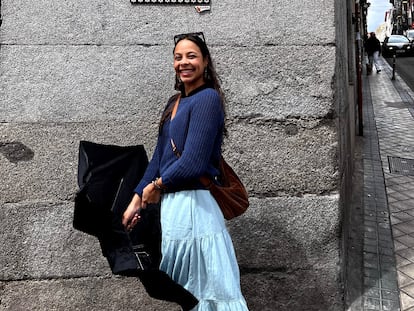
Crepsac lives in Arganzuela (Madrid) and works in food marketing. She enjoys theater and music as hobbies and describes her life in Madrid as “very average”: a stable job, very few savings, and some exercise and meetings with friends when time allows. For this trip, she had saved up all her vacation days for the year and even asked for a few extra days to fit the itinerary. Her family had helped her pay for the ticket. When she realized that it would not be possible to travel, it was no longer feasible to reschedule anything. She estimates that the financial impact for her is between €1,500 and €1,600. “These trips are not easy to plan, either financially or emotionally,” she says. “We worked very hard as a family to be able to have this reunion.”
She had been watching the situation become more complicated for weeks. In Europe, many acquaintances tried to salvage their trips by paying for longer routes or looking for alternatives. She was also offered an option, but it involved a higher cost. She couldn’t afford it. “Since I realized it wasn’t going to be possible, I’ve been apathetic,” she admits. She doesn’t know when she’ll be able to see her family again, or if they’ll all be able to get together as they had planned.
‘Wish my mom were here’
On the other side of Madrid, Mare Pimentel is experiencing another version of the same story. She is 40 years old, a consultant and the founder of Hyggelink, a digital transformation company. She lives in Madrid with her husband and three-year-old daughter Sofía, who was born in Spain. Pimentel left Venezuela in 2016, spent some time on the Spanish island of Tenerife, then in Ireland, and finally returned to Madrid in search of a more culturally familiar environment in which to raise her daughter. They have been in the city for three years.
“With a lot of effort, I have achieved professional stability,” she says. “But that stability does not fill the void of distance. Every achievement comes with a ‘I wish my mom were here to see this.’” This year, for the first time, they had planned a reverse Christmas: instead of traveling themselves, they would bring her mother, sister, and a five-year-old niece that she has yet to meet in person. “Fortunately, we hadn’t bought the tickets when the mass cancellations began, but we had to put the whole plan on hold,” she explains.
In her case, the blow is not measured by a lost ticket, but by a paralysis that affects other procedures. Her husband, who was planning to travel to Venezuela, applied for a passport renewal more than two months ago. He paid around €300 and it still hasn’t arrived. “With flights suspended, we assume that diplomatic bags with passports are also affected. We are in limbo: without a passport and without certainty as to whether he will be able to travel,” she says.
Pimentel describes it as “silent chaos”: “You paid, you met the requirements, and now all you can do is wait, with no dates or clear information.” When they tried to find flights for their family, they found the same thing: routes disappearing from websites and vague answers. “There are no official apologies, just silence and phrases telling us that they are evaluating the situation.”
In debt to pay for accommodation
While some plans fall through before they even begin, others are left stranded with tickets already paid for. At Barajas Airport, some were experiencing the wait firsthand. Samuel Urbina, 28, a musician, writer, and researcher, was trying to travel from Madrid when everything started to go wrong. On November 18, he was at the airport and delays were already noticeable. Iberia rescheduled his flight for the 24th. Two days earlier, on the 22nd—his birthday—he learned that flights had been suspended. The customer service lines were overwhelmed.
From then on, everything went downhill. His suitcases flew without him and he was left with only a carry-on bag. He estimates that he lost more than €2,000 in expenses: he had to get into debt to pay for accommodation, food, transportation, and winter clothes. “The hardest part was the uncertainty. Not knowing what was going to happen or how long this was going to last.”
Finally, Iberia rebooked him on an alternative route: a flight to Bogotá, then on to Cúcuta, then crossing the border on foot, and then flying from San Antonio to Caracas. A long and tedious journey that, in his case, will allow him to be reunited with his family. “All in all, I’m lucky. I know people who sleep at the airport, with their suitcases on the cold floor,“ he says. ”It pains me that many brothers and sisters cannot spend these holidays with their loved ones.”
Those who stay in Madrid will do what they have learned to do: uphold their traditions far from home. Crepsac will probably spend the holidays with her best friend, who is also Venezuelan. They will bake pan de jamón together and prepare chicken salad: “I’ll trade it with anyone who gives me ham,” she jokes. They will also sing Christmas carols.
At Pimentel’s house, they will celebrate the birth of the Baby Jesus with a traditional dinner, the children will welcome Santa Claus, write a letter to the Spirit of Christmas, and — “more than ever this year” — ask for freedom for Venezuela. On the 31st, they will eat 12 grapes and pretend to leave with a suitcase in order to attract travel. “The irony is not lost on me,” she says. “We pretend to travel when what we want the most is to be able to do so.”
Sign up for our weekly newsletter to get more English-language news coverage from EL PAÍS USA Edition









































