
Plus Ultra airline probed over use of bailout money to launder funds from Venezuela in France, Switzerland and Spain
The company received €53 million in 2021 after being considered ‘strategic’ by the Spanish government. The CEO and president have now been arrested as part of a larger operation
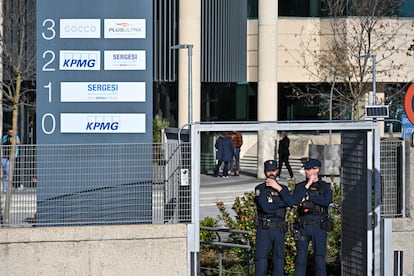

Spain’s anti-corruption prosecutors are investigating whether the airline Plus Ultra diverted €53 million in bailout money injected by the government after the Covid pandemic and used it to launder funds from Venezuela through France, Switzerland and Spain. On Thursday, police searched the company’s headquarters and arrested its president, Julio Martínez, and CEO, Roberto Roselli. The investigation remains under seal.
Last year, the Anti-Corruption Prosecutor’s Office received two requests for international cooperation from France (Parquet National Financier) and Switzerland (Geneva Public Prosecutor’s Office) to authorize the search of several residences located in the Spanish locations of Madrid, Pozuelo, Tenerife and Mallorca. Those officials requested assistance because they were investigating a money laundering network linked to Venezuela that also allegedly operated in Spain.
Spanish prosecutors are probing evidence that the company made an “inadequate use” of public funds approved by the Spanish government on March 9, 2021, and that the bailout money was instead used to pay off previously existing loans. “Plus Ultra appears as a signatory and beneficiary of loan agreements with three companies belonging to the criminal organization, and involved in sales of gold,” states the documentation seen by EL PAÍS. The Prosecutor’s Office believes the bailout was used to repay outstanding debts and that the real purpose was to launder illicit income. In the complaint, prosecutors say that the sale of luxury watches may also have been used for money laundering.

The department headed by Chief Prosecutor Alejandro Luzón filed the complaint with Spain’s National Court on October 21, 2024. It targeted three people of Peruvian origin, two Venezuelans, a Dutch citizen, and at least one Spanish lawyer, who were all considered members of a “criminal organization.”
The activity allegedly consisted of laundering illicit funds originating from embezzlement committed in Venezuela by public officials there. Specifically, the funds came from the Venezuelan Local Committees for Supply and Production (CLAP)—a government food distribution program—and from the sale of gold from the country’s central bank. The organization’s involvement in Spain was so extensive that, according to the prosecution, the airline diverted the bailout money shortly after receiving it to “overseas accounts belonging to companies that are part of the criminal organization.”
The National Court declined to investigate because it believed the case was outside its own jurisdiction. Instead, it directed the matter to Madrid’s investigative court Number 15, where a previous case concerning the Plus Ultra bailout had already been processed and provisionally dismissed. The new evidence has reopened that case.
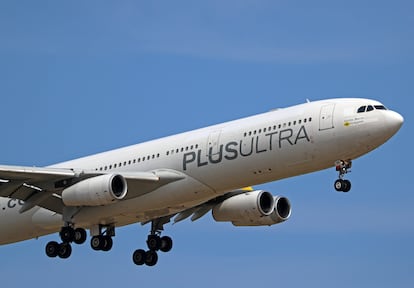
The judge in charge of the investigation into the 2021 bailout had to toss it out due to a procedural error with the deadlines. The probe sought to determine whether the company truly deserved public aid and whether the bailout money had instead ended up as a payment to Venezuela’s state-owned oil company, PDVSA.
The Spanish government had designated Plus Ultra as a “strategic” company in order to justify the bailout, but experts appointed by the court indicated that the company had been showing signs of insolvency since 2019, making it in theory ineligible for the multi-million dollar injection of cash.
The prosecution believes the criminal network used shell companies to acquire real estate, and entered into loan contracts with Plus Ultra, which were fully repaid. The complaint also pointed to the sale of gold worth approximately €30 million to a company in the United Arab Emirates by the company that granted the loans, and the transfer of money by the same company to a Panama bank account.
Some of the clients of this money laundering network have criminal records in Spain. Beyond the airline’s president and CEO, Julio Martínez and Roberto Roselli, the other names have not yet surfaced, as the case remains under seal.
Sign up for our weekly newsletter to get more English-language news coverage from EL PAÍS USA Edition









































