
Russian ultranationalism, inflamed by the killing of the hooligan commander ‘Spaniard’
Stanislav Orlov, who united diehard soccer fans under a volunteer brigade fighting on Russia’s side, was shot dead by his own country’s security forces in Crimea

On December 4th, four vehicles parked next to number 51 at the Flotsky community garden in Sevastopol, Crimea. Several masked men got out with automatic weapons, stormed into the house, and immediately opened fire. According to witnesses, the Russian commander Stanislav Orlov, nicknamed “Ispanets (Spaniard),” did not return fire. The popular founder of the pro-Russian volunteer brigade “La Española” was thus killed by his own country’s security forces, although news of his death was not confirmed by his former unit until two weeks later, on December 19th.
His old comrades-in-arms are divided between those who think the man who united Russian soccer hooligans into a single brigade died “for murky reasons,” and those who think he was the victim of yet another internal power struggle, as has happened in the past with other well-known paramilitary leaders. The most famous of these was Yevgeny Prigozhin, the head of the Wagner mercenaries who died in a plane crash in August 2023, a few months after daring to challenge the power of President Vladimir Putin.
On Monday, just an hour before Orlov’s funeral began, the Astra television channel showed the arrival of Russian security forces at his home in the occupied peninsula. The leaked images contradicted the version of his death in Moscow, although Astra maintained, citing anonymous sources, that Orlov “was involved in organized crime.”
“His death, like that of other commanders of the Russian Spring [the 2014 Donbas war], suggests once again that some people fear the resurgence of Russian national identity more than the Ukrainian separatists and their masters,” the Russian Imperial Movement channel stated on Monday.
The Española unit, in which volunteers from all over Europe, including Spaniards, fought, had been disbanded “on orders from above” in October, two months before the death of its founder, according to Russian war correspondents. It wasn’t the first time the authorities had tried to rein in hooligans: in 2022, the latter united against Fan ID, a controversial measure to identify all fans in stadiums.
Now, the wave of disinformation about the death of “Ispanets,” promoted by media outlets close to the Kremlin, has only heightened suspicions among nationalists. The crisis that erupted between the high command and the Wagner Group in 2023, and the arrest of military personnel and ultranationalist bloggers, are still fresh in the minds of the volunteers.
Silence and suspicion
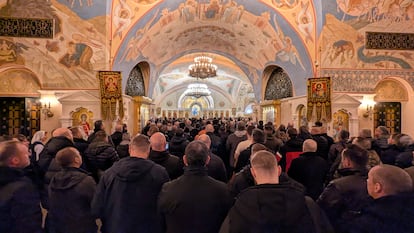
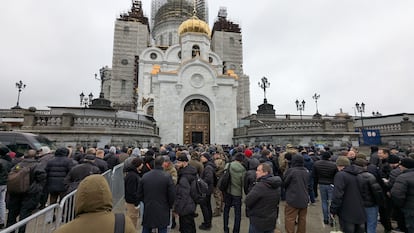
Around a thousand fighters from La Española, the Wagner Group and other former ultra-nationalist brigades bid farewell to Orlov on Monday at Moscow’s most important temple, the Cathedral of Christ the Savior. Camouflage jackets and soccer team emblems — enemies on the playing field, brothers on the battlefield — mingled under the fine drizzle of a snowless winter in the Russian capital.
“I’m going to be frank with you, we’ve been told not to speak with anybody,” said a combatant wearing a La Española logo as he stood outside the church doors.
“We’ll have to wait for the official version. It’s a very murky story,” said another former combatant from the unit who, after its dissolution, joined the former Rúsich reconnaissance squadron of the now defunct Wagner. This soldier, nicknamed Arjipka, wore patches on his jacket with the Russian imperial flag and his position as a sapper, along with the motto “no right to make mistakes.”
“It’s incredible that, at such a difficult time for the country, he brought all soccer fans together and they came out to defend their homeland. I felt very proud of this achievement, and I’m saddened that he is no longer alive,” said Tafgói, a former combatant from La Española and a fan of Dynamo Moscow, one of the rivals of his former leader’s CSKA.
Tafgói is now part of the Veterans assault brigade, an elite unit specializing in sabotage operations whose emblem is a portrait of Putin with the Russian flag. “Probably, yes,” he replies when asked if he will believe the official version of Ispanets’ death.
The first news about Orlov’s whereabouts was published on December 9 by the Tsargrad channel, owned by the ultra-Orthodox oligarch Konstantin Malofeyev, a close ally of Putin. The outlet reported that he was still alive and had been arrested in Moscow for arms trafficking.
However, on that same day, members of Unit 106, also made up of soccer fans, and representatives of more than 30 groups linked to Russian football, suddenly demanded to be disassociated from Malofeyev’s ultranationalist movement.
Fighters close to Ispanets claimed in the following days that the commander had died. Meanwhile, the brigade’s channel, under new management, remained silent, and other media outlets reported that he had died resisting arrest.
United hooligans
Stanislav Orlov, a CSKA Moscow fan and veteran of the 2014 Donbas war, united Russian soccer hooligans under the flag of La Española at the start of the invasion of Ukraine in 2022. The group was initially part of the Vostok Battalion, another unit created in Donetsk in 2014 by deserters from the Ukrainian special forces, although due to its size it would eventually become independent as its own volunteer battalion in 2023.
Despite relying on volunteers, La Española was one of the mercenary companies created by the Russian elite, inspired by the Wagner Group, to gain influence. According to sources from the independent newspapers Cherta and Vazhnie Istorii, its funding came from the Rotenberg brothers, businessmen very close to Putin, who appointed Viktor Shendrik, head of security for Russian Railways, and Vladislav Surkov, the once-powerful Kremlin advisor and former supervisor of the separatist territories of Donetsk and Luhansk, as liaisons with the brigade.
The brigade was disbanded two months before Orlov’s violent death. The commander announced that month that the brigade’s structures would be transferred “to new leadership, new people,” while some Russian war bloggers claimed that “it was orders from above.”
“Why, for whom, and for what reason; we won’t know soon. Later, after the special military operation. For me, personally, this is unpleasant news,” wrote Dmitri Steshin, war correspondent for the state-run newspaper Komsomolskaya Pravda, at the time. “What’s needed isn’t intelligent and proactive people; what’s needed is loyal people,” the Russian war reporter added.
“They were a major nuisance,” said Vadim Trujachev, a political scientist for the nationalist newspaper Vzgliad. “La Española debunked the myths of soccer fans and bad Russian nationalists,” he noted.
Sign up for our weekly newsletter to get more English-language news coverage from EL PAÍS USA Edition









































