
When art feels the call of war
The ‘Culture vs. War’ project brings together in six documentaries the stories of Ukrainian writers, musicians, photographers and filmmakers who traveled to the front after the Russian invasion


The writing of Ukrainian Serhiy Zhadan flows freely in his narrative and poetry. When he speaks, his words are charged with force, with rage, and without restraint. “Beside us is a society of war criminals, looters, rapists, and murderers.” The novelist, poet, and activist utters this phrase, directed at Russia, in one of the six documentaries that comprise Culture vs. War, a project launched from the outskirts of Kyiv over three years ago, shortly after the start of Moscow’s large-scale invasion. It has a dual purpose: to show the war through the eyes of creators and artists, some even located near the front lines, and to protect the country’s culture, a pillar of national identity that the Kremlin seeks to annihilate. “We try to touch other parts of the human soul,” explains Alina Krasnianska, the project’s executive producer, in a message exchange, “to get closer to people, tired of the journalistic coverage of this war.”
Zhadan, author of best-selling books such as Voroshilovgrad and The Orphanage, is not one for interviews, making the 16-minute documentary about his involvement in the defense of Ukraine a true gem. Directed by Kadim Tasarov, the man who launched Culture vs. War after surviving the Russian siege of Bucha, the footage follows the writer as he raises funds for the army. His poetry plays in the background, accompanied by his reflections. Speaking into the microphone, with a touch of lyricism, he says: “You try to see a human being even in your enemy. You think: if I don’t want to hurt you, why do you want to hurt me; if I don’t want to kill you, why do you want to kill me?” Zhadan is currently a member of the Khartia Brigade, one of the best-known and most respected brigades in the National Guard of Ukraine.
With the support of local film promotion organizations and the backing of the European Commission and Ukraine’s Ministry of Foreign Affairs, Culture vs. War has compiled a six-part series, available online for free on YouTube, that tells the story of the war’s unique challenges: how several artists, photographers, filmmakers, and musicians left almost everything behind to go to the front lines. “Art reflects our values, our way of thinking; it gives us the opportunity to speak to the audience in a different way,” Krasnianska points out.
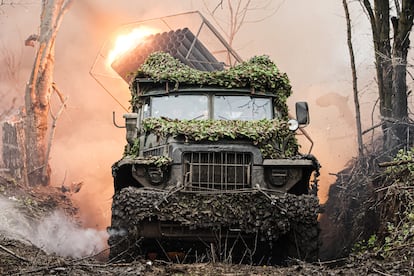
The six documentaries have been dubbed into English, Arabic, and Spanish. The Spanish dubbing was done by Olga Ledo, a Ukrainian who is the project’s ambassador in Spain, where she has lived for two decades. Artificial intelligence (AI) tools were used for this process, so the audio, although carefully crafted between Madrid and the Kyiv suburb of Irpin, where the project operates, lacks the polish of the powerful audiovisual production. “We carefully selected the AI voices that best resembled the protagonists and reviewed every detail: the intonation, the rhythm, the pauses, the pronunciation,” explains Ledo. “It was meticulous and demanding work.” And effective.
The story of the musical group Antytila’s journey is the longest of the half-dozen documentaries. For 42 minutes, Tarasov gives voice to this band, an icon of the battalion of artists who took up arms. In the footage, Taras Topolia, their vocalist, recalls, among other things, the day at the front when he received a call from a private number. On the other end of the line was Bono, the lead singer of U2. A few weeks later, the members of Antytila traveled from the east to Kyiv to perform alongside the Irish band. “Playing music during this war is like medicine for us,” Topolia recounts.
War, between harshness and comedy
The images are harsh; death is ever-present. There are also moments of comedy and pure music. And perhaps for this reason, Antytila has been the subject of criticism. Topolia responds to the camera: “There’s a great Depeche Mode line: ‘Try walking in my shoes.’ Put these on [pointing to his military boots], which have been stained with blood at least 20 times, and then draw your own conclusions.”
Few imagined themselves in a war before that early morning of February 24, 2022, but many stepped forward. And for this reason, the accounts of the combat volunteers are humble. Such is the story of award-winning Ukrainian filmmaker Serhiy Mykhalchuk: “I didn’t even become a soldier to kill the enemy, because, even though I’m well-trained, I don’t think I’d do it better than others, but rather to stand alongside those who do, those who protect us,” he says to the camera. Mykhalchuk can’t forget — and recounts the scene during the documentary he stars in — the image of a family with children inside a burning vehicle. “You cross a psychological boundary,” he confesses.
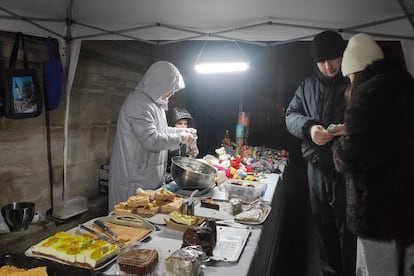
Tarasov also introduces the audience to the work of a pair of photographers, Vlada and Konstiantyn Liberov, who went from immortalizing love stories to capturing snapshots of the war itself against their homeland. Their work was so brilliant that it earned them a contract with the American agency Associated Press. Along the way, as they recount in the documentary, they lost friends like Private Da Vinci (a codename), whom they saw die. “It’s so painful because we know it shouldn’t have happened; we feel cheated by the universe,” Vlada says in one of the interviews included in the film.
“Here, in real life, unlike on a film set, there’s no opportunity to reshoot,” admits filmmaker and actor Akhtem Seitablaiev, a central figure in another of the films in Culture vs. War. The 2014 conquest of Crimea, Russia’s first offensive in its invasion of neighboring Ukraine, caught Seitablaiev recovering from a serious injury after falling off a horse during filming. He currently serves as a soldier in a rifle battalion.
The last of the artists featured in the documentary series also decided to put his profession on hold after the start of the 2022 invasion. His name is Taras Kompanichenko, a kobzar by profession, the name given to a player of the traditional Ukrainian instrument, the kobza. His account is perhaps one of the most sincere: “I was convinced that I had no right to be without a weapon so that no one could accuse me of being just an ornament,” he says about his days in uniform. The most powerful weapon he possesses, however, remains his music, rooted in the times of the Cossacks, when Ukrainian identity began to take shape — an identity now targeted by enemy bombs.
Sign up for our weekly newsletter to get more English-language news coverage from EL PAÍS USA Edition









































